Daily Current Affairs For UPSC | 2 September 2026 | The Hindu Analysis Today
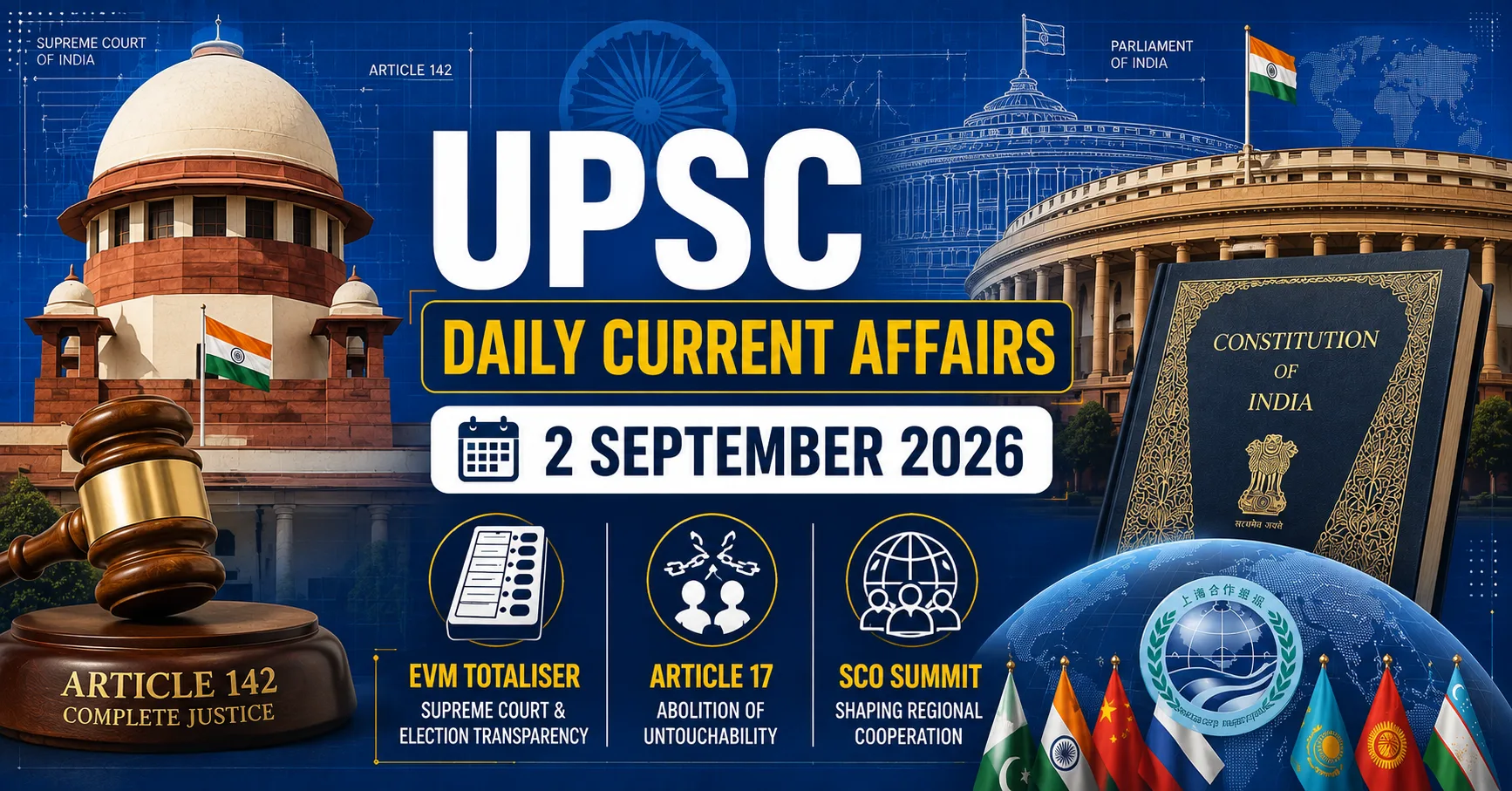
Daily Current Affairs For UPSC | Overview
| S.No. | Topic | GS Paper / Category |
|---|---|---|
| 1 | Article 142 and the Quashing of FIRs Against Gen Z Protesters | GS II – Polity & Governance |
| 2 | SCO Summit 2026, Bishkek | GS II – International Relations |
| 3 | Vembanad Lake and the Robotic Fight Against Water Hyacinth | GS III / Prelims – Environment & Geography |
| 4 | Amoebic Meningoencephalitis (PAM) and Well Water Risk | Prelims – Science & Health |
| 5 | India’s Q1 FY27 GDP Growth — An “Endurance Test” | GS III – Indian Economy |
| 6 | The South’s Muted Voice as Political Power Shifts North | GS II – Federalism & Centre-State Relations |
| 7 | The Two Balance Sheets Behind Every E-Waste Decision | GS III – Environment & Economy |
| 8 | Gig Workers and the e-Shram Portal | GS III – Labour & Social Security |
| 9 | Untouchability and the Idea of ‘Purity’ (Article 17) | GS II – Fundamental Rights |
| 10 | India’s Data Centre Boom vs Climate Reality | GS III – Infrastructure & Environment |
| 11 | EVM Totalisers: Privacy vs Transparency Debate | GS II – Elections & Electoral Reforms |
| 12 | CVC Report on Pending Corruption Cases | GS II – Governance & Accountability |
| 13 | Wakefield Accelerator — A Compact Particle Accelerator | GS III – Science & Technology |
Daily Current Affairs For UPSC | Article 142 and the Quashing of FIRs Against Gen Z Protesters
Heading & Syllabus Mapping: GS Paper II — Indian Constitution, Judiciary, Separation of Powers, Fundamental Rights
Why in News? The Supreme Court, acting on a request from the Centre, used its extraordinary powers under Article 142 to quash criminal cases registered against Gen Z protesters connected with nationwide demonstrations organised by the Cockroach Janta Party (CJP) following the NEET-UG 2026 paper leak controversy. In response, the CJP withdrew its planned march scheduled for 5 September, days before the BRICS summit in the national capital.
Core Facts & Background A three-judge Bench headed by the Chief Justice of India exercised the Court’s power to do “complete justice” under Article 142, ordering that FIRs over the protests would not be investigated and would stand closed across all States and Union Territories where such protests occurred. However, the Bench simultaneously permitted Delhi Police to register a fresh, specific FIR against 2,873 individuals with prior criminal antecedents who were identified through facial recognition technology at the Jantar Mantar protest site — with a clear direction that this should not prejudice their rights.
Article 142(1) empowers the Supreme Court to pass any decree or order necessary for doing complete justice in a matter pending before it, enforceable across India. Article 142(2) grants the Court power to secure attendance of persons, discovery of documents, and punishment for contempt. This provision has previously featured in UPSC Prelims (2019), where it was tested on the principle that the Supreme Court’s powers under Article 142 are not constrained by ordinary laws made by Parliament.
Pros & Cons
| Pros | Cons |
|---|---|
| Protects young protesters from prolonged criminal prosecution over a matter of public interest (exam paper leak). | Relies on an “extraordinary” constitutional power for what could be seen as a law-and-order and prosecutorial decision. |
| Prevents potential misuse of criminal law to suppress legitimate dissent. | Raises questions about selective and case-specific use of Article 142 becoming a recurring pattern. |
| De-escalated tensions ahead of a major diplomatic event. | The carve-out for a subset of “identified” protesters could itself invite fresh litigation. |
Way Forward There is a need for greater judicial and academic clarity on the contours within which Article 142 should be invoked, so it continues to serve as a tool for complete justice rather than becoming a routine substitute for ordinary criminal procedure. A balance must be maintained between protecting the right to peaceful protest and preserving law and order.
Daily Current Affairs For UPSC | SCO Summit 2026, Bishkek
Heading & Syllabus Mapping: GS Paper II — International Relations, International Groupings and Agreements
Why in News? Prime Minister Narendra Modi addressed the 26th summit of the Shanghai Cooperation Organisation (SCO) held in Bishkek, Kyrgyz Republic, calling on member states to “dismantle” the entire ecosystem of terrorism, including financing, recruitment, radicalisation and safe havens. The summit came as Pakistan took over the SCO chairmanship for 2026–27.
Core Facts & Background The summit’s theme was “25 Years of the SCO: Together Towards Sustainable Peace, Development and Prosperity,” marking a quarter-century since the bloc’s founding in 2001 in Shanghai. The grouping today comprises ten member states, including India, China, Russia, Pakistan, Iran and Belarus, with Russian and Chinese as its official working languages.
The summit concluded with the Bishkek Declaration, which called for an “inclusive government” in Taliban-ruled Afghanistan representing all ethno-political groups, and expressed deep concern over the ongoing conflict in the Persian Gulf region. The Declaration also addressed the U.S.–Iran conflict and the Russia–Ukraine war, cautioning against unilateral deployment of global missile defence systems that could harm international security. PM Modi also referred to Afghanistan’s drug trafficking problem as a regional security threat and reaffirmed India’s humanitarian assistance to the Afghan people. Alongside the summit, the sixth edition of the World Nomad Games opened in Bishkek on 31 August 2026.
Pros & Cons
| Pros | Cons |
|---|---|
| Gives India a platform to raise cross-border terrorism concerns directly with regional powers, including Pakistan. | The bloc includes India’s regional rivals China and Pakistan, limiting the depth of consensus on terrorism-related issues. |
| Strengthens India’s engagement with Central Asia and Eurasian connectivity. | Declarations like the Bishkek Declaration are largely non-binding with limited enforcement mechanisms. |
| Provides a collective voice on shared regional challenges such as Afghanistan and the Persian Gulf crisis. | Pakistan’s chairmanship of SCO for 2026–27 could complicate India’s engagement with the bloc. |
Way Forward India needs to continue using SCO as a platform for sustained counter-terrorism diplomacy while simultaneously pursuing bilateral and other multilateral channels for concrete security cooperation, given the limitations of consensus-based regional groupings.
Daily Current Affairs For UPSC | Vembanad Lake and the Robotic Fight Against Water Hyacinth
Heading & Syllabus Mapping: GS Paper III / Prelims — Environment, Conservation, Important Geographical Features
Why in News? Kerala’s State Wetland Authority, in association with the Centre for Water Resources Development and Management (CWRDM), is launching a one-month pilot project starting 10 September at Kumarakom to deploy a robotic unmanned surface vehicle for harvesting invasive water hyacinth from Vembanad Lake.
Core Facts & Background Vembanad is the largest lake in Kerala and the longest lake in India, spread across roughly 2,033 sq. km, and is also recognised as the largest tropical wetland ecosystem on India’s south-west coast. It is also known by names such as Vembanad Kayal, Vembanad Kol and Punnamada Lake, and draws water from four rivers — Meenachil, Achankovil, Pampa and Manimala. A narrow barrier island separates it from the Arabian Sea; while most of the lake is fresh water, it turns saline near the sea. The lake was designated a Ramsar site in 2002 and hosts the Kumarakom Bird Sanctuary on its eastern coast, attracting migratory birds from as far as Siberia and the Himalayas. It is also the venue of the famous Vallam Kali (Nehru Trophy Snake Boat Race) held every August.
The relentless spread of water hyacinth has been choking navigation channels, disrupting boat services, damaging propellers, and affecting tourism, fishing and drinking water access in the region. The upcoming pilot, implemented by the Foundation for Environmental Research and Innovation (FERI), will explore converting the harvested weed into value-added products such as compost and handicrafts.
Pros & Cons
| Pros | Cons |
|---|---|
| Offers a technology-driven, non-chemical solution to an ecological problem. | The initiative is only a one-month pilot, so long-term effectiveness is untested. |
| Restores navigation, tourism and fishing livelihoods around the lake. | Robotic harvesting may be costly to scale across the entire 2,033 sq. km lake. |
| Converts a waste weed into potential economic value through composting and handicrafts. | Water hyacinth regrows rapidly, requiring continuous rather than one-time intervention. |
Way Forward If the pilot succeeds, it should be scaled up across other hyacinth-affected stretches of the lake with a sustainable funding and maintenance model, ideally linking harvested biomass to local livelihood and value-addition industries.
Daily Current Affairs For UPSC | Amoebic Meningoencephalitis (PAM) and Well Water Risk
Heading & Syllabus Mapping: Prelims-oriented — Science & Technology, Public Health
Why in News? A joint field-level study by the Kerala government and the Indian Council of Medical Research (ICMR) has found that exposure to natural water bodies and the use of non-chlorinated well water for bathing and other domestic purposes are significant risk factors for Amoebic Meningoencephalitis (AME).
Core Facts & Background The study, titled “Epidemiology of and Risk Factors for Amoebic Meningoencephalitis, Kerala 2025,” analysed 159 AME cases and found that people using well water for bathing or washing faced nearly three times higher odds of contracting AME. For cases caused specifically by Acanthamoeba, the population attributable fraction was found to be over one-third, meaning a significant share of such cases could be avoided if non-chlorinated well water, as a risk factor, was eliminated. Heavy rainfall, flooding, sewage contamination and algal growth were identified as conditions that encourage the proliferation of free-living amoebae in poorly maintained wells, a major concern given how many Kerala households depend on individual or public wells.
Primary Amoebic Meningoencephalitis (PAM) itself is a rare but usually fatal infection of the central nervous system caused by the free-living amoeba Naegleria fowleri, which belongs to the kingdom Protista. It typically occurs in shallow surface waters and poorly maintained swimming pools, entering the body through the nose during activities like swimming in contaminated warm fresh water, after which it invades the brain and its protective membranes. Symptoms — fever, headache, vomiting and sensitivity to light — usually appear within five days and can progress to stiff neck, seizures, hallucinations and coma. There is no standard treatment; combination therapy using anti-parasitic medicines currently offers the best chance of managing the infection. PAM is distinct from granulomatous amebic encephalitis, another rare and usually fatal CNS infection caused by different free-living amoebae such as Acanthamoeba and Balamuthia mandrillaris.
Pros & Cons / Key Concerns
| S.No. | Key Concern |
|---|---|
| 1 | Rising well-water dependence combined with poor maintenance significantly raises infection risk. |
| 2 | Climate factors like heavy rainfall and flooding are worsening amoeba proliferation in wells. |
| 3 | Absence of standard treatment makes prevention the only reliable public health strategy. |
Way Forward Public health authorities should prioritise chlorination and regular maintenance of household and community wells, along with awareness campaigns on safe bathing practices in natural water bodies, particularly in states with high dependence on well water.
Daily Current Affairs For UPSC | India’s Q1 FY27 GDP Growth — An “Endurance Test”
Heading & Syllabus Mapping: GS Paper III — Indian Economy, Growth & Development
Why in News? India’s real GDP growth for the April–June 2026 quarter came in at a robust 7.8%, well above the 6–7% range that most economists had projected amid concerns over the West Asia crisis, prompting discussion on whether this momentum can be sustained through the rest of the financial year.
Core Facts & Background The growth was broad-based rather than a statistical anomaly, underpinned by strong performances in both manufacturing and services. The manufacturing sector grew at a three-quarter high of 9.2%, benefiting from the Goods and Services Tax rate cut implemented in September 2025 and the Reserve Bank of India’s cumulative 125-basis-point interest rate cuts through 2025. Companies are also believed to have front-loaded output in anticipation of future uncertainty. Capital creation picked up, and the services sector continued its strong run.
Looking ahead, several headwinds loom: inflation, though within the RBI’s comfort zone, is rising and is expected to touch 5.9% in the October–December 2026 quarter; a deficient monsoon could hit rural demand, as already signalled by sluggish consumption data in the Index of Industrial Production for July; and growing AI-driven efficiency elsewhere in the world could dent demand for Indian services exports. Persistently high crude oil prices — expected to stay above $80 a barrel due to Hormuz Strait-related uncertainty — pose a further risk, given India imports 85–90% of its oil requirement. In this context, PM Modi reiterated his appeal to citizens to buy local, avoid non-essential foreign travel and weddings abroad, and cut down unnecessary gold purchases to help manage the trade deficit.
Pros & Cons
| Pros | Cons |
|---|---|
| Broad-based growth across manufacturing and services indicates underlying economic resilience. | Front-loaded manufacturing output may taper off in coming quarters. |
| Rising capital creation has a positive multiplier effect on the wider economy. | Rising inflation could dampen consumption and further tighten monetary policy expectations. |
| Policy support (GST cut, RBI rate cuts) has translated into visible sectoral gains. | External risks — oil prices, a deficient monsoon, and AI-linked disruption to services exports — could weigh on growth ahead. |
Way Forward Sustaining this growth trajectory will require managing the trade deficit through domestic consumption, closely monitoring the impact of the monsoon on rural demand, diversifying export markets and services offerings, and maintaining fiscal and monetary discipline as inflationary pressures build.
Daily Current Affairs For UPSC | The South’s Muted Voice as Political Power Shifts North
Heading & Syllabus Mapping: GS Paper II — Indian Federalism, Centre-State Relations, Delimitation
Why in News? An opinion piece examined the declining political weight of southern India in national politics, coinciding with the recently concluded 31st meeting of the Southern Zonal Council, where — barring a strong intervention from Karnataka Chief Minister D.K. Shivakumar — southern Chief Ministers largely failed to speak with one voice on the politically sensitive issue of delimitation.
Core Facts & Background Historically, only P.V. Narasimha Rao has served a full term as Prime Minister from the south, in contrast to the sustained dominance of northern, western and eastern leadership across both the Congress and the BJP since Independence. At the Southern Zonal Council meeting, Shivakumar strongly demanded that the 1971 Census data continue to be used as the basis for delimitation for another 25 years and called for the Lok Sabha’s current strength of 543 seats and women’s reservation to be implemented. However, other southern leaders showed comparatively lukewarm engagement — Kerala’s Chief Minister made only a brief mention of delimitation, Tamil Nadu’s Chief Minister appeared to have softened his earlier strong opposition, and Telangana’s Chief Minister skipped the meeting altogether, deputing his deputy instead.
The piece contrasts this muted contemporary response with earlier decades when southern leaders such as EMS Namboodiripad and K. Karunakaran played influential roles in shaping national plan-fund formulas and centre-state relations, including prompting the 1983 Sarkaria Commission on Centre-State relations.
Pros & Cons / Key Concerns
| S.No. | Key Concern |
|---|---|
| 1 | The south’s declining political voice comes even as it maintains strong economic performance, potentially widening a north-south imbalance in political representation. |
| 2 | Delimitation based on population growth could reduce southern states’ Lok Sabha seat share, given their more successful population control programmes compared to northern states. |
| 3 | Absence of a unified southern political platform weakens the region’s bargaining power at the Centre despite differences among states on issues like water sharing. |
Way Forward Southern states need a more coordinated political approach on shared concerns like delimitation, financial devolution and river water disputes, alongside a national dialogue on evolving a fair delimitation formula that does not disproportionately penalise states with better demographic outcomes.
Daily Current Affairs For UPSC | The Two Balance Sheets Behind Every E-Waste Decision
Heading & Syllabus Mapping: GS Paper III — Environment, Conservation, Economic Development
Why in News? An opinion piece explored the hidden long-term costs and benefits behind how India manages the growing volume of discarded computers, servers, networking devices and electronics — a theme increasingly relevant to India’s Extended Producer Responsibility (EPR) and critical minerals policy.
Core Facts & Background Discarded IT equipment contains valuable materials, including copper, aluminium, gold, silver, palladium and other critical minerals such as lithium and nickel, that the world is increasingly racing to secure. “Urban mining” — recovering these materials from used products rather than digging further into the earth — offers a route to resource security, but this is often overlooked because procurement in both public and private sectors tends to reward the lowest visible cost (purchase price, disposal cost, resale value, immediate savings) rather than long-term value.
The piece argues that every e-waste decision effectively creates two balance sheets: the first is financial and immediate; the second is strategic, recording long-term consequences for resource security, environmental sustainability, industrial capability, supply-chain resilience, public health and national competitiveness. It draws a parallel with solar power, which looked expensive fifteen years ago but has since become one of the world’s cheapest electricity sources due to countries that invested early and built manufacturing capacity. It calls for a shift from lowest-price procurement to life-cycle costing and value-based procurement, and for reforming compliance markets like EPR to reward traceability, recovery efficiency and technological capability rather than the cheapest available recycling certificate.
Pros & Cons
| Pros (of proper e-waste management) | Cons (of the current lowest-cost approach) |
|---|---|
| Strengthens India’s domestic supply of critical minerals and reduces import dependence. | Encourages informal, unsafe recycling that leads to pollution and health-care costs. |
| Enhances data security through environmentally compliant, traceable processing. | Risks improper data destruction and resulting cybersecurity vulnerabilities. |
| Reduces virgin mining and its associated environmental costs. | Weakens domestic recycling capability and strategic mineral security over time. |
Way Forward India needs procurement and EPR frameworks that reward life-cycle value over lowest upfront cost, encouraging investment in advanced, traceable recycling infrastructure that strengthens the country’s long-term supply of critical minerals.
Daily Current Affairs For UPSC | Gig Workers and the e-Shram Portal
Heading & Syllabus Mapping: GS Paper III — Labour Reforms, Inclusive Growth, Social Security
Why in News? Registration of gig workers on the government’s e-Shram portal has been gaining momentum, but a significant gap remains between the estimated size of India’s gig workforce and the number formally registered, raising questions about the effectiveness of social security delivery to this segment.
Core Facts & Background The government formally defined “gig worker” under the Code on Social Security, 2020, which came into force last year and promised benefits such as accident insurance, maternity benefits and a dedicated social security fund — most of which are yet to materialise. As of January 2026, only about 8.58 lakh gig workers were registered on e-Shram, against NITI Aayog’s 2024–25 estimate of roughly 1.27 crore gig workers (projected to rise to 2.35 crore by 2029–30 from an earlier 2020–21 estimate of 77 lakh). Registrations have not been uniform across states — highly urbanised states like Tamil Nadu, Telangana and Kerala do not feature among the top ten states by gig-worker registration, which is instead led by Maharashtra, Uttar Pradesh and Bihar.
By sector, the food industry accounts for the largest share of registered gig workers (about 33%), followed by automobile and transportation (around 25%) and domestic/household work (nearly 10%). The Periodic Labour Force Survey (PLFS) does not yet capture gig workers as a distinct category, even though NITI Aayog’s 2022 report had already identified 21 sectors employing gig workers.
Pros & Cons
| Pros | Cons |
|---|---|
| e-Shram enables the government to identify and eventually target welfare benefits to a historically informal, hard-to-track workforce. | A large majority of estimated gig workers remain unregistered and outside the formal safety net. |
| Registration numbers have grown sharply since 2025, indicating rising awareness. | Promised benefits like the dedicated social security fund have not yet been operationalised. |
| Sectoral data helps in designing targeted social security schemes (e.g., for food-delivery and transport workers). | PLFS undercounting means the true scale of India’s gig economy may still be underestimated. |
Way Forward There is a need for focused registration drives in urbanised states with low e-Shram penetration, faster operationalisation of the promised social security fund, and methodological upgrades to PLFS to accurately capture the gig and platform workforce.
Daily Current Affairs For UPSC | Untouchability and the Idea of ‘Purity’ (Article 17)
Heading & Syllabus Mapping: GS Paper II — Fundamental Rights, Indian Constitution
Why in News? A “shuddhikaran” (purification) ritual performed at Haldwani’s Ramlila ground, days after Congress president Mallikarjun Kharge addressed a rally there, triggered a legal and political controversy over whether the act amounted to untouchability under Indian law.
Core Facts & Background Article 17 of the Constitution abolishes “untouchability” and forbids its practice “in any form,” making enforcement of any resulting disability a punishable offence; the Supreme Court has held that Article 17 is enforceable even against non-state actors. Parliament gave effect to Article 17 through the Untouchability (Offences) Act, 1955, later substantially amended and renamed the Protection of Civil Rights Act in 1976, which criminalises both the practice and enforcement of untouchability-based disabilities. This is legally distinct from the Scheduled Castes and Scheduled Tribes (Prevention of Atrocities) Act, 1989, which creates separate offences — for instance, Section 3(1)(r), dealing with intentionally insulting or intimidating an SC/ST member in a place within public view.
Key judicial precedents cited include Sukanya Shantha v Union of India (2024), where the Supreme Court struck down caste-discriminatory provisions in prison manuals; Surya Narayan Choudhary v State of Rajasthan (1988), where the Rajasthan High Court held that subjecting Dalit devotees to an additional purification condition for temple entry was discriminatory and violated Articles 14, 15 and 17; Hitesh Verma v State of Uttarakhand (2020), which clarified that not every insult to an SC/ST person attracts the Atrocities Act unless connected to caste-based identity; and Gunjan @ Girija Kumari v State (NCT of Delhi) (2026), which reiterated that the insult or intimidation must occur in “public view.” Whether the Haldwani ritual itself amounts to untouchability, the piece notes, would depend on evidence connecting the ritual to caste-based notions of purity and pollution — the mere timing of the ritual would not, by itself, establish this.
Pros & Cons / Key Concerns
| Aspect | Detail |
|---|---|
| Strength | A strong constitutional and statutory framework exists to combat untouchability, backed by an evolving body of case law. |
| Challenge | Courts require specific evidence linking an act to caste-based intent and “public view,” making real-world enforcement fact-dependent and often difficult to establish conclusively. |
Way Forward Building clearer evidentiary standards for identifying caste-based discriminatory practices, alongside sustained social awareness efforts and coordinated enforcement of the Protection of Civil Rights Act and the SC/ST (Prevention of Atrocities) Act, remains essential to giving full effect to Article 17.
Daily Current Affairs For UPSC | India’s Data Centre Boom vs Climate Reality
Heading & Syllabus Mapping: GS Paper III — Infrastructure, Environment, Science & Technology
Why in News? India’s rapidly expanding data centre industry — attracting billions of dollars in investment from global tech giants — is increasingly colliding with resource and climate constraints, particularly around electricity, water demand and heat generation.
Core Facts & Background India’s data centre capacity has nearly tripled since 2020 and is projected to reach around 4.5 GW by 2030, a fourfold increase within four years, driven by both conventional computing and the rising energy needs of Artificial Intelligence. Electricity demand from these facilities is expected to jump multi-fold by 2030, with AI-related demand alone projected to add tens of gigawatts by the early 2030s according to Union Ministry estimates. On the resource side, a single large (roughly 100 MW) data centre can consume around 2 million litres of water daily for cooling; India’s data centres consumed an estimated 150 billion litres of water in 2024–25, a figure projected to roughly double by 2030. States like Rajasthan, Maharashtra and Telangana, already facing groundwater stress, host a significant share of these facilities.
Data centres also contribute to the urban heat island effect — a Cambridge University-linked study found that clusters of data centres can raise local surface temperatures by several degrees Celsius. Many states have declared data centres “essential services” and offered incentives such as renewable energy quotas, duty exemptions and fast-track clearances to attract investment, but experts point to weak enforcement of environmental and water-use standards, and the absence of a national regulatory framework governing power and water use by this sector.
Pros & Cons
| Pros | Cons |
|---|---|
| Attracts significant foreign and domestic investment, boosting India’s digital and AI infrastructure. | Strains already stressed groundwater and electricity resources in several states. |
| Generates employment and strengthens India’s position as a global data and cloud-computing hub. | Contributes to localised heat generation and higher emissions where power is drawn from coal. |
| Encourages some states to expand renewable energy capacity to meet data centre demand. | Absence of enforceable national standards risks unsustainable, uncoordinated growth. |
Way Forward Experts recommend a national sustainability framework with enforceable benchmarks for renewable energy sourcing, water-use disclosure and thermal-impact assessment, alongside stronger grid and transmission planning to absorb rising data centre demand without compromising other users.
Daily Current Affairs For UPSC | EVM Totalisers: Privacy vs Transparency Debate
Heading & Syllabus Mapping: GS Paper II — Elections, Electoral Reforms, Representation of the People Act
Why in News? The Supreme Court sought the Central government’s response on a petition seeking the use of “totalisers” in EVM vote counting, with the petitioner arguing that totalisers would protect voter privacy, while the Election Commission of India (EC) cautioned that this could reduce transparency in the electoral process.
Core Facts & Background A totaliser is a machine that connects a cluster of typically 14 EVM control units via cable, simultaneously counting and displaying a single consolidated result for a group of polling stations, without revealing individual booth-wise results. The petition, filed by advocate Ashwini Kumar Upadhyay, argues that booth-wise results can reveal how small localities voted, exposing voters to potential political victimisation or reprisals, and that totalisers would reduce this risk of identification.
The EC, in its affidavit, opposed the idea, pointing out that there is currently no legal framework for totalisers — neither the Representation of the People Act, 1951 nor the Conduct of Election Rules, 1961 recognises or regulates their use, and that three of six national parties and 18 of 29 state parties oppose the idea. Only the Law Commission of India, in its 255th Report, had recommended their selective use. The EC’s key concerns are that totalisers would reduce transparency by removing the current practice of counting in the presence of candidates and their agents booth-wise, could mask technical malfunctions or human error within individual EVMs, and would complicate verification through Form 17C (which records votes polled at each polling station) and EVM-VVPAT correspondence, particularly during election disputes and court proceedings.
Pros & Cons
| Pros (of introducing totalisers) | Cons |
|---|---|
| Could protect voters, especially in small or identifiable localities, from political victimisation based on how their booth voted. | No existing statutory framework governs their use, requiring significant legislative changes. |
| Addresses a genuine, long-standing demand linked to voter privacy. | Aggregating results across EVMs could mask individual machine malfunctions or errors. |
| — | Reduces the ability to verify and audit results at the booth level during disputes. |
Way Forward Any move toward totalisers should be preceded by a clear legal framework, and should carefully balance voter privacy with the need for booth-level auditability — as the Law Commission suggested, a selective, conditional approach may be more appropriate than a blanket rollout, and existing safeguards such as Form 17C and VVPAT verification should be preserved regardless of the final decision.
Daily Current Affairs For UPSC | CVC Report on Pending Corruption Cases
Heading & Syllabus Mapping: GS Paper II — Governance, Transparency and Accountability, Statutory Bodies
Why in News? The Central Vigilance Commission’s (CVC) annual report revealed that over 7,200 cases probed by the Central Bureau of Investigation (CBI) under the Prevention of Corruption Act were pending trial as of 31 December 2025, including more than 400 cases pending for over 20 years.
Core Facts & Background According to the report, 7,229 Prevention of Corruption Act cases were awaiting trial completion, and a further 14,083 appeals, revisions and writ petitions related to the Act were pending in High Courts and the Supreme Court — of which 3,161 were 10–15 years old, 1,347 were 15–20 years old, and 739 were more than 20 years old. On a more positive note, the conviction rate in CBI cases rose to 71.71% in 2025, up from 69.14% in 2024. During the year, the CBI registered 797 regular cases, 177 preliminary enquiries and 31 Lokpal references. However, staffing remains a major bottleneck: against a sanctioned strength of 7,300, the CBI had 1,088 vacant positions as of end-2025, with the largest gap — 672 posts — at the executive rank level.
The CVC itself was established in 1964 on the recommendation of the Santhanam Committee as a non-statutory body and was granted statutory status in 1998 through an ordinance, later formalised via the CVC Act, 2003. It combats corruption and comprises a Central Vigilance Commissioner and up to two Vigilance Commissioners, appointed by the President on the recommendation of a committee comprising the Prime Minister, the Home Minister and the Leader of the Opposition. Removal requires proved misbehaviour or incapacity, established through a Supreme Court enquiry ordered by the President, and the body is funded from the Consolidated Fund of India.
Pros & Cons
| Pros | Cons |
|---|---|
| A rising conviction rate indicates improving investigative and prosecutorial efficiency. | A massive backlog, including cases pending for over two decades, significantly weakens the deterrent effect of anti-corruption law. |
| Institutional mechanisms like the CVC continue to provide oversight and accountability. | Large staff vacancies, especially at the executive level, constrain the CBI’s investigative capacity. |
| — | Prolonged pendency erodes public confidence in the speed of justice in corruption cases. |
Way Forward Time-bound trial mechanisms, dedicated fast-track courts for long-pending corruption cases, urgent filling of CBI vacancies, and stronger coordination between the CVC and CBI are essential to reduce the backlog and strengthen India’s anti-corruption architecture.
Daily Current Affairs For UPSC | Wakefield Accelerator — A Compact Particle Accelerator
Heading & Syllabus Mapping: GS Paper III — Science and Technology, Awareness in Space/Physics-related Fields
Why in News? A science explainer discussed the “wakefield accelerator,” an emerging technology that could allow particle acceleration on a tabletop scale, in contrast to conventional accelerators like the kilometres-long Large Hadron Collider (LHC).
Core Facts & Background A particle accelerator gives energy to charged particles such as electrons and protons. Conventional accelerators, such as the LHC in Europe — a 27-kilometre tunnel using powerful magnets and electric currents to push protons close to the speed of light — can be hundreds of metres to several kilometres long. A wakefield accelerator, by contrast, uses plasma — often called the fourth state of matter, also found in the sun, stars, lightning and auroras — to push charged particles. Plasma is a gas in which some electrons have been stripped from their atoms, creating a mix of free electrons and positively charged ions.
The process works as follows: a laser pulse or beam of charged particles passes through the plasma, pushing electrons aside; once the pulse has moved on, the positive ions pull the electrons back, causing them to overshoot and oscillate, creating a travelling pattern of alternating electric fields known as a “plasma wake.” If additional electrons are injected at just the right point, they can “surf” this moving wake and draw energy from it, gaining significant energy across a very short distance. This makes wakefield acceleration attractive for reducing the size of future accelerators and lowering infrastructure requirements, with potential applications in particle physics research, advanced radiation sources and compact medical accelerator technologies. However, current wakefield designs can only accelerate electrons to a few tens of GeV, whereas facilities like the LHC can achieve particle energies roughly a thousand times higher in relevant comparisons — meaning the technology excels at high acceleration gradients but not yet at very high final particle energies.
Pros & Cons
| Pros | Cons |
|---|---|
| Dramatically smaller footprint compared to conventional accelerators. | The technology is still emerging and not yet mature. |
| Lower infrastructure requirements (no need for giant tunnels and magnet arrays). | Cannot currently match the very high final particle energies achieved by large conventional accelerators like the LHC. |
| Potential to make high-energy physics research more accessible, along with medical and radiation-source applications. | — |
Way Forward Continued research is needed to scale up the final particle energies achievable through wakefield acceleration while retaining its compactness, which could eventually make advanced particle physics research and related technologies more widely accessible.
Daily Current Affairs For UPSC | 1 Sep.2026