Daily Current Affairs For UPSC | 3 September 2026 | The Hindu Analysis Today

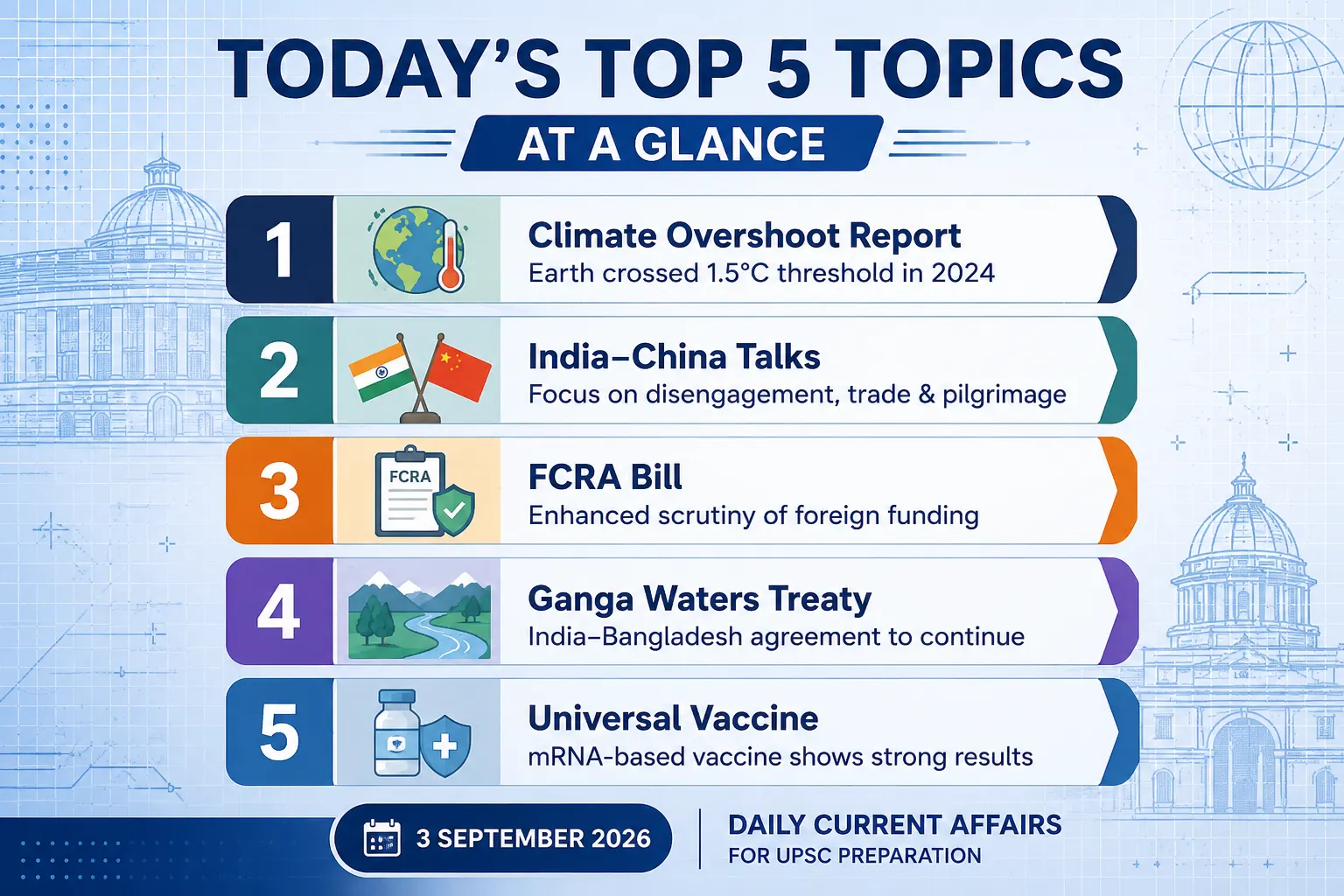
This Daily Current Affairs For UPSC post for 3rd September 2026 covers all the important news stories from The Hindu newspaper, specially curated for UPSC, State PCS, and other competitive exam aspirants. Today’s edition includes UNEP’s Overshoot climate report, the Pichavaram Mangroves valuation, India-China boundary talks, US tariff risk on India, onion price volatility, Russia’s dependence on Indian petroleum, the FCRA Amendment Bill, Article 124 on distinguished jurists, the India-Bangladesh Ganga Water Treaty, a universal pneumonia vaccine breakthrough, and the Asiatic Black Bear. Each topic is mapped to its relevant GS Paper along with facts, background, pros & cons, and the way forward — perfect for quick daily revision.
Daily Current Affairs For UPSC | OVERVIEW
Overview: Topics Covered in Today’s Current Affairs
| S.No | Topic | GS Paper / Category |
|---|
| 1 | UNEP’s “Limiting Overshoot” Report on Global Warming | GS III – Environment |
| 2 | Pichavaram Mangroves Economic Valuation | GS III – Environment & Ecology |
| 3 | India-China Boundary Talks (Early Harvest) | GS II – International Relations |
| 4 | Reducing India’s Exposure to US Tariff Risks | GS II – International Relations / Economy |
| 5 | Onion Price Volatility in India | GS III – Agriculture & Economy |
| 6 | Russia’s Growing Reliance on Indian Petroleum Products | GS III – Economy / Energy Security |
| 7 | Constitutional Faultlines in the FCRA Amendment Bill, 2026 | GS II – Polity & Governance |
| 8 | Article 124(3): Appointment of “Distinguished Jurists” as SC Judges | GS II – Indian Polity |
| 9 | India-Bangladesh Ganga Water Treaty Renewal | GS II – International Relations / Federalism |
| 10 | Universal Vaccine Against Pneumonia and Meningitis | Prelims – Science & Technology |
| 11 | Asiatic Black Bear (Moon Bear) | Prelims – Environment & Biodiversity |
Daily Current Affairs For UPSC | UNEP’s “Limiting Overshoot” Report
| Section | Details |
|---|
| Heading & Syllabus Mapping | UN Report Warns of Unavoidable Breach of the 1.5°C Global Warming Limit — GS III: Environment, Conservation, Climate Change |
| Why in News? | The United Nations Environment Programme (UNEP) has, for the first time, released a detailed roadmap describing how the world will overshoot the Paris Agreement’s 1.5°C target and outlined a pathway to bring temperatures back down later in the century. |
| Core Facts & Background | The Paris Agreement (2015) set a goal of restricting global temperature rise to well below 2°C, ideally 1.5°C, above pre-industrial levels. UNEP’s new “overshoot, peak, and decline” framework accepts that the 1.5°C mark will be crossed within the next few years. Even in the most optimistic scenario — where every nation fully delivers on its climate pledges and net-zero targets — peak warming is still projected to touch around 1.8°C before declining. Under existing/current national policies, however, warming could reach roughly 2.6°C by the year 2100, with a possible range between 1.9°C and 3.6°C depending on future action. |
| Pros & Cons | Pros: The report offers a realistic, science-based roadmap instead of pretending the 1.5°C target is still fully achievable; it pushes nations to focus on minimizing both the height and duration of the “overshoot” phase; it strengthens the case for faster decarbonisation and stronger national climate plans (NDCs). Cons: Acknowledging an “acceptable overshoot” risks reducing political urgency; overshooting even temporarily can trigger irreversible tipping points (glacier melt, coral bleaching, permafrost thaw) that cannot be undone by later cooling; poorer and climate-vulnerable nations bear disproportionate damage during the overshoot years. |
| Way Forward | Countries must strengthen their Nationally Determined Contributions (NDCs), accelerate renewable energy deployment, invest in carbon capture and large-scale reforestation, and build climate-resilient infrastructure to survive the overshoot period. International climate finance to vulnerable nations must also be scaled up urgently. |
Daily Current Affairs For UPSC | Pichavaram Mangroves Economic Valuation
| Section | Details |
|---|
| Heading & Syllabus Mapping | Pichavaram Mangrove Forest Valued at Over ₹2,485 Crore: New Study — GS III: Conservation, Biodiversity, Environmental Economics |
| Why in News? | A new economic valuation study has estimated the Total Economic Value (TEV) of the Pichavaram mangrove ecosystem in Tamil Nadu, highlighting the massive but often invisible economic contribution of mangrove forests. |
| Core Facts & Background | Pichavaram, located in Tamil Nadu, is one of India’s most ecologically significant coastal wetlands. The study pegged its Total Economic Value at approximately ₹2,485 crore, translating to a per-hectare value of around ₹1.83 crore. This includes the blue carbon asset value (carbon stored in coastal ecosystems), estimated separately at over ₹1,600 crore, along with soil organic carbon reserves. Mangroves like Pichavaram provide provisioning services (fish, crabs, timber), regulating services (cyclone and tsunami buffering, carbon sequestration), supporting services (habitat for marine species), and cultural/tourism value. Thousands of people from nearby villages depend on these mangroves for their livelihood. |
| Pros & Cons | Pros: Mangroves act as a natural shield against cyclones and tsunamis for coastal Tamil Nadu; they are among the most efficient carbon sinks on the planet (“blue carbon”); they sustain fisheries-based livelihoods for local communities; valuation studies like this can help unlock carbon credit financing. Cons: Ecosystem services from mangroves are still largely excluded from mainstream development and infrastructure planning; coastal urbanisation, aquaculture expansion, and pollution continue to threaten mangrove cover; without legal recognition of their economic value, mangroves remain vulnerable to encroachment. |
| Way Forward | The study recommends integrating ecosystem service valuation into coastal zone planning, recognising mangroves as key nature-based climate solutions, and developing blue carbon financing mechanisms and Payment for Ecosystem Services (PES) schemes to fund conservation. |
Daily Current Affairs For UPSC | India-China Boundary Talks (“Early Harvest”)
| Section | Details |
|---|
| Heading & Syllabus Mapping | India-China Special Representatives Talks: An Uncertain “Early Harvest” — GS II: India’s Foreign Relations, Bilateral Groupings |
| Why in News? | India’s National Security Adviser and China’s Foreign Minister held the 25th round of Special Representative (SR) talks on the India-China boundary question in Beijing, resulting in a joint statement referencing an “Early and Substantial Harvest” of border delimitation. |
| Core Facts & Background | The phrase “Early and Substantial Harvest” was originally an Indian proposal, initially referring specifically to settling the Sikkim Sector. China had earlier only agreed to a partial version covering Sikkim and some undisputed Middle Sector areas — a proposal India had rejected as an “agreement with holes.” The India-China boundary dispute spans three sectors: the Western Sector (Ladakh), the Middle Sector (Uttarakhand/Himachal), and the Eastern Sector (Sikkim and Arunachal Pradesh). A key friction point is the Sikkim sector, where both sides refer to the 1890 Anglo-Chinese Convention but interpret the location of Mount Gipmochi differently — this has direct implications for the sensitive Doklam tri-junction area, where China has maintained a military presence since the 2017 standoff. The talks also referenced the 2005 Agreement on Political Parameters and Guiding Principles for a Boundary Settlement. |
| Pros & Cons | Pros: Any forward movement in SR-level talks after years of stalemate (post-Galwan 2020) is diplomatically significant; an “Early Harvest” in Sikkim could set a template for broader delimitation; renewed dialogue mechanisms improve border management and reduce accidental escalation risk. Cons: China’s differing interpretation of the 1890 Convention could set a precedent unfavourable to India in other sectors like Arunachal Pradesh; a piecemeal, sector-by-sector settlement approach could mean India loses leverage on tougher issues in the Western and Eastern sectors; China’s continued infrastructure buildup near Doklam and the sensitive Siliguri Corridor remains a strategic concern for India’s northeastern connectivity. |
| Way Forward | Experts suggest India should insist on a genuine “package settlement” covering all sectors together rather than accepting selective, easy gains first while leaving harder territorial questions like Arunachal Pradesh open indefinitely. Trijunction points (like Doklam) affecting third countries such as Bhutan should be settled only in consultation with them, as per the 2012 Common Understanding. |
Daily Current Affairs For UPSC | Reducing India’s Exposure to US Tariff Risks
| Section | Details |
|---|
| Heading & Syllabus Mapping | US Sanctions Bill Threatens Steep Tariffs on India Over Russian Oil Imports — GS II/III: India’s Economic Diplomacy, Effect of Policies of Developed Countries on India |
| Why in News? | The US Senate has passed a bill (targeting sanctions related to Russia and Iran) that authorises tariffs of up to 100% on countries that are among the top five importers of Russian crude oil or gas — a category India falls into, given its sharply increased Russian oil imports since 2022. |
| Core Facts & Background | Before the Russia-Ukraine war, Russian crude made up barely 2% of India’s oil imports; today it accounts for roughly half. Combined with an earlier US “forced-labour” tariff and a separate duty under Section 122, India’s cumulative tariff exposure to the US could reach around 110% if the new sanctions bill becomes law (China’s potential exposure is even higher, near 112.5%). Simulations using a global trade model show that under a full sanctions scenario, India’s economic welfare could decline sharply, with GDP, exports, and domestic demand all contracting. However, the same simulations show that if India pursues serious export diversification — for example, through a functional India-EU Free Trade Agreement (FTA) — the negative impact is significantly cushioned, with exports and demand actually turning positive. |
| Pros & Cons | Pros of continuing Russian oil imports: Cheaper crude helps control India’s import bill and domestic fuel inflation; supports India’s principle of “strategic autonomy” in foreign policy. Cons: Heavy tariffs on the US market — one of India’s largest export destinations — could hurt price competitiveness of Indian goods; over-reliance on a single supplier (Russia) creates energy security risk; trade tensions could strain the broader India-US strategic partnership. |
| Way Forward | Analysts recommend a two-track strategy: continuing to safeguard energy security through diversified crude sourcing, while urgently deepening trade ties with alternative markets like the EU. Domestic reforms — improving product quality standards, easing export paperwork, strengthening logistics, and moving up the manufacturing value chain — are seen as essential to reduce long-term dependence on any single export market. |
Daily Current Affairs For UPSC | Onion Price Volatility in India
| Section | Details |
|---|
| Heading & Syllabus Mapping | India’s Onion Pricing Puzzle: Farmers Need Storage, Not Just Export Bans — GS III: Agricultural Marketing, Buffer Stocks, Food Security |
| Why in News? | Fluctuating onion prices have once again put the spotlight on India’s reactive, ad-hoc approach to managing this politically sensitive commodity, with the government swinging between export bans and duty cuts depending on price pressure. |
| Core Facts & Background | Since the 1960s, India has tried to balance affordable onion prices for consumers against remunerative prices for farmers. In recent cycles, the government banned onion exports (Dec 2023–May 2024), then imposed a minimum export price plus a 40% export duty, later reduced it to 20%, before abolishing it entirely in April 2025. Erratic monsoon rainfall and a drop in Maharashtra’s kharif onion output (India’s largest onion-producing state) have repeatedly disrupted this balance. Some states, like Tamil Nadu, have rolled out targeted subsidised distribution of onions through ration card systems to protect consumers, though this creates pressure on the central buffer stock, especially given post-harvest storage losses that can run as high as 30% for onions — far higher than for grains like wheat or rice. |
| Pros & Cons | Pros of government intervention: Export bans/duties can quickly stabilise domestic prices during shortages; buffer stocks and subsidised PDS distribution protect vulnerable consumers. Cons: Frequent, reactive policy changes undermine farmers’ planning and erode their trust, since decisions are often made only after prices have already crashed or spiked; India’s onion storage infrastructure remains weak, causing huge post-harvest losses; policy flip-flops damage India’s reliability as an onion exporter in the long run. |
| Way Forward | Long-term solutions recommended include building more scientific cold-storage and warehousing capacity closer to production clusters, maintaining a more predictable and less erratic export policy, improving inter-state distribution networks, and protecting farmers against sudden price shocks through assured procurement mechanisms rather than last-minute interventions. |
Daily Current Affairs For UPSC | Russia’s Growing Reliance on Indian Petroleum Products
| Section | Details |
|---|
| Heading & Syllabus Mapping | Decoding Russia’s New Dependence on Indian Petroleum Products — GS III: Indian Economy, Energy Security, Effects of Geopolitics on Trade |
| Why in News? | Repeated Ukrainian drone and missile strikes on Russian oil refineries have forced Russia to import refined petroleum products from India in significant volumes for the first time since the war began in 2022 — a striking reversal of the usual India-Russia oil relationship. |
| Core Facts & Background | India imports crude oil from Russia (which accounted for nearly a third of India’s total crude imports as of mid-2026) and refines it domestically, largely through private refineries. With Ukraine’s sustained attacks damaging Russian refining capacity throughout 2026, Russia has now started importing back refined products like petrol and diesel from India, Turkey, and Morocco to help stabilise its domestic fuel market. India currently ranks fourth in global oil-refining capacity, behind China, the US, and Russia itself — a capacity gap that Russia is now leaning on. This represents a notable shift, since Russia’s exports to India had historically been almost entirely crude oil, with negligible refined product imports. |
| Pros & Cons | Pros for India: Indian refiners gain a new, high-value export market and improve foreign exchange earnings; strengthens India’s standing as a major global refining hub; helps offset some of the pressure India faces from Western tariff threats over its crude purchases. Cons: Deepens India’s economic entanglement with a country facing extensive Western sanctions, raising diplomatic complications with the US and EU; over-dependence on a single crude supplier (Russia) for feedstock still leaves India exposed to supply-side shocks; the arrangement invites greater international scrutiny of India’s energy trade choices. |
| Way Forward | India needs to continue balancing its energy security interests with diplomatic caution — diversifying crude sourcing over the medium term while using its refining strength strategically, and maintaining transparent trade practices to avoid secondary sanctions risk. |
Daily Current Affairs For UPSC | Constitutional Faultlines in the FCRA Amendment Bill, 2026
| Section | Details |
|---|
| Heading & Syllabus Mapping | FCRA Amendment Bill 2026: Does It Give the State Too Much Control Over NGOs? — GS II: Government Policies, Civil Society, Constitutional Provisions |
| Why in News? | The Foreign Contribution (Regulation) Amendment Bill, 2026, has drawn scrutiny for creating a “Designated Authority” with sweeping powers over the management and disposal of assets belonging to NGOs whose FCRA registration is cancelled, surrendered, or lapses. |
| Core Facts & Background | The FCRA has long empowered the state to regulate foreign donations to Indian civil society organisations, citing concerns of national security, transparency, and accountability. However, the 2026 amendment goes further — it allows the central government, through a specially appointed “Designated Authority,” to take possession of and manage foreign-funded assets (land, buildings, hospitals, schools) even when an organisation merely loses its registration, not necessarily due to any proven wrongdoing. Existing law already allowed vesting of assets created from foreign funds upon cancellation, but the new Bill adds detailed provisions for provisional vesting, possession, management, restoration, and — ultimately — permanent vesting and disposal of such assets. Legal experts argue this shifts the relationship between the State and the organisation from mere ownership regulation to potential control over an institution’s day-to-day management and independence. |
| Pros & Cons | Pros: Strengthens financial oversight and helps prevent diversion or misuse of foreign contributions; creates a clearer statutory accountability framework where earlier rules were comparatively vague. Cons: Raises serious constitutional questions about proportionality — the doctrine that any restriction on rights must be reasonably connected to a legitimate objective and not excessive; risks conflating loss of registration (often due to non-renewal or procedural lapses) with actual wrongdoing; could give the executive disproportionate control over independent institutions like hospitals and schools that merely happen to have received foreign funding in the past; raises fears of misuse against civil society groups critical of the government. |
| Way Forward | Legal experts recommend the Bill be scrutinised for adequate safeguards — clear, time-bound, and judicially reviewable procedures — to ensure that any state action against an NGO’s assets is proportionate, transparent, and restricted strictly to cases of proven diversion or misuse of funds, not mere administrative non-renewal. |
Daily Current Affairs For UPSC | Article 124(3) — Can “Distinguished Jurists” Be Appointed as SC Judges?
| Section | Details |
|---|
| Heading & Syllabus Mapping | The Unused Constitutional Provision: Appointing Jurists as Supreme Court Judges — GS II: Indian Constitution, Judiciary |
| Why in News? | A sitting Supreme Court judge publicly questioned why Article 124(3) of the Constitution — which allows a “distinguished jurist” to be appointed as an SC judge — has remained unused for over 76 years since the Constitution came into force. |
| Core Facts & Background | Article 124(3) lays down three eligibility routes for Supreme Court appointment: a person must have served as a High Court judge for at least five years, practised as an advocate in a High Court for at least ten years, OR be, in the President’s opinion, a “distinguished jurist.” However, the Constitution never defines exactly what qualifies someone as a “distinguished jurist,” and to date, no legal academic or scholar has ever been elevated to the Supreme Court under this route — all SC judges have come almost exclusively from High Court judges, with only a small number of advocates directly elevated from the Bar. Constituent Assembly debates from 1949 reveal this provision was deliberately included to widen the field of choice beyond conventional judges and lawyers, citing the example of US Supreme Court Justice Felix Frankfurter, a former Harvard Law professor appointed directly to the bench in 1939. A similar “distinguished jurist” clause for High Court appointments was added via a 1976 constitutional amendment but was later removed in 1978, and it too was never used. |
| Pros & Cons | Pros of using this provision: Could bring valuable academic and specialised legal expertise (e.g., in constitutional theory, international law) to the Supreme Court that career judges or litigating advocates may lack; broadens diversity of professional backgrounds on the bench. Cons: Since a jurist would first need to be recommended by the Supreme Court Collegium — a body composed of judges — there’s limited institutional incentive to look outside the judicial pipeline; India’s Bar Council rules also restrict full-time law academics from simultaneously practising as advocates, narrowing the practical pool of eligible “jurists.” |
| Way Forward | Legal scholars have suggested relaxing Bar Council restrictions to allow full-time law faculty to practise in courts, which would help bridge the gap between “law in books” and “law in action,” and eventually make the distinguished jurist route more viable in practice. |
Daily Current Affairs For UPSC | India-Bangladesh Ganga Water Treaty Renewal
| Section | Details |
|---|
| Heading & Syllabus Mapping | India to Decide on Renewing the 1996 Ganga Water Treaty, Weighing Bihar’s Concerns — GS II: India’s Neighbourhood Relations, Federalism, Water as a State Subject |
| Why in News? | India’s External Affairs Minister has assured a Bihar political leader that the state’s concerns will be factored in while deciding on the renewal of the 1996 India-Bangladesh Ganga Water Treaty, which is set to expire on 31 December 2026. |
| Core Facts & Background | The treaty, signed in December 1996 during Sheikh Hasina’s first tenure as Bangladesh’s PM, governs the sharing of Ganga waters at the Farakka Barrage (built in 1975 in West Bengal) during the dry season (January–May), primarily to maintain the navigability of Kolkata Port via the Hooghly River. It runs for 30 years, with mandatory reviews every five years. Its sharing formula is tiered: if the flow at Farakka is below 70,000 cusecs, water is split 50:50; between 70,000–75,000 cusecs, Bangladesh gets a fixed 35,000 cusecs while India takes the rest; and above 75,000 cusecs, India gets 75,000 cusecs with Bangladesh receiving the balance. An emergency clause requires immediate bilateral consultation if flows fall below 50,000 cusecs. Bihar has argued the treaty has “negatively impacted” the state over the past 30 years, citing rising silt accumulation upstream of the Farakka Barrage that worsens flooding and hurts agriculture. India and Bangladesh together share 54 transboundary rivers, of which the Ganga is one of the most seasonal and contentious. |
| Pros & Cons | Pros: The treaty has ensured a stable, rules-based mechanism for sharing a critical shared river resource for nearly three decades, avoiding unilateral water disputes; it protects the livelihoods of millions dependent on Ganga water for drinking, irrigation, and industry on both sides. Cons: Bihar’s concerns over silt build-up and flooding linked to the Farakka Barrage remain unresolved after 30 years; as water is a State subject under India’s Constitution while international river treaties fall under the Centre’s domain, this creates a recurring federalism tension in negotiations; the current political breakdown in bilateral talks (following changes in Bangladesh’s leadership) adds uncertainty to timely renewal. |
| Way Forward | Experts recommend India base its renewal decision on updated scientific hydrological assessments (rather than the treaty’s dated 1949–1988 flow data), ensure genuine consultation with Bihar and other affected states before finalising terms, and use the renewal process to also address broader regional water-sharing issues, including the long-pending Teesta River Agreement. |
Daily Current Affairs For UPSC | Universal Vaccine Against Pneumonia and Meningitis
| Section | Details |
|---|
| Heading & Syllabus Mapping | Scientists Move Closer to a Universal Pneumococcal Vaccine — Prelims: Science & Technology, Health Innovations |
| Why in News? | A team of British scientists has reported an important early breakthrough toward developing a universal vaccine capable of protecting against all — or most — of the roughly 100 different serotypes (forms) of the bacterium Streptococcus pneumoniae. |
| Core Facts & Background | S. pneumoniae normally lives harmlessly in the human nose and throat, but when the immune system weakens (e.g., during a viral infection), it can invade the lungs and bloodstream, causing pneumonia, meningitis, and sepsis. Existing pneumococcal vaccines work by targeting the sugary polysaccharide capsule unique to each serotype, but they only cover 20 or so of the roughly 100 known serotypes, leaving other strains free to spread — a phenomenon called “serotype replacement.” The new experimental approach uses “reverse vaccinology,” a method that starts by scanning the bacterium’s genome to identify universal proteins (rather than the variable capsule) that could work across all serotypes. Researchers shortlisted candidate proteins based on their location, accessibility to the immune system, and similarity — or lack thereof — to human tissue (to avoid triggering autoimmune reactions). In mouse trials, the resulting vaccine formulation showed strong protection and produced potent antibodies, though it was found to be less effective at physically preventing bacteria from spreading in the upper respiratory tract compared to fully eliminating infection. |
| Pros & Cons | Pros: Could eventually eliminate the need for repeatedly updated, serotype-specific vaccines; would close protection gaps for non-vaccine serotypes that currently exploit ecological space left by existing vaccines; particularly valuable for regions with high pneumococcal disease burden and limited healthcare access. Cons: Still in early experimental (mouse-model) stages — human trials and regulatory approval remain a long way off; the current formulation does not fully stop bacterial spread even when it protects against severe illness, meaning transmission could continue among vaccinated but colonised individuals; developing truly universal antigens that are safe and broadly effective remains scientifically challenging. |
| Way Forward | Continued research is needed to refine the vaccine candidates, move from animal models to human clinical trials, and evaluate real-world protection levels — with the eventual goal of a single, affordable vaccine that protects against nearly all pneumococcal disease, reducing global mortality from pneumonia and meningitis. |
Daily Current Affairs For UPSC | Asiatic Black Bear (Moon Bear)
| Section | Details |
|---|
| Heading & Syllabus Mapping | Japan Tests Coexistence Model to Manage Rising Bear Encounters — Prelims: Environment, Wildlife Conservation, Species in News |
| Why in News? | Rising bear attacks in Japan have led to record-scale culling of Asiatic black bears, prompting some regions like Nagano to pilot an alternative “coexistence” model involving trapping, tagging, and safe release instead of mass culling. |
| Core Facts & Background | The Asiatic black bear is popularly known as the “Moon Bear,” named for the distinctive crescent-shaped patch of white/cream fur on its chest, set against otherwise smooth black fur. It has seven recognised subspecies globally, one of which — the Himalayan Black Bear — is found in India, specifically in Arunachal Pradesh, Assam, Sikkim, and the Union Territory of Jammu & Kashmir. Its broader global range stretches from south-eastern Iran through the Himalayan foothills to Myanmar. The species is omnivorous. In terms of conservation status, it is listed as “Vulnerable” on the IUCN Red List, placed under CITES Appendix I (highest level of international trade protection), and protected under Schedule II of India’s Wildlife (Protection) Act, 1972. In Japan, rising encounters — linked to shrinking natural food sources, rural depopulation, and reduced buffer zones between forests and towns — have led authorities to cull thousands of bears annually. Some regions have instead adopted a management model since 1995 involving GPS tagging, tranquilising and relocating bears, deploying scent-fencing and trained “Karelian Bear Dogs” to deter bears from human settlements. |
| Pros & Cons | Pros of the coexistence model: Reduces unnecessary killing of a vulnerable species while still protecting human safety; helps build long-term, healthier bear populations; offers data (via GPS tracking) that improves understanding of bear movement and behaviour. Cons: Resource- and labour-intensive compared to culling; requires sustained funding and trained personnel; results are difficult to compare directly across regions with different bear densities and habitats; climate-linked food scarcity (e.g., acorn shortages) remains a root cause that trapping alone cannot fix. |
| Way Forward | Experts recommend combining monitoring-and-relocation approaches with habitat management — such as maintaining clear buffer zones around settlements, managing depopulated rural land, and addressing food-source variability linked to climate change — as a more sustainable long-term alternative to mass culling. |
Daily Current Affairs For UPSC | FAQs
Q1. What is covered in today’s Daily Current Affairs For UPSC (3 September 2026)?
A1. Today’s edition covers UNEP’s “Limiting Overshoot” climate report, Pichavaram Mangroves valuation, India-China boundary talks, US tariff risk on India, onion price volatility, Russia’s reliance on Indian petroleum products, the FCRA Amendment Bill 2026, Article 124 on distinguished jurists, the India-Bangladesh Ganga Water Treaty renewal, a universal pneumococcal vaccine breakthrough, and the Asiatic Black Bear.
Q2. Why is the India-Bangladesh Ganga Water Treaty in the news?
A2. The 1996 Ganga Water Treaty between India and Bangladesh is set to expire on 31 December 2026, and India is currently deciding on its renewal while factoring in Bihar’s concerns over silt accumulation and flooding near the Farakka Barrage.
Q3. What does the UNEP “Limiting Overshoot” report say about the 1.5°C target?
A3. The UNEP report states that breaching the 1.5°C global warming limit is now unavoidable in the coming years, and proposes an “overshoot, peak, and decline” pathway to bring temperatures back within the limit by 2100.
Q4. Why is the FCRA Amendment Bill, 2026 controversial?
A4. The Bill creates a “Designated Authority” with wide powers to take possession of and manage foreign-funded assets of NGOs whose FCRA registration is cancelled or lapses, raising constitutional concerns about proportionality and executive overreach.
Q5. What is a “distinguished jurist” under Article 124(3) of the Constitution?
A5. Article 124(3) allows a person recognised by the President as a “distinguished jurist” — not necessarily a judge or practising advocate — to be appointed as a Supreme Court judge. Despite being part of the Constitution since 1950, this provision has never been used.
Post Views: 12