Latest UPSC Current Affairs Today 31 August 2026 | India-Uzbekistan, CERD, Meta, Aditya-L1 ye title thik rahega
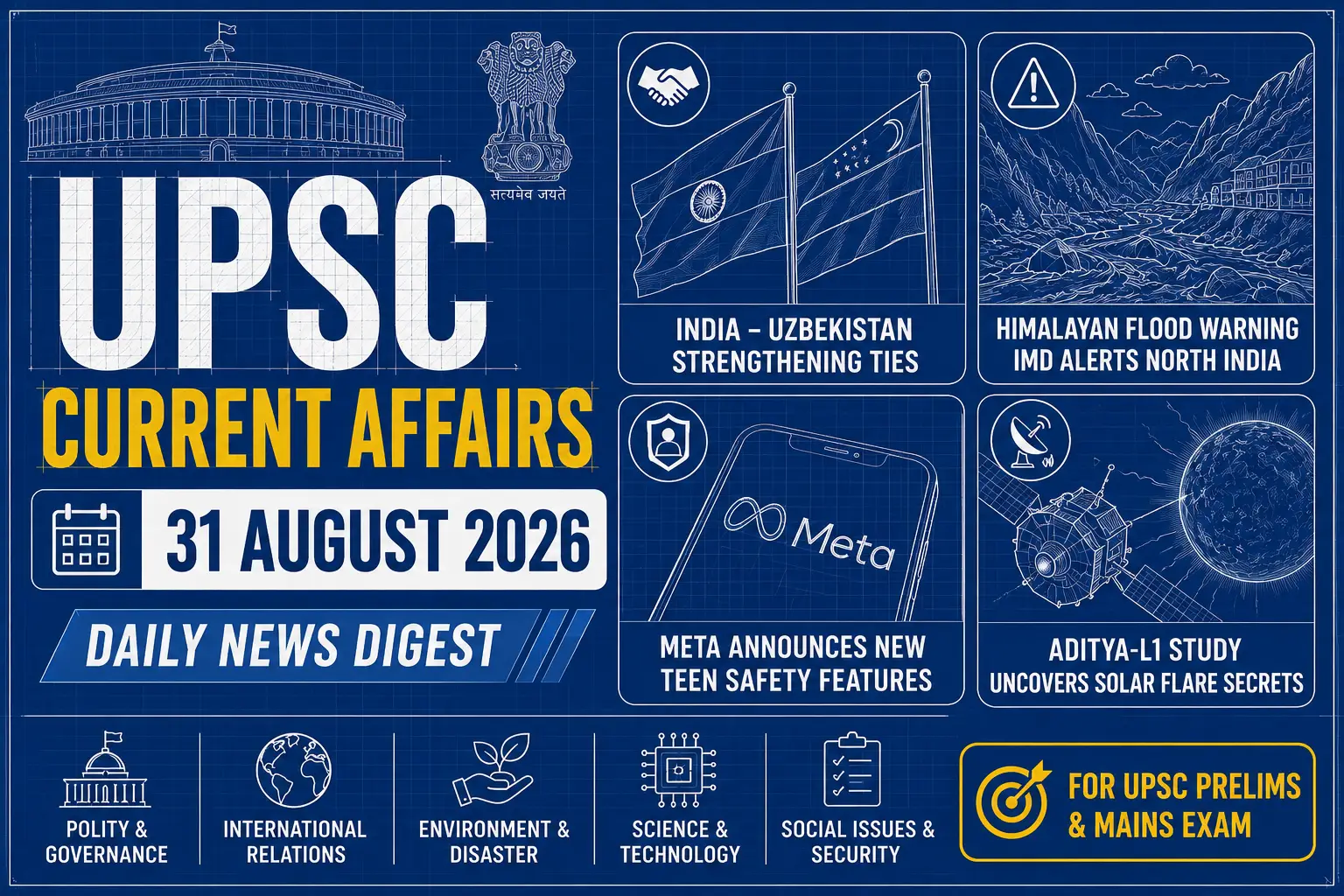
Today’s roundup covers eleven high-value topics drawn from the day’s national and international news cycle — spanning foreign policy, internal security, science & technology, and governance. Each topic below is mapped to its relevant GS paper (or Prelims) so you can revise with exam context in mind rather than reading news in isolation.
Latest UPSC Current Affairs | Overview
| # | Topic | GS Paper / Prelims | Why in News (in short) |
|---|---|---|---|
| 1 | India-Uzbekistan Comprehensive Strategic Partnership | GS II | PM Modi’s Tashkent visit; uranium deal, $5 billion trade target by 2030 |
| 2 | Rani Avanti Bai Lodhi | Prelims | Defence Minister paid tribute to the 1857 freedom fighter in Lucknow |
| 3 | The Himalayan Warning | Prelims | Nepal floods spark GLOF and seismic-risk warnings for the Himalayan belt |
| 4 | State of Exception (CERD Review) | GS II | UN body flags discrimination concerns in India’s first review since 2007 |
| 5 | Meta’s Teen Safety Controls | GS II | $18 billion settlement; new default limits on Facebook & Instagram for teens |
| 6 | Distinguished Jurist under Article 124(3) | GS II | SC judge calls for activating a never-used provision for SC appointments |
| 7 | Mission ShaktiSAT & PM SVANidhi | Prelims / GS II | PM highlights women-focused space and street-vendor credit schemes |
| 8 | Aditya-L1 Solar Flare Study | Prelims | New study finds early warning signs before major solar flares |
| 9 | Legal Metrology (IST) Rules, 2026 | Prelims | IST notified as India’s single legal time reference; 180-day compliance |
| 10 | Vacuum Birefringence in QED | GS III | Magnetar observation offers strong evidence that “empty” space isn’t empty |
| 11 | Nancy Grace Roman Space Telescope | Prelims | NASA’s next flagship telescope set for launch to study dark energy/matter |
Latest UPSC Current Affairs | India-Uzbekistan Comprehensive Strategic Partnership
Syllabus Mapping: GS Paper II — India and its Neighbourhood; Bilateral, Regional and Global Groupings
Why in News?
During Prime Minister Narendra Modi’s state visit to Tashkent, India and Uzbekistan agreed to elevate their bilateral relationship from a Strategic Partnership to a Comprehensive Strategic Partnership, alongside a fresh long-term uranium supply framework for India’s civil nuclear sector.
Core Facts & Background
| Aspect | Detail |
|---|---|
| Occasion | PM Modi’s state visit to Tashkent, Uzbekistan |
| Upgraded status | Strategic Partnership → Comprehensive Strategic Partnership |
| Trade target | $5 billion by 2030 (current volume ~$1 billion) |
| Agreements signed | 11 (mining, tourism, critical minerals, defence, agriculture, UPI/digital infra) |
| Aral Sea grant | ~$1 million for afforestation |
| Cultural link | Restoration of Fayaz Tepa & Kara Tepa Buddhist sites |
| Honour conferred | Oliy Darajali Do’stlik Order (Uzbekistan’s highest honour for foreign leaders) |
- The two countries set a bilateral trade target of $5 billion by 2030, up from the current volume of roughly $1 billion.
- Eleven agreements were signed covering mining, tourism, critical minerals, defence, agriculture, and digital public infrastructure such as UPI.
- A commercial tie-up between India’s NPCI International Payments and Uzbekistan’s national payments body will let Indian UPI apps scan Uzbek merchant QR codes.
- India committed roughly $1 million toward afforestation efforts around the shrinking Aral Sea.
- A Letter of Intent was signed for restoring the ancient Buddhist monastic sites of Fayaz Tepa and Kara Tepa, underlining Silk Road-era India-Central Asia cultural links.
- The PM also paid tribute at the Tashkent memorial to Lal Bahadur Shastri, who died in the city in 1966 shortly after signing the Tashkent Declaration ending the 1965 India-Pakistan war.
- Uzbekistan conferred its highest civilian honour for foreign leaders, the Oliy Darajali Do’stlik Order, on PM Modi.
- Geographically, Uzbekistan is one of only two doubly landlocked countries in the world (the other being Liechtenstein) and sits at the heart of the historic Silk Road.
Latest UPSC Current Affairs | Pros & Cons
Pros: Diversifies India’s uranium sourcing beyond traditional suppliers; strengthens India’s Central Asia outreach amid growing Chinese influence in the region; opens new trade and connectivity corridors through the International North-South Transport Corridor. Cons: Uzbekistan’s landlocked geography and limited existing trade infrastructure could slow the pace of achieving the $5 billion target; regional connectivity still depends heavily on transit through Iran or Russia-linked routes, which carries geopolitical uncertainty.
Way Forward
Sustained follow-through on the uranium supply framework, faster implementation of the connectivity and payment-linkage agreements, and deeper cultural diplomacy through joint heritage restoration can help India consolidate a long-term strategic foothold in Central Asia.
Latest UPSC Current Affairs | Rani Avanti Bai Lodhi — 1857 Freedom Fighter
Syllabus Mapping: Prelims — Modern Indian History (Revolt of 1857)
Why in News?
Union Defence Minister Rajnath Singh paid tribute to Rani Avanti Bai Lodhi at an event organised by the Lodhi Kshatriya Rajput Sabha in Lucknow, reigniting political and public attention on this lesser-known 1857 icon.
Core Facts & Background
| Aspect | Detail |
|---|---|
| Born | 16 August 1831, Mankedi village, Seoni (Madhya Pradesh) |
| Died | 20 March 1858 (refused capture) |
| Married to | Vikramaditya Singh Lodhi, Rajput prince of Ramgarh state |
| Key battle | Battle of Kheri (1857) — defeated British troops |
| Cause of revolt | British attempt to annex Ramgarh under Doctrine of Lapse |
| Legacy | UP’s all-women PAC battalion at Badaun named after her |
- Born on 16 August 1831 in Mankedi village, Seoni district (present-day Madhya Pradesh).
- Married Rajput prince Vikramaditya Singh Lodhi of Ramgarh state (now in Dindori district, MP).
- Took charge of Ramgarh state’s administration after her husband fell ill, later assuming the throne.
- Skilled in swordsmanship, horse riding, and guerrilla warfare tactics.
- Defeated British forces at the Battle of Kheri (1857).
- Led her own army against the British after they attempted to annex Ramgarh under the Doctrine of Lapse.
- Died on 20 March 1858, choosing to fight to the end rather than be captured.
- Uttar Pradesh’s all-women Provincial Armed Constabulary battalion at Badaun has been named after her, and the state government recently announced 50,000 scooters for women as a tribute to her legacy.
Latest UPSC Current Affairs | Pros & Cons
Pros: A high-value, often-overlooked static GK entry linking regional 1857 resistance figures with the Doctrine of Lapse — useful for both Prelims MCQs and Essay/GS I answers on women in India’s freedom struggle. Cons: Being a lesser-known figure compared to Rani Lakshmibai, students often mix up her details (birthplace, state, and battle) with those of more famous 1857 leaders — a common source of Prelims errors.
Way Forward
Revise Rani Avanti Bai Lodhi alongside other regional 1857 leaders (Rani Lakshmibai, Begum Hazrat Mahal, Tantia Tope) in a comparative table to avoid confusion and strengthen recall for Prelims.
Latest UPSC Current Affairs | The Himalayan Warning — Nepal Floods and GLOF Risk
Syllabus Mapping: Prelims — Disaster Management, Geography; GS III (Disaster Management) if elaborated in Mains
Why in News?
A devastating flood event in upper Nepal has renewed warnings about the seismic and glacial fragility of the Himalayan region, with experts urging India to treat this as an early warning rather than an isolated disaster.
Core Facts & Background
| Aspect | Detail |
|---|---|
| Trigger under study | Possible Glacial Lake Outburst Flood (GLOF) |
| Region affected | Upper Nepal |
| Related China project | Medog hydropower station, on Brahmaputra (Yarlung Tsangpo), near Paizhen Fault |
| India’s counter-project | Upper Siang Multipurpose Project, Arunachal Pradesh |
| Key risk zones flagged | Seismic Himalayan belt; India’s own high-risk dams/reactors |
- The Himalayas form one continuous, seismically active mountain system stretching across Afghanistan, Pakistan, India, Nepal, and the Tibet-China-Bhutan belt — not a series of isolated zones.
- The immediate trigger under scrutiny is a possible Glacial Lake Outburst Flood (GLOF) — a sudden release of water from a glacial lake, often caused by ice or moraine dam failure, frequently linked to global warming.
- Experts flagged China’s mega hydropower project at Medog, located at the great bend of the Brahmaputra (Yarlung Tsangpo) river near the seismically sensitive Paizhen Fault, as a factor that could worsen downstream flood risk for India’s Northeast in the event of an earthquake.
- India’s Upper Siang Multipurpose Project in Arunachal Pradesh is being developed partly as a strategic counter-response in this “dam race.”
- Suggested lessons include: continuous scientific monitoring shared with the public (not confined to academic seminars), proactive evacuation planning in high-risk zones, a review of India’s own dams and reactors in seismic zones, and time-bound decongestion of high-risk settlements.
Latest UPSC Current Affairs | Pros & Cons
Pros: Early scientific monitoring and shared Himalayan disaster data can save lives across multiple countries; highlights the need for South Asian regional cooperation on glacial and seismic hazards. Cons: Politically sensitive, since it involves both cross-border data-sharing with Nepal/China and domestic relocation of vulnerable communities — both historically slow-moving processes in India.
Way Forward
Institutionalise real-time GLOF and seismic monitoring shared with vulnerable communities, fast-track a safety audit of dams in high-risk Himalayan zones, and pursue regional hydro-diplomacy with China on trans-boundary rivers like the Brahmaputra.
Latest UPSC Current Affairs | State of Exception — CERD’s First Review of India Since 2007
Syllabus Mapping: GS Paper II — Government Policies, Human Rights, International Bodies
Why in News?
The UN Committee on the Elimination of Racial Discrimination (CERD) conducted its first review of India since 2007 and expressed “grave concern” over patterns of discrimination and law-enforcement violence against minority ethnic and religious groups, Dalits, and non-citizens.
Core Facts & Background
| Aspect | Detail |
|---|---|
| Body | UN Committee on the Elimination of Racial Discrimination (CERD) |
| Last review of India | 2007 (this is the first review since then) |
| India ratified convention | 1968 |
| India’s position on caste | Says caste bias falls outside Article 1 (rejected by CERD) |
| Institution flagged | NHRC — downgraded by Global Alliance of NHRIs last year |
| Laws flagged for civil-society restriction | FCRA, UAPA, AFSPA, PMLA |
- India ratified the International Convention on the Elimination of All Forms of Racial Discrimination in 1968 but has reportedly not shared detailed, updated information on state inquiries and sanctions related to violence against these groups.
- India has told CERD that caste bias falls outside the Convention’s Article 1 definition since caste is not synonymous with race — a position CERD has consistently rejected, holding that discrimination based on inherited/descent-based status is covered.
- CERD flagged: continued manual scavenging despite a legal ban, hate speech against and poor living conditions of Rohingya refugees, mass refoulement concerns, citizenship deprivation issues linked to the National Register of Citizens, large-scale deletions in Special Intensive Revisions of electoral rolls, and use of laws like FCRA, UAPA, AFSPA, and PMLA to restrict civil society space.
- The Bharatiya Nyaya Sanhita does not explicitly criminalise racist hate speech, and the Forest (Conservation) Amendment Act exempts “national security” projects from consultative decision-making.
- A delayed Census and slow release of NCRB crime data further limit independent verification of India’s discrimination claims.
- The Global Alliance of National Human Rights Institutions downgraded India’s National Human Rights Commission (NHRC) last year, citing lack of independence and pluralism.
Latest UPSC Current Affairs | Pros & Cons
Pros: International scrutiny can push India toward better disaggregated data collection and stronger anti-discrimination enforcement; keeps civil society engaged on accountability. Cons: India treats such reviews as interference in a “domestic matter,” which can limit genuine policy follow-through; risk of the report being dismissed as politically motivated rather than acted upon.
Way Forward
Restore NHRC’s institutional independence, expedite Census and disaggregated crime-data publication, strengthen legal action against hate speech, and improve transparency in electoral roll revision processes to address CERD’s concerns credibly.
Latest UPSC Current Affairs | Can Meta’s Safety Controls Make Facebook and Instagram Less Addictive for Teens?
Syllabus Mapping: GS Paper II — Government Policies and Interventions relating to Health, Social Justice, and Technology Regulation
Why in News?
Meta agreed to an approximately $18 billion settlement with dozens of U.S. states over allegations that Facebook and Instagram are harmful to children and illegally collect their personal data, and announced stricter default controls for teen accounts.
Core Facts & Background
| Aspect | Detail |
|---|---|
| Settlement amount | ~$18 billion, payable over 10 years |
| Default time limit | 2 hours/day on Facebook & Instagram |
| Night Mode | 12 AM – 6 AM (app use blocked) |
| School Mode | 8 AM – 3 PM |
| Conditional payout | $5.3 billion released only if YouTube/TikTok adopt similar standards |
| Australia comparison | First to ban social media for under-16s; study found limited real impact |
- New default features include a two-hour daily time limit across Facebook and Instagram (teens need parental permission to turn it off), a Night Mode blocking app use between 12 AM–6 AM, and a School Mode limiting access between 8 AM–3 PM.
- Teens get usage-time prompts after every 15, 30, and 60 minutes of continuous use (excluding direct messages).
- Meta is giving teens and parents the option of a non-algorithmic feed and the ability to switch off Autoplay.
- Likes and reactions counts are being hidden by default for under-18 users to reduce social comparison pressure, alongside restrictions on beauty/cosmetic-surgery-style filters.
- Teen accounts are being made private by default, with restrictions preventing “potentially suspicious adults” from contacting minors.
- $5.3 billion of the settlement amount will only be released if rival platforms like YouTube and TikTok adopt similar child-safety standards — creating a market-wide incentive.
- Australia was the first country to enforce a blanket social media ban for under-16s; a University of Newcastle study found the ban did not significantly reduce under-16 social media use, largely due to easy age-verification bypass (e.g., fake birthdates).
Latest UPSC Current Affairs | Pros & Cons
Pros: Default (opt-out rather than opt-in) restrictions are far more effective than voluntary tools; industry-wide incentive structure could raise safety standards across competing platforms. Cons: Age verification remains easily bypassed by tech-savvy teens; restrictions don’t apply to direct messages, a major vector for harmful contact; enforcement burden is shifted onto device-makers like Apple and Google rather than resolved outright.
Way Forward
Robust, privacy-respecting age-verification technology, cross-platform enforcement (not just Meta), and continued parental and educator engagement are needed to make these controls genuinely effective rather than easily circumvented.
Latest UPSC Current Affairs | Appointment of “Distinguished Jurists” under Article 124(3)
Syllabus Mapping: GS Paper II — Indian Constitution, Judiciary, Appointment of Judges
Why in News?
Supreme Court judge Justice Ujjal Bhuyan publicly called for activating the constitutional provision allowing appointment of “distinguished jurists” — including legal academics — as Supreme Court judges, noting this provision has never been used in over 76 years of the Constitution’s existence.
Core Facts & Background
| Aspect | Detail |
|---|---|
| Provision | Article 124(3), Indian Constitution |
| Who raised it | Justice Ujjal Bhuyan, Supreme Court judge |
| Times used since 1950 | Never |
| Existing SC judge categories | Sitting High Court judges; practising advocates |
| Related controversy | BCI’s brief bar on a law university’s 2026 batch (later withdrawn) |
- Article 124(3) of the Constitution allows a person to be appointed as a Supreme Court judge if they are a “distinguished jurist,” in addition to the usual categories of sitting High Court judges and practising advocates.
- Justice Bhuyan argued the term “jurist” is often applied too narrowly in India — while any competent lawyer or judge may be a jurist, the constitutional category extends further to include legal scholars and academics with recognised expertise.
- He suggested that reluctance to use this route may stem from a perception of insufficient depth in Indian legal academia, or simply the provision not being taken seriously.
- The remarks came amid an unrelated controversy where the Bar Council of India had briefly barred a law university’s 2026 batch from enrolment over students objecting to certain remarks by a chief guest at their convocation — an order the BCI later withdrew after public criticism.
- Justice Bhuyan linked both issues to a broader point about tolerance for dissenting views being essential to a healthy democracy and judiciary.
Latest UPSC Current Affairs | Pros & Cons
Pros: Appointing distinguished legal academics could diversify the Bench with scholarship-driven perspectives not always present among career litigators/judges; could strengthen the Court’s engagement with emerging areas of law. Cons: No clear precedent or established process exists for identifying a “distinguished jurist,” raising concerns about subjectivity, transparency, and possible politicisation of such appointments.
Way Forward
The Supreme Court Collegium and government could develop transparent, merit-based criteria for identifying distinguished jurists, enabling India to finally operationalise this dormant constitutional provision.
Latest UPSC Current Affairs | Mission ShaktiSAT and PM SVANidhi Yojana
Syllabus Mapping: Prelims — Government Schemes; GS Paper II — Welfare Schemes for Vulnerable Sections
Why in News?
In his 137th Mann ki Baat episode, Prime Minister Modi highlighted two initiatives — Mission ShaktiSAT, a satellite-technology programme for young women, and the PM SVANidhi Yojana for street vendors — while also flagging the dangers of drug addiction among youth.
Core Facts & Background
| Aspect | Detail |
|---|---|
| Occasion highlighted | 137th Mann ki Baat episode |
| Mission ShaktiSAT launch | National Space Day, 23 August, Gautam Buddha University, Greater Noida |
| ShaktiSAT reach | ~12,000 girl students from 108 countries |
| PM SVANidhi Yojana | Collateral-free working capital loans for street vendors |
| SVANidhi women beneficiaries | ~35 lakh nationwide |
- Mission ShaktiSAT, launched on National Space Day (23 August) at Gautam Buddha University, Greater Noida, gives around 12,000 girl students from 108 countries the opportunity to learn satellite technology; its second phase brought together about 100 female students from across India and abroad to work on developing a satellite.
- PM SVANidhi Yojana is a central government scheme providing collateral-free working capital loans to street vendors and hawkers in urban areas; around 35 lakh women nationwide are reported to have benefited, expanding small businesses like vegetable carts, tea stalls, and flower/craft vending.
- The PM urged young musicians, theatre groups, and content creators to spread anti-drug awareness messages in multiple languages, promoting a “drug-free life.”
Latest UPSC Current Affairs | Pros & Cons
Pros: Mission ShaktiSAT builds a STEM/space-sector pipeline for young women, aligning with India’s growing space economy; PM SVANidhi formalises informal-sector credit access without collateral, directly aiding women’s economic empowerment. Cons: Scale of Mission ShaktiSAT (a few thousand beneficiaries) is still small relative to India’s youth population; SVANidhi’s real impact depends on last-mile loan disbursal efficiency, which has faced implementation delays in several states.
Way Forward
Scaling up STEM outreach programmes like Mission ShaktiSAT to more states and tier-2/3 cities, alongside faster and better-monitored SVANidhi loan disbursal, can maximise the reach of both initiatives.
Latest UPSC Current Affairs | Aditya-L1 Mission: Early Warning Signs Before Solar Flares
Syllabus Mapping: Prelims — Science & Technology, Space Missions
Why in News?
A new study using data from ISRO’s Aditya-L1 mission has identified small, short-lived brightening events in the Sun’s atmosphere that appear hours before a major solar flare erupts, clustering around the exact spot where the flare later occurs.
Core Facts & Background
| Aspect | Detail |
|---|---|
| Mission | Aditya-L1 (ISRO), stationed at Lagrange Point 1 |
| Lead institutions | Manipal Centre for Natural Sciences, MAHE, with ISRO |
| Payloads used | SUIT, SoLEXS, HELIOS |
| Key finding | Small brightening events appear hours before major flares |
| Application | Improved space-weather / flare forecasting |
- The research was conducted by scientists from the Manipal Centre for Natural Sciences, Manipal Academy of Higher Education, along with ISRO scientists.
- It used simultaneous ultraviolet and X-ray observations from three payloads aboard Aditya-L1: the Solar Ultraviolet Imaging Telescope (SUIT), the Solar Low Energy X-ray Spectrometer (SoLEXS), and the High Energy L1 Orbiting X-ray Spectrometer (HELIOS).
- SUIT observed the Sun in 11 near-ultraviolet wavelength filters, capturing layers from the upper photosphere to the chromosphere — wavelengths largely inaccessible from ground-based telescopes because Earth’s atmosphere absorbs most UV radiation.
- The small “transient” brightening events showed corresponding X-ray signatures, suggesting they involve genuine magnetic energy release, and repeated small-scale releases appear to progressively destabilise the magnetic field before a major flare.
- Aditya-L1 is stationed at the Lagrange Point 1 (L1), a gravitationally stable point between the Earth and the Sun, enabling continuous, uninterrupted solar observation.
- Better flare forecasting from such findings could help protect satellites, astronauts, and communication/power infrastructure from space weather disruptions.
Latest UPSC Current Affairs | Pros & Cons
Pros: Moves India closer to reliable flare forecasting, useful for protecting satellites and power grids; demonstrates strong scientific returns from India’s low-cost Aditya-L1 mission. Cons: Findings are still at an early research stage — translating this into an operational, real-time flare-warning system will require further validation and dedicated forecasting infrastructure.
Way Forward
Continued data collection from Aditya-L1, combined with global solar-observation networks, can help develop an operational early-warning system for space weather events affecting India’s growing satellite and digital infrastructure.
Latest UPSC Current Affairs | Legal Metrology (Indian Standard Time) Rules, 2026
Syllabus Mapping: Prelims — Government Policies, Science & Technology
Why in News?
The Union Consumer Affairs Ministry notified the Legal Metrology (Indian Standard Time) Rules, 2026, mandating Indian Standard Time (IST) as the single legal, administrative, and commercial time reference across the country.
Core Facts & Background
| Aspect | Detail |
|---|---|
| Rule name | Legal Metrology (Indian Standard Time) Rules, 2026 |
| Notified on | 27 August 2026 |
| Compliance window | 180 days from Gazette publication |
| Ministry | Consumer Affairs Ministry |
| Key goal | Reduce dependence on foreign satellite-based time sources |
| Sectors affected | Banking, payments, railways, airports, telecom, power grids |
- The rules were notified on 27 August and will come into force 180 days after Gazette publication, giving government departments, businesses, and institutions time to align their systems.
- The move responds to growing reliance on precisely synchronised timestamps across banking, digital payments, railways, airports, power grids, and computer networks — where inconsistencies between time sources can cause coordination failures (e.g., mismatched timestamps enabling cyber fraud).
- A key feature is reduced dependence on foreign satellite-based time sources, which several critical Indian systems currently rely on; the government is building infrastructure to disseminate accurate IST through Indian institutions and legal metrology laboratories.
- Precise time-stamping is expected to support banking/digital-payment transaction integrity, railway and airport coordination, telecom and internet network reliability, and emergency service coordination.
Latest UPSC Current Affairs | Pros & Cons
Pros: Reduces India’s dependence on foreign satellite time sources, strengthening technological sovereignty; improves fraud detection by standardising transaction timestamps. Cons: A 180-day compliance window may be tight for smaller businesses and legacy government systems to upgrade infrastructure; enforcement mechanisms for non-compliance are yet to be clearly detailed.
Way Forward
Building indigenous, GPS-independent atomic-clock-based time dissemination infrastructure (such as NPL’s IST network) and providing compliance support to smaller institutions will help ensure smooth nationwide adoption.
Latest UPSC Current Affairs | Vacuum Birefringence: Proving Space Is Not Truly Empty
Syllabus Mapping: GS Paper III — Science & Technology (Awareness in Space/Physics); also useful for Prelims
Why in News?
An international team of astronomers reported in the journal Nature that they observed vacuum birefringence — a decades-old prediction of quantum electrodynamics (QED) — using X-ray data from a magnetar, offering the strongest evidence yet that “empty” space behaves like a crystal under extreme magnetic fields.
Core Facts & Background
| Aspect | Detail |
|---|---|
| Prediction origin | Heisenberg & Euler, 1930s (QED) |
| Object studied | Magnetar 1E 1547.0-5408 (~14,700 light-years away) |
| Instruments used | NASA’s IXPE, NICER; Australia’s Murriyang telescope |
| Polarisation detected | Up to 80% |
| Magnetic field needed | ~88 trillion times stronger than Earth’s |
| Published in | Nature (5 August) |
- In the 1930s, physicists Werner Heisenberg and Hans Heinrich Euler predicted that in the presence of an extremely strong magnetic field, the vacuum of space would behave like a crystal, altering the properties of light passing through it.
- Under Quantum Electrodynamics (QED), a vacuum is not “true nothingness” but a sea of virtual particle pairs (electrons and positrons) that pop in and out of existence too briefly to be observed directly — but which respond to intense magnetic fields.
- The magnetic field required to detect this effect must be around 88 trillion times stronger than Earth’s — found only around magnetars, the incredibly dense, magnetised remnants of collapsed stars (neutron stars).
- The team studied a magnetar named 1E 1547.0-5408, roughly 14,700 light-years away, combining X-ray data from NASA’s IXPE satellite and NICER instrument with radio data from Australia’s Murriyang telescope.
- They detected X-ray polarisation levels up to 80% — far higher than classical physics would predict if space were truly empty — matching QED’s predictions for vacuum birefringence.
- The evidence is indirect (inferred from polarised light patterns) and depends on assumptions about the magnetar’s geometry; some independent scientists argue the effect could instead be caused by plasma near the star’s surface, not vacuum birefringence itself.
Latest UPSC Current Affairs | Pros & Cons
Significance: Could help confirm quantum field theory predictions that have never been directly testable in a lab, and refine scientific understanding of “empty” space and the universe’s most extreme magnetic environments. Limitations: The finding is not yet conclusive proof — competing explanations exist, and direct (rather than inferred) confirmation would require coordinated, multi-magnetar observational campaigns across a wider part of the electromagnetic spectrum.
Way Forward
Future coordinated observation campaigns covering multiple magnetars and a broader range of wavelengths are needed to rule out alternative explanations and directly confirm vacuum birefringence.
Latest UPSC Current Affairs | Nancy Grace Roman Space Telescope
Syllabus Mapping: Prelims — Science & Technology, Space Missions
Why in News?
NASA is preparing to launch its next flagship space observatory, the Nancy Grace Roman Space Telescope, designed to investigate dark energy, dark matter, test gravity at cosmic scales, and hunt for planets beyond our solar system.
Core Facts & Background
| Aspect | Detail |
|---|---|
| Cost | ~$4 billion |
| Launch vehicle | SpaceX Falcon Heavy, Kennedy Space Center |
| Named after | Nancy Grace Roman, NASA’s first chief astronomer |
| Predecessor missions | Hubble (1990), James Webb (2021) |
| Destination | Lagrange Point 2 (~1.6 million km from Earth) |
| Main survey scope | 2+ billion galaxies, over 1+ year |
- It is a roughly $4 billion project, planned for launch from NASA’s Kennedy Space Center in Florida aboard a SpaceX Falcon Heavy rocket.
- The telescope is named after Nancy Grace Roman, NASA’s first chief astronomer, often referred to as the “Mother of Hubble” for her role in championing space telescopes.
- It is a follow-on mission to the Hubble Space Telescope (launched 1990) and the James Webb Space Telescope (launched 2021), both of which remain operational, and is expected to expand on the discoveries made by both.
- After launch, it will travel to Lagrange Point 2 (L2), about 1.6 million km from Earth — the same location where the James Webb Space Telescope operates.
- Its main survey is expected to take over a year and will image more than two billion galaxies, studying how cosmic structures — stars, galaxies, and galaxy clusters — formed and evolved, and measuring how the universe has expanded over time.
- The U.S. Congress preserved funding for the mission despite attempts during two different presidential terms to reduce or eliminate it.
Latest UPSC Current Affairs | Pros & Cons
Pros: Offers an unusually wide field of view for a space telescope, enabling large-scale surveys of galaxies impossible with Hubble or Webb alone; strengthens research into dark matter and dark energy, two of cosmology’s biggest open questions. Cons: High mission cost (~$4 billion) amid competing funding priorities; like all L2-based missions, servicing or repair after launch is effectively impossible if technical faults arise.
Way Forward
Successful deployment and calibration at L2, followed by data-sharing with the global astronomy community, will be key to maximising the scientific return on this major flagship mission.
Top 5 FAQs
Q1. What is the India-Uzbekistan Comprehensive Strategic Partnership, and why is it important for UPSC? A. It is an upgraded bilateral relationship between India and Uzbekistan announced during PM Modi’s 2026 Tashkent visit, covering a uranium supply framework, a $5 billion trade target by 2030, and cooperation in critical minerals, defence, and connectivity — relevant for GS II (India’s neighbourhood and Central Asia policy).
Q2. What is a GLOF, and why is it relevant to the Himalayan flood warning news? A. GLOF stands for Glacial Lake Outburst Flood — a sudden, often catastrophic release of water from a glacial lake due to dam failure, frequently linked to global warming. It is central to understanding the recent Nepal flood event and Himalayan disaster preparedness discussions.
Q3. What does Article 124(3) of the Indian Constitution say about “distinguished jurists”? A. Article 124(3) allows a person recognised as a “distinguished jurist” — not just a sitting judge or practising advocate — to be appointed as a Supreme Court judge. This provision has never been used since the Constitution’s adoption, a point recently raised by Justice Ujjal Bhuyan.
Q4. What is vacuum birefringence, and why is it significant? A. Vacuum birefringence is a quantum electrodynamics (QED) prediction that “empty” space behaves like a crystal under extremely strong magnetic fields, altering the polarisation of light passing through it. Scientists recently found strong evidence for it using X-ray data from a magnetar, offering fresh insight into the nature of the vacuum.
Q5. Where will the Nancy Grace Roman Space Telescope operate from, and what will it study? A. It will operate from Lagrange Point 2 (L2), the same location as the James Webb Space Telescope, and will study dark energy, dark matter, gravity at cosmic scales, and exoplanets by imaging more than two billion galaxies.
Latest UPSC Current Affairs | 27/08/2026