UPSC Current Affairs | Today 2 October 2026 – The Hindu Analysis
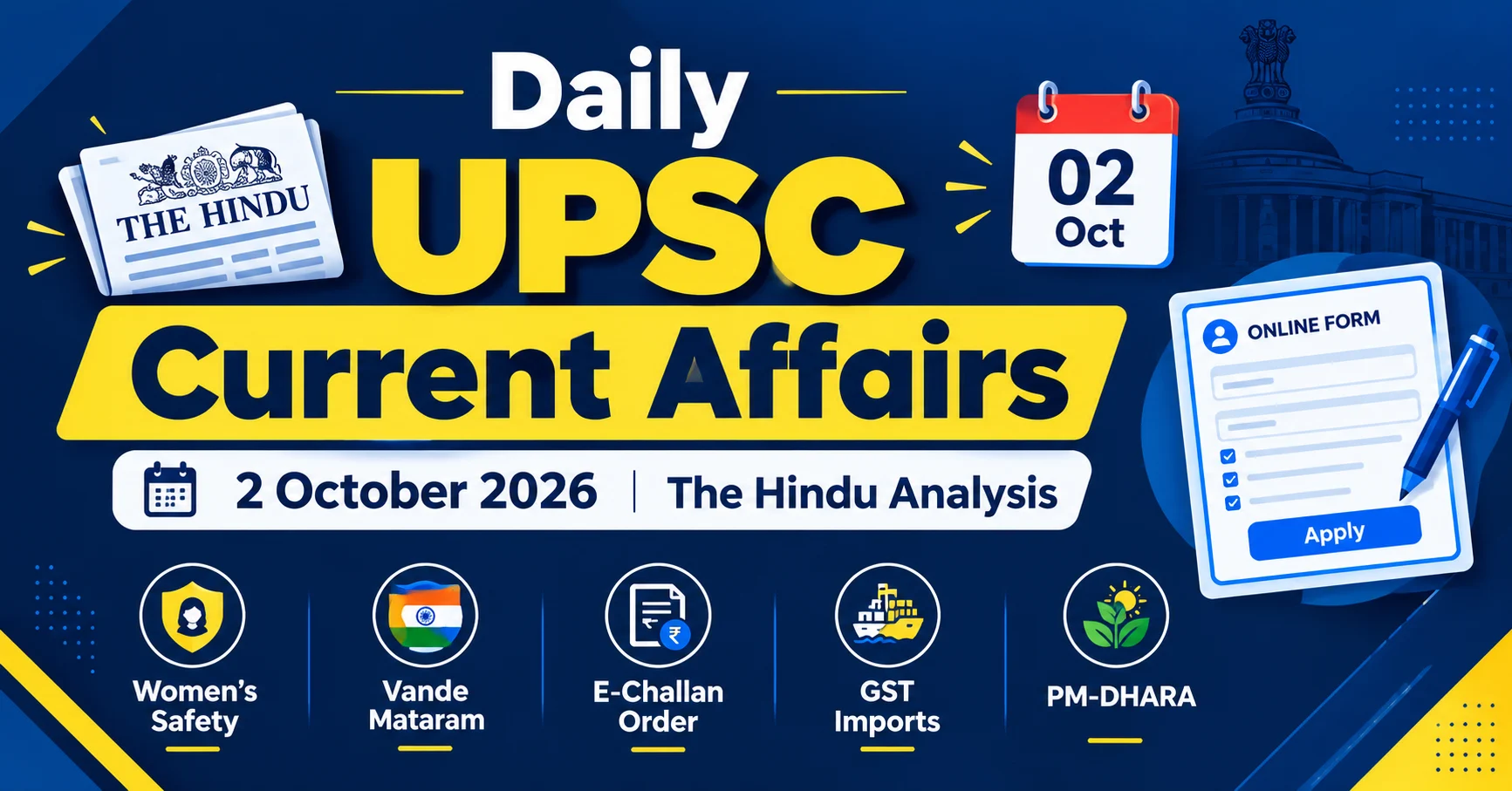
Today’s Daily UPSC Current Affairs from The Hindu and PIB covers five key issues: unsafe public spaces, the Vande Mataram and Vaishnava Jana To debate, the Supreme Court’s e-challan order, the rising import share in GST, and xenocortication. It also covers quick Prelims topics: Swyer Syndrome, PM-DHARA, National Coastal Mission 2.0, CHIME Telescope, the Iva and Misagh missiles, and the Schokari Sand Racer.
Daily UPSC Current Affairs | Overview
India woke up on 2 October to a mix of heavy governance questions and sharp science news. Gandhi Jayanti set the tone for a debate on nationalism, a Supreme Court order is about to change how traffic fines work, and GST data has turned up a surprising trend. This post gives you everything in one place, with the GS paper and the reason each topic matters.
| Topic | GS Paper | Why in News? (One Line) |
|---|---|---|
| Unsafe Public Places | GS 2 | Fresh sexual assault cases in Delhi reopen the question of why safety schemes are not working. |
| Vande Mataram vs Vaishnava Jana To | GS 2 | A Gandhi Jayanti reflection on two songs and two ideas of nationalism. |
| SC on Unpaid E-Challans | GS 2 | Supreme Court blocks licence renewal and vehicle transfer for those with pending fines. |
| Import Share in GST | GS 3 | Imports now make up a record 32.2% of gross GST revenue. |
| Xenocortication | GS 3 / GS 4 | Human brain tissue grown inside mice raises scientific and ethical questions. |
| Swyer Syndrome | Prelims | The Hindu explainer on a rare sex development condition. |
| PM-DHARA | Prelims | Cabinet clears a ₹1.86 lakh crore green energy transmission scheme. |
| National Coastal Mission 2.0 | Prelims | Guidelines launched for a ₹767 crore coastal scheme. |
| CHIME Telescope | Prelims | First standalone detection of hydrogen glow from the early universe. |
| Iva and Misagh Missiles | Prelims | Russia’s new shoulder-fired missile resembles Iran’s Misagh. |
| Schokari Sand Racer | Prelims | A snake seen in Kutch after 150 years. |
Daily UPSC Current Affairs | Unsafe Public Places: Why Restrictions on Women Are Not the Answer
Syllabus Mapping: GS Paper 2 – Issues relating to women, welfare schemes, governance, police and judiciary reforms.
Why in News?
Last month’s headlines were painful to read. A 17-year-old was gang-raped in Delhi’s Asta Kunj Park by three men posing as police personnel. A 16-year-old was gang-raped and murdered in Swaroop Nagar. Another 17-year-old was assaulted on a sleeper bus travelling from Greater Noida to Delhi. The Hindu’s editorial argues that the nation feels brief shock and then moves on. It also warns that the answer cannot be to tell women to stay indoors.
Core Facts & Background
Fourteen years after the Nirbhaya case, the question is what has really changed. The editorial points to the numbers.
| Data Point | Detail |
|---|---|
| Crimes against women, 2012 | About 2.4 lakh |
| Crimes against women, 2024 | About 4.4 lakh (an 80% rise since Nirbhaya) |
| Frequency in 2024 | More than 50 crimes every hour |
| Highest rates | Jaipur, Indore, Lucknow and Delhi |
Some of this rise comes from better reporting, helped by new laws and schemes. The editorial says that alone cannot explain such a big number.
The government’s response includes the Safe City project, Mission Shakti, a women’s helpline and emergency response support system, one-stop centres for survivors, and fast-track courts (many funded through the Nirbhaya Fund). The recent crimes show that implementation is the weak link, not the number of schemes.
Pros & Cons
| Strengths of the Present System | Gaps on the Ground |
|---|---|
| Many laws, schemes and funds already exist | Poor implementation of safety schemes |
| Dedicated support for survivors (one-stop centres, fast-track courts) | CCTV and lighting often exist but do not work or are not monitored |
| Helplines and emergency systems are in place | Police response can be slow and personnel are not always trained or sensitised |
| Rising reporting suggests more women are coming forward | Court backlog makes “speedy” justice a promise on paper |
| Unsafe urban design and a patriarchal mindset |
A worrying side-effect is that advice such as “avoid parks after dark” quietly shifts responsibility from offenders and institutions to women.
Way Forward
The editorial’s central idea is to move from scheme-based policing to outcome-based policing. In practice that means:
- Map vulnerable locations and conduct regular public safety audits with deadlines.
- Fix lighting and make CCTV functional, monitored and linked to a quick response system.
- Improve patrols so that they end in prompt action by trained, gender-sensitive police.
- Cut investigation and trial delays to clear the enormous case backlog.
- Hold authorities accountable for fixing the deficiencies identified in audits.
- Challenge patriarchal attitudes and toxic masculinity through long-term social change.
Quick memory trick: Active policing in vulnerable areas, working CCTV (monitoring), good street lights (patrolling), and a change in patriarchal mindset.
Daily UPSC Current Affairs | Vande Mataram and Vaishnava Jana To: Two Songs, Two Nationalisms
Syllabus Mapping: GS Paper 2 – Constitutional provisions (Articles 14, 51A), Fundamental Duties, national symbols and governance. Also useful for GS 1 (freedom movement) and Essay.
Why in News?
On Gandhi Jayanti, a column by Supreme Court advocate Sanjay Hegde asks what nationalism really means. He sets two songs side by side: the National Song Vande Mataram and Gandhi’s favourite bhajan Vaishnava Jana To. The timing is not accidental. The Vande Mataram rules have tightened this year, and the matter is now before the Supreme Court.
Core Facts & Background
The column traces the recent legal developments:
| When | What Happened |
|---|---|
| January 2026 | The Union Home Ministry directed that all six stanzas of the National Song be performed at official functions, with everyone standing. |
| July 2026 | A second order made the six-stanza text the “official version” and placed it before the National Anthem. |
| Later | Parliament amended the Prevention of Insults to National Honour Act, 1971, bringing the National Song under criminal law for the first time (intentionally preventing its singing or disturbing a gathering that is singing it). |
| 22 September | The Supreme Court heard musician T.M. Krishna’s challenge. Justice Joymalya Bagchi observed that the state may decide on two or six stanzas, but the Bijoe Emmanuel judgment on conscientious objection still holds. |
The history of Vande Mataram. Bankim Chandra Chatterjee wrote the first two stanzas around 1875. They describe the motherland as a landscape. The later stanzas came in his novel Anandamath and portray the motherland as the goddess Durga, Lakshmi and Saraswati. During the freedom movement, the song became a war cry of Swadeshi, and over time it became a point of religious discomfort for some groups.
The 1937 settlement. In October 1937, a resolution moved by Rajendra Prasad and seconded by Vallabhbhai Patel led the Congress Working Committee to adopt only the first two stanzas for national gatherings. Rabindranath Tagore, who first set the song to music, supported this approach. On 24 January 1950, President Rajendra Prasad declared that Jana Gana Mana would be the National Anthem and Vande Mataram would be honoured equally. Honour was meant to be respected, not legally enforced.
The other song. Vaishnava Jana To was composed by Narsinh Mehta of Junagadh in the 15th century. He was reportedly excommunicated by his own caste for singing among “untouchables”. The song’s core idea is that a true devotee understands and feels another person’s pain. Gandhi carried it to his prayer meetings. The author links its values to the Preamble, Article 14 (equality) and Article 51A (fundamental duties, including harmony and brotherhood).
Pros & Cons
| The Case for Legal Mandate | The Case Against |
|---|---|
| Builds a shared national identity and respect for symbols | Honour cannot be forced; compulsion turns love into obedience |
| Clear rules prevent deliberate insult | Criminal law may clash with freedom of conscience (Bijoe Emmanuel) |
| Highlights an important part of the freedom struggle | Ignores the 1937 compromise that took religious sensitivities into account |
Way Forward
The author’s “modest proposal” is simple: keep the National Anthem protected by law, keep the National Song honoured by usage, and let Vaishnava Jana To be recognised as a National Prayer without any penalty or compulsion. Schools can teach children the meaning in every language. In his view, nationalism is built by feeling “another’s pain”, not by standing in attention for 90 seconds.
Daily UPSC Current Affairs | Supreme Court Bars Licence Renewal for Motorists With Unpaid E-Challans
Syllabus Mapping: GS Paper 2 – Judiciary, governance, e-governance, role of technology in enforcement. Also relevant for road safety under GS 3.
Why in News?
Many of us have ignored an online traffic fine at some point. The Supreme Court has now said that this will cost you. A Bench of Justices J.B. Pardiwala and K.V. Viswanathan directed that vehicles with unpaid e-challans be blacklisted on the Central Parivahan portal, effectively stopping their sale or transfer until dues are cleared.
Core Facts & Background
| Point | Detail |
|---|---|
| Outstanding e-challans | About ₹49,194 crore across India |
| Recovered so far | About ₹26,175 crore |
| Blocked services | Registration renewal, fitness and PUC certificates, ownership transfer, driving licence renewal |
| Repeat violators | Authorities to withhold licence renewal and move to suspend existing licences |
| Detection | Electronic devices such as CCTV, speed cameras and speed guns |
| Dashboard | Ministry of Road Transport and Highways to run a public dashboard on electronic enforcement |
| Legal basis | Section 136A of the Motor Vehicles Act, 1988, with Rule 167A of the Central Motor Vehicles Rules, 1989 |
The Court also wants states to immediately implement the Ministry’s SOP of 28 October 2025, and to identify and notify locations for electronic enforcement. It further asked for random checks, and if an e-challan has not been honoured, the vehicle can be impounded. The order came in a road safety case pending since 2012, in which the Court has been monitoring implementation of the law. The Court also asked the Delhi government about steps taken on its 15 September directions on pedestrian safety near Mathura Road.
Pros & Cons
| Pros | Cons |
|---|---|
| Gives teeth to e-challans, which many people simply ignore | Wrong or disputed challans could block a citizen’s vehicle |
| Can improve revenue recovery and deter repeat offenders | Needs a reliable, error-free database across states |
| Promotes technology-based, transparent enforcement | Equipment procurement and calibration may be slow in some states |
| Encourages road safety | Digital divide and grievance redressal need attention |
Way Forward
- Build a quick, simple appeal and correction system for disputed challans.
- Make sure cameras are properly installed and calibrated.
- Keep the public dashboard updated for transparency.
- Combine strict enforcement with awareness and road engineering.
Daily UPSC Current Affairs | GST Revenue at ₹2.03 Lakh Crore: Why the Import Share Matters
Syllabus Mapping: GS Paper 3 – Indian economy, taxation, resource mobilisation, fiscal policy.
Why in News?
A headline number can hide a bigger story. India’s gross GST revenue rose to ₹2.03 lakh crore in September 2026, up 14.7% year-on-year. But an analysis of historical data shows that a rising share of this revenue comes from taxes on imports, while the share from domestic transactions has fallen to its lowest-ever level.
Core Facts & Background
| Indicator | Detail |
|---|---|
| Gross GST, September 2026 | ₹2.03 lakh crore (+14.7%) |
| Net GST growth | 18.1% |
| First half (Apr–Sep 2026) growth | 11.6% |
| Import-linked GST growth, Sept | 25.9% |
| Domestic GST growth, Sept | 10.1% |
| Share of imports | 32.2% (highest-ever) |
| Share of domestic | 67.8% (lowest-ever) |
| Total refunds | Down 3%, due to lower domestic refunds |
A tax expert quoted in the article said the sharp rise in import-linked GST reflects currency, commodity prices and import dynamics. Industry voices credited GST audits and fewer compliance complications for the stronger collections.
GST basics for Prelims and Mains:
- The 101st Constitutional Amendment Act, 2016 introduced GST, subsuming central taxes (Excise Duty, Additional Excise Duties, Service Tax) and state taxes (VAT, Central Sales Tax, Luxury Tax).
- GST is a value-added, destination-based consumption tax levied on the supply of goods and services.
- It has a dual structure: CGST and SGST on the same transaction, and IGST on inter-state supplies and imports, besides customs duties.
- After GST 2.0, the main slabs are 5% and 18%, plus 40% for luxury and sin goods.
- The GST Council recommends rates, and GSTN runs the IT system for the GST portal.
Simple example of value addition: A shopkeeper sells goods worth ₹1,000 and charges 18% GST (₹180). He earlier bought them from a wholesaler at ₹800 plus 18% GST (₹144). He claims credit for the ₹144 he already paid and deposits only the remaining ₹36. The tax is on the value he added.
Pros & Cons
| Positive Signals | Concerns |
|---|---|
| Strong revenue mobilisation, crossing the ₹2 lakh crore mark | Domestic share is falling and needs monitoring |
| Better compliance and audits are showing results | Import GST depends on commodity prices, exchange rates and import mix |
| Domestic GST growth is still among the fastest since August 2025 | Higher imports may not mean stronger domestic production |
Way Forward
Improve compliance and simplify procedures.
Strengthen technology-based tax administration.
Reduce tax evasion and fake invoices.
Ensure stable, broad-based growth in domestic GST.
Check whether growth comes from real economic activity or only temporary price and import effects.
Daily UPSC Current Affairs | Xenocortication: Human Brain Tissue Grown Inside Mice
Syllabus Mapping: GS Paper 3 – Science and technology, biotechnology. GS Paper 4 – Ethics in scientific research.
Why in News?
It sounds like science fiction. A Stanford University experiment, led by neuroscientist Sergiu Pasca and published in Nature in September, grew human brain tissue inside a living mouse. The technique is called xenocortication. The Hindu’s explainer says it offers a new way to study how the human brain develops, but also raises serious ethical questions.
Core Facts & Background
- Xeno means originating from another species; the cortex is the outer brain region linked to higher functions such as language and complex thinking.
- Researchers used human stem cells to make brain organoids, which are small lab-grown pieces of neural tissue that copy some features of early brain development.
- Mice were genetically engineered so that much of their own cortex could not form. The transplanted human tissue filled this empty space.
- The graft produced several human cortical cell types, became electrically active, connected to the mouse nervous system and was linked with measurable behavioural differences.
- In the experiment, the human tissue grew to about 92% of the animal’s cortical tissue within months, according to the article.
- Mice were also exposed to five hours of low oxygen. A molecular stress marker appeared in the human graft but not in the adjacent mouse brain. This shows the platform’s potential to study brain disorders involving oxygen deprivation.
- Behaviour was tracked with a machine-learning system called Motion Sequencing (MoSeq).
Important limitation: the human tissue stayed immature and did not form the layered structure of a normal cortex. The study cannot prove that human cells directly caused a particular behaviour.
Pros & Cons
| Potential Benefits | Ethical and Scientific Concerns |
|---|---|
| Studying how the human brain develops in a living system | Could grafts become more mature and better integrated in future? |
| Understanding neurodevelopmental and psychiatric disorders | At what point might an animal’s cognition or perception change in an ethically significant way? |
| Testing drugs and regenerative therapies | Experiments on primates will need much closer scrutiny |
| Offers a “third window” beyond patient studies and lab dishes | Results from a human-animal hybrid system cannot be treated as direct proof about the human brain |
Way Forward
- Adopt clear bioethics oversight before such research moves to more complex animals.
- Keep strict limits on how mature the grafts can become.
- Combine this technique with organoids and other methods to reduce reliance on animal models.
- Maintain transparency in publishing and public debate.
Daily UPSC Current Affairs | Prelims Fact File: Quick Topics for 2 October 2026
Swyer Syndrome
Syllabus Mapping: Prelims – Science and health.
Why in News?
The Hindu published an explainer on 1 October 2026.
Core Facts & Background:
Swyer syndrome is a rare difference of sex development (46,XY complete gonadal dysgenesis), affecting roughly one in 80,000 people. People have one X and one Y chromosome in every cell but develop female reproductive structures, because the sex glands (testes or ovaries) fail to develop. It is caused by disruption of the genetic pathway involved in testis development in the early embryo. They are genetically male but phenotypically female. It often goes unnoticed in childhood and is found in adolescence when puberty does not progress or menstruation does not begin (primary amenorrhoea).
| Pros / Management | Cons / Limits |
|---|---|
| Effects can be managed with hormone replacement therapy | No treatment can change the 46,XY pattern or turn streak gonads into functioning ovaries |
| Early diagnosis helps | Often detected late, in adolescence |
Way Forward: Better awareness and early screening, and sensitive counselling.
Daily UPSC Current Affairs | PM-DHARA (PM-Developing Harmonized and Accelerated Renewable-energy Access)
Syllabus Mapping: Prelims / GS 3 – Energy, infrastructure.
Why in News?
The Union Cabinet approved the scheme on 30 September 2026 with an outlay of about ₹1.86 lakh crore.
Core Facts & Background:
| Feature | Detail |
|---|---|
| Aim | Strengthen the Intra-State Transmission System (InSTS) to evacuate up to 135 GW of renewable energy |
| Storage | 50 GWh of Battery Energy Storage Systems (BESS) |
| Total outlay | ₹1,86,405 crore |
| InSTS under Green Energy Corridor Phase-III | ₹1,36,378 crore |
| BESS | ₹50,000 crore |
| Central Financial Support | ₹54,082 crore |
| Target | By FY 2032-33 |
| Mode | Greenfield: Tariff Based Competitive Bidding (TBCB); Brownfield and network strengthening: Cost Plus Basis |
| Agency | State Transmission Utilities, with Transmission Service Providers under the BOOM (Build-Own-Operate-Maintain) model |
Pros & Cons: The scheme can help move renewable power from generation sites to consumers and improve grid flexibility with storage. The challenge will be coordination between states, timely land and clearances, and delivering through competitive bidding.
Way Forward:
Ensure timely execution and match transmission capacity with new renewable generation.
Daily UPSC Current Affairs | National Coastal Mission 2.0 (NCM 2.0)
Syllabus Mapping: Prelims / GS 3 – Environment, coastal regions, blue economy.
Why in News?
Environment Minister Bhupender Yadav launched the implementation guidelines on 30 September 2026.
Core Facts & Background:
| Feature | Detail |
|---|---|
| Type | Central Sector Scheme |
| Outlay | ₹767 crore |
| Period | 2025-26 to 2030-31 |
| Earlier version | NCM 1.0 (2021-22 to 2025-26), now subsumed |
| Aim | Strengthen the resilience and sustainability of coastal regions and unlock the blue economy |
| Nodal Ministry | Environment, Forest and Climate Change |
| Coverage | 9 coastal States (Gujarat, Maharashtra, Goa, Karnataka, Kerala, Tamil Nadu, Andhra Pradesh, Odisha, West Bengal) and 4 UTs (Dadra & Nagar Haveli and Daman & Diu, Andaman & Nicobar Islands, Puducherry, Lakshadweep) |
Pros & Cons: It can support coastal resilience and livelihoods. The outlay is modest compared with the long coastline, so state-level delivery will matter.
Way Forward: Strong monitoring and convergence with state coastal plans.
CHIME Telescope
Syllabus Mapping: Prelims / GS 3 – Space science.
Why in News?
CHIME made its first standalone detection of the glow of hydrogen from a time when the universe was about five billion years old, according to PIB (30 September 2026). Researchers from India (including the Raman Research Institute) were part of the collaboration, and the study was published in The Astrophysical Journal.
Core Facts & Background:
| Feature | Detail |
|---|---|
| Full form | Canadian Hydrogen Intensity Mapping Experiment |
| Location | British Columbia, Canada; built in 2017 |
| Purpose | Map the distribution of hydrogen gas in the early universe |
| Design | Four massive parabolic radio antennas, 400–800 MHz; no moving parts, uses signal processing to point digitally |
| Coverage | Receives signals from half the sky as the Earth rotates |
| Data | A correlator handles about 7 terabits per second |
| Other use | Detecting Fast Radio Bursts (FRBs) |
Pros & Cons: The result opens a faster and cheaper way to study dark energy. It is still an early step, and more data is needed.
Way Forward: More international collaboration and data analysis.
Daily UPSC Current Affairs | Iva and Misagh Missiles
Syllabus Mapping: Prelims – Defence and international relations.
Why in News?
Russian troops were reportedly seen in Rostov carrying a new shoulder-fired missile called Iva. Analysts say it looks closer to Iran’s Misagh or the Chinese QW series than to Russia’s Igla and Verba.
Core Facts & Background:
Iva is said to have a different grip, a single-flip safety switch and no Russian serial numbers, which has raised speculation about deeper Iran–Russia defence ties. Misagh is an Iranian man-portable, infrared-guided surface-to-air missile, a variant of China’s QW-2 Vanguard. Misagh-2 weighs 11.32 kg at launch (warhead 1.42 kg, system 18 kg), engages approaching targets up to 6 km and receding targets up to 5.2 km, and is effective up to about 2.5 km altitude against jets (3.5 km against helicopters and subsonic aircraft). It has a dual-band passive IR seeker and is a fire-and-forget weapon, resistant to flares.
Pros & Cons:
Such systems are strong against low-flying aircraft. The link between Russia and Iran remains speculation based on media reports.
Way Forward: Watch for official confirmation.
Daily UPSC Current Affairs | Schokari Sand Racer
Syllabus Mapping: Prelims – Environment and biodiversity.
Why in News?
A forest patrol in Gujarat’s Kutch photographed this snake after it had not been conclusively recorded in the region for more than 150 years.
Core Facts & Background
: Also called the Afro-Asian sand snake (Psammophis schokari), it is an extremely fast, diurnal snake adapted to deserts. It is mildly venomous and poses little danger to people, feeding on lizards and rodents. It is typically 100–120 cm long, with a slender, glossy body, sandy, olive or grey-brown colour with dark stripes and a pale belly. In India it is reported only from Rajasthan and Kutch. IUCN status: Least Concern.
Pros & Cons:
The sighting shows the value of routine patrols for biodiversity records. Desert habitats remain under pressure.
Way Forward: Continue field surveys and habitat protection in arid zones.
Daily UPSC Current Affairs | FAQs
Q1. What are the most important topics in UPSC Current Affairs for 2 October 2026?
The key topics are women’s safety in public spaces, the Vande Mataram debate, the Supreme Court’s e-challan order, the rising import share in GST and xenocortication.
Q2. What is the main message of the editorial on unsafe public places?
It argues that the answer to sexual violence is not to restrict women but to shift to outcome-based policing, with working CCTV and lighting, quick response and a change in patriarchal attitudes.
Q3. What did the Supreme Court order on unpaid e-challans?
It directed states and UTs to block services such as licence renewal, registration renewal and ownership transfer for vehicles with unpaid e-challans, and to blacklist them on the Parivahan portal.
Q4. Why is the rising import share in GST important?
Imports now account for 32.2% of gross GST revenue, the highest ever. This can be influenced by commodity prices and exchange rates, so it does not necessarily show stronger domestic activity.
Q5. What is xenocortication?
It is a technique in which human brain tissue grown from stem cells is transplanted into a living animal, such as a mouse, to study brain development and disease.
Q6. What is PM-DHARA?
It is a ₹1.86 lakh crore scheme approved by the Cabinet to strengthen intra-state transmission and add 50 GWh of battery storage, enabling evacuation of up to 135 GW of renewable energy.
Q7. What is Swyer syndrome?
A rare condition in which a person with XY chromosomes develops female reproductive structures because the gonads do not develop. It is managed with hormone replacement therapy.
Previous Post >>