Daily UPSC Current Affairs | Today 24 September 2026 – The Hindu Analysis
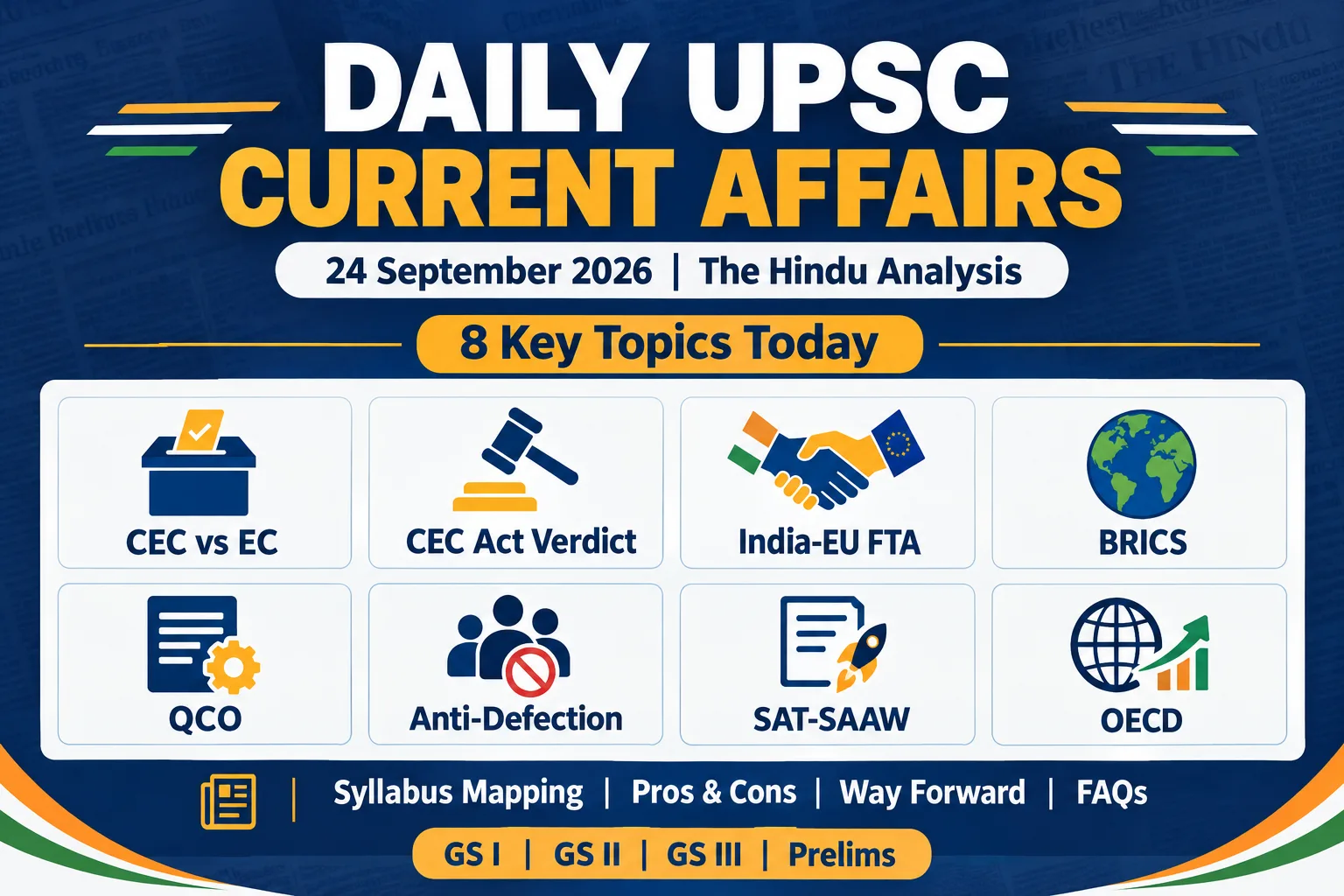
Today’s Hindu analysis covers eight exam-relevant stories: the CEC vs Election Commissioners controversy, the split verdict on the CEC Appointment Act, the India-EU FTA signing date, BRICS and strategic autonomy, quality control orders, the Speaker’s role in anti-defection cases, the SAT-SAAW glide bomb deal and the OECD’s new India forecast. Each topic comes with syllabus mapping, key facts, pros and cons and a way forward.
Daily UPSC Current Affairs | Introduction
Some days the newspaper is quiet. Today is not one of those days. An investigation has put the country’s poll body under the scanner, a Supreme Court bench has split on who should pick the Election Commissioners, and India and the EU have fixed a date to seal their long-awaited trade pact. Add BRICS, quality standards, a defence deal and a fresh growth forecast, and you have a packed day for UPSC preparation. Here is the full breakdown, written to be read once and remembered.
Daily UPSC Current Affairs | Overview
| Topic | Syllabus | Why in News? (one line) |
|---|---|---|
| CEC vs EC Controversy | GS II | Two ECs reportedly objected on record at least 14 times; Opposition demands CEC’s removal |
| Split Verdict on CEC Appointment Act | GS II | Two judges differ on referring the 2023 Act’s challenge to a Constitution Bench |
| India-EU Trade Deal | GS II | FTA signing scheduled for 16 December 2026 |
| India and BRICS Multilateralism | GS II | Lessons from the 18th BRICS summit in New Delhi |
| Quality Control and Manufacturing Growth | GS III | QCO reassessment and the new Transition Facilitation Order, 2026 |
| Speaker’s Power in Anti-Defection Case | GS II | SC declines to set a deadline for Speaker on 20 rebel TMC MPs |
| SAT-SAAW | Prelims | ₹810.79 crore deal for 160 glide bombs for the IAF |
| OECD | Prelims | OECD raises India’s 2026-27 growth forecast to 7.1% |
Daily UPSC Current Affairs | CEC vs EC Controversy – Heading & Syllabus Mapping
| Heading | Syllabus Mapping |
|---|---|
| CEC vs Election Commissioners: Who Decides in the Election Commission? | GS Paper II: Constitutional bodies, appointments, electoral reforms, Representation of the People Act |
Why in News?
Imagine a three-member team where two members say, again and again, that big decisions are being taken in the team’s name without them even knowing. That is what an Indian Express investigation claims about the Election Commission of India (ECI). According to the report, Election Commissioners Sukhbir Singh Sandhu and Vivek Joshi formally recorded objections at least 14 times over 10 months, calling several decisions “unauthorised and illegal”. On Wednesday, Opposition parties sought the removal of Chief Election Commissioner (CEC) Gyanesh Kumar. The EC replied that all its actions follow the relevant laws and that isolated internal notes show only “one part of the picture”.
Core Facts & Background
What the report flags
| Issue Raised | Detail |
|---|---|
| Centralisation of electoral database | Concern over control of the roll database |
| Alteration of Form 6 | Mr. Joshi warned in May that the form for new voters could not be altered without amending rules |
| Appeals against voter inclusion | Mr. Sandhu asked who authorised the EC to file appeals against voters whom tribunals had already included; 38 lakh appeals are pending |
| ERONet access | Field officials reportedly lacked complete access to the portal |
| Goa | 97 eligible voters reportedly left out of the roll |
Reactions: Rahul Gandhi called “vote chori” a crime and an attack on the Constitution. Congress leader K.C. Venugopal demanded a Supreme Court-monitored probe. Mamata Banerjee said the INDIA bloc would meet to decide its next step.
Constitutional background you must know
- ECI is a constitutional body under Part XV (Articles 324-329). It conducts elections to the Lok Sabha, Rajya Sabha, State Legislative Assemblies and the offices of President and Vice-President. Panchayat and municipal polls belong to State Election Commissions. It was set up on 25 January 1950 (celebrated as National Voters’ Day).
- The Commission has the CEC plus such number of ECs as the President fixes. It began with one Commissioner and later became a multi-member body. At present it has three members of equal rank; the CEC is first among equals and cannot decide alone.
- Appointment: by the President. After the Anoop Baranwal case (2023), the Supreme Court set up a PM, CJI and Leader of Opposition committee, until the CEC and Other ECs (Appointment, Conditions of Service and Term of Office) Act, 2023 replaced the CJI with a Union Cabinet Minister.
- Tenure: not in the Constitution; the 2023 Act fixes 6 years or 65 years, whichever is earlier. No reappointment, but a retiring EC can take further government appointments.
- Removal: CEC is removed like a Supreme Court judge (proved misbehaviour or incapacity). ECs can be removed only on the CEC’s recommendation. Any of them can resign anytime.
- Section 18 of the 2023 Act: business is to be transacted unanimously as far as possible; if members differ, the majority prevails; procedure and division of work can be set only by unanimous decision. The CEC has no overriding power.
Profiles in the news
| Commissioner | Joined as EC | Background |
|---|---|---|
| Sukhbir Singh Sandhu | 15 March 2024 | 1988-batch IAS (Uttarakhand); ex-Chief Secretary; ex-NHAI Chairman |
| Vivek Joshi | 19 February 2025 | 1989-batch IAS (Haryana); ex-Chief Secretary |
Pros & Cons
| Institutional Strengths | Concerns Raised |
|---|---|
| Constitutional status under Article 324 | Alleged decisions in the “full EC’s” name without two members’ knowledge |
| Collegiate rule: majority prevails under Section 18 | Centralised roll database and access issues |
| Fixed tenure and judge-like removal protection for the CEC | Public trust in EC’s neutrality questioned |
| EC states its actions follow law | Opposition alleges misconduct; demands SC-monitored probe |
Way Forward
- Independent audit of the electoral roll database, as Mr. Joshi had proposed.
- Follow Section 18 in letter and spirit, and record dissent openly.
- Clear rules on who can authorise appeals and changes to forms.
- Full ERONet access for statutory authorities such as Electoral Registration Officers.
Practice Questions
- Prelims (2017 PYQ): The Election Commission is a five-member body? False. Correct answer: (d) 3 only (EC resolves disputes on splits/mergers of recognised parties).
- Mains (2022 PYQ): Discuss the role of the Election Commission of India in the light of the evolution of the Model Code of Conduct.
Daily UPSC Current Affairs | Split Verdict on CEC Appointment Act – Heading & Syllabus Mapping
| Heading | Syllabus Mapping |
|---|---|
| Should a Minister Sit on the CEC Selection Panel? | GS Paper II: Separation of powers, independence of constitutional bodies, judiciary |
Why in News?
Think of a cricket match where the captain of one team picks the umpire. Even if every decision is correct, doubts will linger. That was the heart of a Supreme Court judgment on Wednesday. Justice Dipankar Datta said that replacing the CJI with a Union Cabinet Minister on the PM-led panel amounts, prima facie, to an effective veto in favour of the Union government and fails the “perception test”. His colleague Justice Satish Chandra Sharma wanted the case sent to a Constitution Bench. The bench therefore delivered a split verdict.
Core Facts & Background
- Question: Whether the challenge to the 2023 Act should be referred to a Constitution Bench.
- Justice Datta: Independence of the ECI is part of the Basic Structure; the EC must not only be independent but also appear independent. A Minister is unlikely to defy the PM, and the LoP’s role becomes “merely ornamental”. He saw no need for a reference.
- Justice Sharma: Several questions of substantial importance justify a Constitution Bench.
- Counter-point noted: The PM and Cabinet Ministers share collective responsibility under Article 75(3).
- Panel then vs now:
| Feature | Anoop Baranwal (2023) Committee | CEC Act, 2023 Panel |
|---|---|---|
| Members | PM, Leader of Opposition, CJI | PM, Leader of Opposition, Union Cabinet Minister |
| Appointing authority | President | President |
- The same panel chose Mr. Gyanesh Kumar as CEC.
Pros & Cons
| Case for the 2023 Act | Case Against |
|---|---|
| Ministers also share collective responsibility (Art. 75(3)) | Government-majority panel; LoP’s vote cannot prevail |
| Law made by Parliament, not by judicial interim arrangement | Fails the “perception test” of independence |
| Selection by elected representatives | Independence of ECI is part of the Basic Structure |
Way Forward
- A Constitution Bench should settle the issue quickly.
- Consider a broader, more balanced selection panel.
- Publish reasons for shortlisting to build public trust.
Daily UPSC Current Affairs | India-EU Trade Deal – Heading & Syllabus Mapping
| Heading | Syllabus Mapping |
|---|---|
| India-EU FTA: Countdown to the “Mother of All Deals” | GS Paper II: Bilateral groupings and agreements, India’s foreign trade relations |
Why in News?
After years of stop-start talks, the finish line is in sight. Two diplomatic sources told The Hindu that the India-EU Free Trade Agreement will be signed on 16 December 2026 in Brussels, in the presence of PM Narendra Modi.
Core Facts & Background
| Point | Detail |
|---|---|
| Talks restarted | June 2022, after a long hiatus |
| Negotiations concluded | January 2026 |
| EU’s offer | Drops tariffs on 99.5% of Indian exports to the region; most go to 0% immediately |
| India’s offer | Tariff concessions on 97.5% of traded value |
| Next steps | European Parliament passage (1-2 months), then “early 2027” roll-out |
| Ratification | No separate approval by each EU country once the European Council clears it |
- Contentious issues were left out so that “the best does not become the enemy of the good”.
- Travel plan: Mr. Modi is expected to visit Canada (around 12 December), then the G-20 Summit in Miami, followed by Belgium. Canada’s PM Mark Carney said trade talks had made “good progress”.
Pros & Cons
| Pros | Cons / Watch Points |
|---|---|
| Near-zero tariffs on almost all Indian exports | Deal excludes contentious issues for now |
| Wider market access for Indian exporters | India also opens up 97.5% of traded value to EU goods |
| Boosts India’s diversification of trade partners | Still needs European Parliament approval |
Way Forward
- Prepare exporters to use the concessions from day one of roll-out.
- Build capacity in MSMEs to meet EU standards.
- Address the left-out contentious issues in future rounds.
Daily UPSC Current Affairs | India and BRICS Multilateralism – Heading & Syllabus Mapping
| Heading | Syllabus Mapping |
|---|---|
| India and the Plausible Multilateralism of BRICS | GS Paper II: Groupings affecting India’s interests, effect of policies of other countries |
Why in News?
BRICS meetings always spark heated debate in India. Optimists see a tool to reshape the global order; sceptics fear Russian and Chinese dominance; a third camp dismisses it as an annual talk-shop. The 18th BRICS summit (New Delhi, 12-13 September 2026) was the first annual summit since the U.S. and Israel began bombing Iran on 28 February 2026. An op-ed argues it shows how India can use BRICS to protect its strategic autonomy.
Core Facts & Background
- Delhi Declaration: Consensus among 11 member-countries, including the UAE and Iran, who are in an undeclared conflict. The summit hosted the Presidents of Russia, China and Iran.
- Balancing act: India first held back from condemning attacks on Iran, then repositioned itself as a balancer. It backed the SCO’s Bishkek resolution condemning the strikes.
- Platform for talks: A UAE-Iran bilateral was held on the summit’s sidelines, and forums like BRICS keep India and China engaged despite border tensions.
- Washington factor: On 16 September the U.S. House passed the Russia sanctions Bill seeking tariffs of up to 100% on some countries, including India.
- Class takeaways: BRICS is not anti-US and not a Russia-China-dominated bloc; India uses it for multi-alignment, not de-dollarisation.
Pros & Cons
| Benefits for India | Challenges |
|---|---|
| Platform to engage China, Russia, Iran and other emerging powers | India-China border tensions can limit cooperation |
| Strengthens India’s voice for the Global South | Russia-West tensions divide the group |
| Backs reform of global governance institutions | Risk of being seen as a “counterweight to the West” |
| Extra diplomatic channels for countries in dispute | Consensus among 11 diverse members is hard |
| Supports multi-alignment over dependence on one bloc | Declarations must turn into concrete institutional outcomes |
Way Forward
- Keep strategic autonomy and multi-alignment as the anchor.
- Use BRICS for cooperation without turning it into an anti-Western alliance.
- Use it alongside G20, SCO, Quad, UN and bilateral diplomacy.
- Push practical cooperation in trade, finance, technology and climate.
Daily UPSC Current Affairs | Quality Control and Manufacturing Growth – Heading & Syllabus Mapping
| Heading | Syllabus Mapping |
|---|---|
| Quality Control Orders (QCOs): Protecting Consumers Without Choking Manufacturers | GS Paper III: Indian economy, industrial policy, manufacturing, MSMEs |
Why in News?
Quality is a good thing until the paperwork slows down the factory. Concerns over India’s QCOs were raised even at the WTO’s eighth Trade Policy Review of India (July 2026), by the EU, the U.S., Brazil, China and Indonesia. Meanwhile, the government notified the Transition Facilitation (Quality Control) Order, 2026 on 25 June 2026, and an op-ed by researchers Prerna Prabhakar and Nancy Gupta says the QCO reassessment must go further.
Core Facts & Background
- QCOs make BIS (Bureau of Indian Standards) certification mandatory for notified products.
- Products under QCOs rose from 88 (2019) to 765 (December 2024). The pace slowed towards the end of 2025 as several QCOs, mainly on intermediate goods, were revoked or suspended.
- Transition Facilitation Order, 2026 (DPIIT): allows eligible firms struggling to get BIS Scheme-I certification to source temporarily from Scheme-II licensed suppliers in specified sectors such as toys, footwear and air conditioners, after committee approval.
- 600+ QCO-covered products are still to be reassessed, including chemicals, steel, textiles, machinery, electronics and rubber and plastics.
What the CSEP chemicals study found
| Finding | Number |
|---|---|
| Chemical products under QCOs (2024) | 52 |
| Chemical-using firms exposed on input side | 11.8% (2019) to 56.6% (2024) |
| Larger firms: output change | +9.6% production |
| Larger firms: value added | -37% GVA |
| Smaller firms: profitability | -47.6% |
Class illustration (GVA): If output value rises from ₹100 to ₹110 but input cost jumps from ₹60 to ₹90, GVA falls from ₹40 to ₹20. Likewise, a ₹10 lakh certification cost is ₹1 per unit for a firm making 10 lakh units, but ₹100 per unit for an MSME making 10,000 units.
Pros & Cons
| Benefits | Challenges |
|---|---|
| Protects consumers from substandard products | Higher compliance and input costs, especially on intermediate goods |
| Improves quality and safety | Certification delays cause supply-chain disruption |
| Helps meet international standards and enter global value chains | MSMEs struggle to absorb costs |
| Curbs unfair competition from low-quality goods | Larger firms also see lower value addition |
Way Forward
- Do a supply-chain impact assessment before introducing any QCO.
- Give special attention to intermediate goods.
- Offer transition periods and temporary alternatives where supply is genuinely short.
- Help MSMEs with certification and compliance.
- Review existing QCOs periodically and judge them by quality gains, not by the number of products regulated.
Daily UPSC Current Affairs | Speaker’s Power in Anti-Defection Case – Heading & Syllabus Mapping
| Heading | Syllabus Mapping |
|---|---|
| Speaker, Tenth Schedule and the Deadline Debate | GS Paper II: Parliament, functions and conduct of business, Speaker’s role, judiciary |
Why in News?
Can the Supreme Court tell the Lok Sabha Speaker how fast to decide? On Wednesday, a three-judge Bench headed by CJI Surya Kant stopped short of setting a specific timeline for Speaker Om Birla to decide disqualification proceedings against 20 rebel Trinamool Congress MPs who have aligned with the Nationalist Citizens Party of India (NCPI). The plea was filed by TMC leader Abhishek Banerjee.
Core Facts & Background
- Government’s stand: Solicitor General Tushar Mehta urged the Court not to fix the Speaker’s schedule.
- Rebels’ stand: Their counsel said the three-month limit in Keisham Meghachandra Singh applies only to “complete inaction”.
- Court’s record: Rebels intend to file replies in four weeks; the case is posted after that. Justice Joymalya Bagchi called the Speaker’s role “amphibious”: part of the House, and a Tribunal under the Tenth Schedule.
Anti-defection law basics
- Added by the 52nd Constitutional Amendment (1985) as the Tenth Schedule; the 91st Amendment removed the “split” exception (one-third).
- Only a merger (2/3rd of legislators, Para 4) escapes disqualification.
- Grounds: voting or abstaining against the party whip; voluntarily giving up party membership; an independent joining a party; a nominated member joining a party after six months.
Key judgments
| Case | Ruling |
|---|---|
| Kihoto Hollohan v. Zachillhu (1993) | Upheld the Tenth Schedule; Speaker’s decisions are subject to judicial review; Speaker acts as a tribunal |
| Rajendra Singh Rana v. Swami Prasad Maurya (2007) | Judicial review allowed when the Speaker fails to act, accepts splits/mergers without reasons, or violates the Schedule; ignoring a petition is a constitutional breach |
| Keisham Meghachandra Singh v. Speaker (2020) | Speaker should ordinarily decide within a reasonable period, around three months, barring exceptional cases |
Pros & Cons
| Arguments for Fixing a Timeline | Arguments Against |
|---|---|
| Delay can defeat the purpose of the law | Court monitoring is “not necessary” (SG) |
| Precedent already suggests about three months | Speaker holds a constitutional office with discretion |
| Prevents rebels from enjoying office while cases drag | Timeline is meant only for cases of “complete inaction” |
Way Forward
- Speakers should decide within a reasonable period, roughly three months.
- Reasoned orders on splits and mergers.
- Consider an independent tribunal to remove the “referee-and-player” tension (analysis point for Mains).
Daily UPSC Current Affairs | SAT-SAAW – Heading & Syllabus Mapping
| Heading | Syllabus Mapping |
|---|---|
| SAT-SAAW Glide Bomb Deal | Prelims: Defence technology, Science & Tech; GS III: Indigenisation of defence |
Why in News?
The Ministry of Defence signed a ₹810.79-crore contract with Bharat Dynamics Limited (BDL) on Wednesday for 160 Satellite Smart Anti-Airfield Weapons (SAT-SAAW) and associated equipment for the Indian Air Force. Defence Secretary Rajesh Kumar Singh was present.
Core Facts & Background
| Fact | Detail |
|---|---|
| Full form | Satellite Smart Anti-Airfield Weapon |
| Type | Air-to-ground, precision-guided glide bomb |
| Role | Neutralise enemy airfields from stand-off range |
| Procurement category | Buy (Indian-IDDM): Indigenously Designed, Developed and Manufactured |
| Maker | Bharat Dynamics Limited |
| User | Indian Air Force |
Pros & Cons
| Pros | Points to Watch |
|---|---|
| Enhances stand-off precision strike capability | Delivery timelines for 160 units |
| Indigenous design boosts Atmanirbharta | Integration with IAF platforms |
Way Forward
- Deliver on schedule to build confidence in Buy (Indian-IDDM) projects.
- Continue indigenous development of precision-guided munitions.
Daily UPSC Current Affairs | OECD – Heading & Syllabus Mapping
| Heading | Syllabus Mapping |
|---|---|
| OECD and India’s 7.1% Growth Forecast | Prelims: International organisations; GS III: Indian economy |
Why in News?
The Organisation for Economic Co-operation and Development (OECD) has raised India’s growth forecast for 2026-27 to 7.1%, up from 6.3% in June, in its Economic Outlook Interim Report (September 2026). It follows upgrades by Moody’s, S&P Global and Fitch last week. The report credits domestic demand and government policy for cushioning India from higher energy prices during the West Asia crisis.
Core Facts & Background
| Point | Detail |
|---|---|
| Full form | Organisation for Economic Co-operation and Development |
| Origin | Grew from the OEEC, created after World War II to run the Marshall Plan aid |
| Convention signed | Paris, 14 December 1960 |
| Came into force | 30 September 1961 |
| Headquarters | Château de la Muette, Paris, France |
| Members | 38 (2026); 20 founding members (1961) and 18 later joiners (1964-2021) |
| Latest member | Costa Rica (2021), fourth Latin American member |
| Accession candidates | Argentina, Brazil, Bulgaria, Croatia, Indonesia, Peru, Romania |
| Key partners | India, China, Brazil, Indonesia, South Africa |
| Secretariat | Headed by the Secretary-General; 3,500+ staff |
| Reports | Government at a Glance, Better Life Index |
India and the OECD: India is not a member but a key partner. It supports the 15% global minimum corporate tax and takes part in the OECD/G20 Inclusive Framework on BEPS.
Pros & Cons
| Pros of the Partnership | Cons |
|---|---|
| Cooperation on tax, investment, digital economy and education | No membership, so limited say in decisions |
| Policy advice has helped governance and business climate | Some prescriptions may not fit emerging-economy priorities |
Way Forward
- Keep deepening key-partner engagement.
- Shape OECD standards through G20 platforms while protecting India’s development priorities.
Daily UPSC Current Affairs | FAQs
Q1. Who appoints the Chief Election Commissioner of India?
The President appoints the CEC and ECs, on the recommendation of a selection panel under the CEC Act, 2023.
Q2. What does Section 18 of the CEC Act, 2023 say?
Business is transacted unanimously as far as possible. If members differ, the majority opinion prevails. Procedure and division of work require unanimous decision.
Q3. When will the India-EU FTA be signed?
It is scheduled for 16 December 2026, after which the European Parliament will take one to two months to clear it.
Q4. What is SAT-SAAW?
It is an air-to-ground precision-guided glide bomb meant to hit enemy airfields from stand-off range. BDL will supply 160 units to the IAF.
Q5. Is India a member of the OECD?
No. India is a key partner. The OECD has 38 member countries.
Q6. Can courts fix a deadline for the Speaker in disqualification cases?
Courts can review the Speaker’s decisions, and Keisham Meghachandra suggests about three months, but in this case the Supreme Court declined to set a specific timeline.
Previous Post >>