Daily UPSC Current Affairs | Today 19 September 2026 – The Hindu Analysis
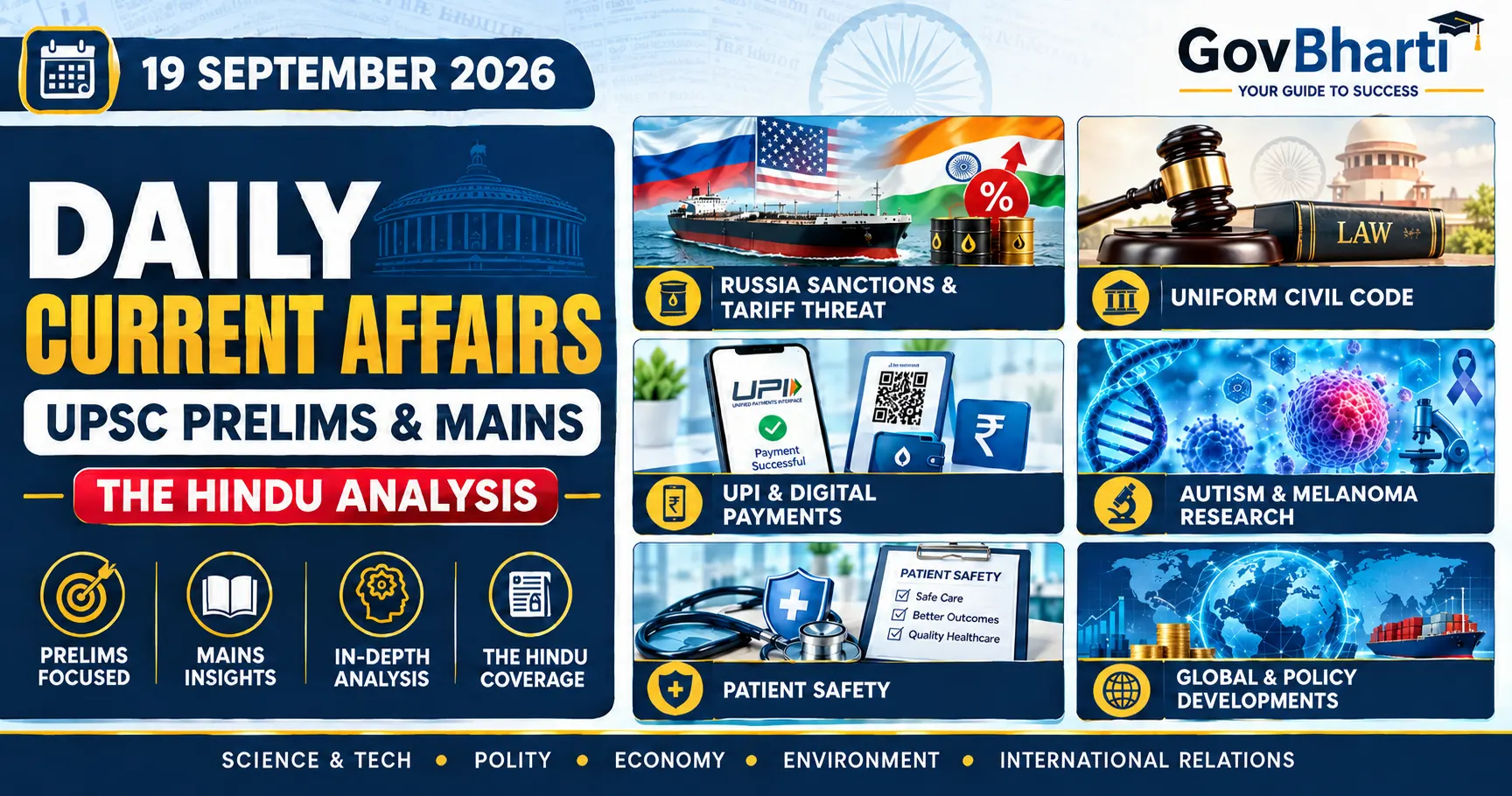
The U.S. House of Representatives has cleared a bill that could slap tariffs of up to 100% on countries buying Russian oil, and India finds itself squarely in the crosshairs. On the same day, the Reserve Bank’s UPI merchant fee rollout ran into fresh complications, the Home Minister reignited the Uniform Civil Code debate, and the health ministry drew a hard line on unproven stem-cell “cures” for autism. Add a sharp piece on why melanoma is diagnosed dangerously late in India, and a World Patient Safety Day reminder that safety is about far more than a checklist — and you have a genuinely GS II/III-heavy news day. Here’s the full breakdown.
Daily UPSC Current Affairs | Overview
| Topic | GS Paper Relevance | Why in News (One Line) |
|---|---|---|
| Russia-Iran Sanctions Act 2026 | GS II (IR), GS III (Economy) | US House passed a bill authorising up to 100% tariffs on top buyers of Russian oil, putting India at risk |
| A “War Room” for the Age of Sanctions | GS II (IR), GS III (Economy) | Editorial argues India needs one coordinating body to manage “weaponised interdependence” and secondary sanctions |
| Complex MDR Structure on UPI | GS III (Economy) | New Merchant Discount Rate rules from October 15 create confusing slabs, exemptions, and compliance headaches |
| Uniform Civil Code Debate | GS II (Polity) | Amit Shah reaffirms UCC rollout in all 21 NDA-ruled states by 2029, reviving the constitutional debate |
| Autism & Stem Cell Therapy Advisory | GS II (Health), Prelims | Health Ministry restricts stem cell therapy for autism to approved clinical trials only, citing no supporting evidence |
| Melanoma in India | GS III (Science & Tech, Health) | Oncologist flags why this skin cancer is caught late in Indian patients despite new precision-medicine breakthroughs |
| Patient Safety Day 2026 | GS III (Health) | WHO’s September 17 theme, “safe care for non-communicable diseases,” pushes hospitals beyond routine checklists |
Daily UPSC Current Affairs | Russia-Iran Sanctions Act 2026
Why in News?
Imagine your country’s biggest oil supplier suddenly becomes a diplomatic liability — not because you did anything wrong, but because a law passed on the other side of the planet decided your trade relationship was now a problem. That’s roughly the position India woke up to this week. The U.S. House of Representatives passed the “Lindsey O. Graham Sanctioning Russia and Iran Act of 2026,” an amendment that could authorise tariffs of up to 100% on countries that keep buying Russian crude. And India, which has quietly become one of Russia’s largest oil customers since the Ukraine war began, is one of the most exposed economies on that list.
Core Facts & Background
The bill cleared the House by a 262–159 vote, following an earlier Senate passage of 86–11. It now heads to President Trump’s desk, and the White House has already signalled the President intends to sign it into law. The Act targets the top five countries that were the largest importers, by volume, of Russian-origin crude oil or natural gas in the twelve months before the law takes effect — and continued buying oil after the law becomes binding. It also goes after Russia’s so-called “shadow fleet,” a network of tankers, insurers, and intermediaries used to move sanctioned oil while dodging detection.
Here’s the number that should worry Indian policymakers: Russia accounted for over 51% of India’s total oil imports in July 2026, an all-time high, up from just under 50% the previous month. India imported 110.4 lakh tonnes of Russian oil that month alone, worth roughly $7.3 billion — more than double what it spent a year earlier. The discount India gets on Russian crude has narrowed too, but it’s still cheaper than alternatives, which is exactly why New Delhi has been reluctant to walk away from the relationship.
| Key Fact | Detail |
|---|---|
| Bill Name | Lindsey O. Graham Sanctioning Russia and Iran Act of 2026 |
| House Vote | 262–159 |
| Senate Vote | 86–11 |
| Maximum Tariff Authorised | Up to 100% |
| India’s Russian Oil Share (July 2026) | Over 51% of total oil imports |
| Target Mechanism | Top 5 countries by volume of Russian oil/gas purchases |
Pros & Cons
Arguments Supporting the U.S. Move:
- Aims to cut off financing for Russia’s war effort by squeezing its largest revenue source
- Targets the “shadow fleet” directly, closing a loophole nations have used to evade earlier sanctions
- Sends a unified signal from both chambers of Congress, reducing ambiguity about U.S. intent
Concerns and Criticism:
- Several senators, across party lines, opposed the bill over its sweeping presidential powers and the cost it could impose on American consumers via retaliatory trade friction
- India has stated the sanctions have real implications for the bilateral relationship and for energy markets, and that it remains committed to protecting its own energy security
- China has already rejected the tariff threat as unwarranted “long-arm jurisdiction,” and the Kremlin has called the bill an “unfriendly action” that could complicate Ukraine peace efforts
Way Forward
For India, the response cannot simply be “wait and watch.” Diversifying crude sources further, accelerating trade talks with Washington to carve out exemptions, and building institutional capacity to track exactly which shipments and banks are exposed to secondary sanctions will matter more than public statements. This story is also a preview of the broader “weaponised interdependence” theme covered in the next topic — worth reading together.
Daily UPSC Current Affairs | A “War Room” for India in the Age of Sanctions
Why in News?
A single tanker crossing the Strait of Hormuz. A bank wire moving through New York. An insurer in London deciding whether to cover a shipment. None of these sit under one ministry’s watch in India — yet together, they can decide whether a barrel of oil reaches an Indian refinery or gets stranded at sea. A recent Hindu op-ed by a former Indian diplomat argues that this fragmented response is no longer good enough in what he calls “the age of sanctions.”
Core Facts & Background
The piece explains a concept scholars call weaponised interdependence — the idea that whoever controls a critical global network (the dollar payment system, insurance markets, shipping registries, chip supply chains) can pressure any country that depends on that network, even without firing a shot. Sanctions today come in two broad flavours:
- Direct sanctions, aimed squarely at a targeted country — for instance, the U.S. sanctions on Russia and Iran.
- Secondary sanctions, which threaten third parties (like Indian banks, shippers, or companies) with loss of access to American finance if they keep dealing with the sanctioned country.
The op-ed cites real recent examples: Washington sanctioned four India-based companies and three Indian nationals over alleged trade in Iranian oil and petrochemicals; Iran’s Persian Gulf Strait Authority published a growing list of “non-compliant” vessels — some linked to Indian shipping and gas companies — threatening fines and detention. During the West Asia crisis, Indian ministries had to scramble in parallel to monitor vessels, secure LPG supplies, and find alternative cargo routes, with no single body seeing the “whole journey.”
The author’s core recommendation: India should build a permanent Economic Security and Sanctions Office under the Cabinet Secretariat, bringing together foreign policy, finance, commerce, energy, shipping, legal, and defence officials — plus the RBI and market regulators — so no single blind spot sinks a transaction.
Pros & Cons
Why a Coordinated Office Makes Sense:
- Sanctions increasingly target entire transaction chains — banking, insurance, shipping — not just a single seller, so response also needs to be system-wide
- A dedicated office could track where transactions might fail and pre-empt payment or insurance disruptions
- It would let India issue clear guidance to companies and banks facing conflicting legal pressures from different jurisdictions
Challenges in Implementation:
- India explicitly cannot copy China’s approach of directing companies to defy foreign sanctions outright, since India upholds only UN Security Council–mandated sanctions and does not want the diplomatic and financial fallout of open defiance
- Coordinating across ministries with different priorities (energy security vs. diplomatic relations vs. banking stability) is easier proposed than executed
- India’s deep financial and commercial ties with the U.S. make an aggressive posture costly regardless of institutional readiness
Way Forward
The article’s central argument for the Mains answer: India needs more indigenous shipping and insurance capacity (an expanded India-controlled tanker fleet, a stronger Bharat Maritime Insurance Pool), long-term LNG contracts routed outside vulnerable chokepoints like Hormuz, and a single office that can see the “whole journey” before a crisis — not after. Sovereignty, the author notes, is tested twice: once when India makes a decision, and again when that decision collides with a foreign bank or a contested strait.
Daily UPSC Current Affairs | Complex MDR Structure on UPI
Why in News?
Every time a shopkeeper accepts a UPI payment, someone eventually pays for the infrastructure behind that “free” transaction. From October 15, a new Merchant Discount Rate (MDR) regime kicks in — and instead of a clean, simple rule, India has ended up with a structure so layered that even payment companies are asking for clarification before rollout.
Core Facts & Background
The Merchant Discount Rate is essentially a fee merchants pay to maintain the digital payments ecosystem. The new NPCI-announced structure applies only to UPI payments of ₹2,000 or more made at merchants — around just 2.5% of all UPI transactions — which sounds like a reasonable, narrow scope. But within that narrow band, the rules get complicated fast:
| Category | MDR Treatment |
|---|---|
| Small merchants (turnover under ₹1 lakh/month) | Fully exempt |
| Person-to-person (P2P) transfers | No MDR, regardless of amount |
| General merchant payments above ₹2,000 | 0.4% flat rate |
| Merchants in “essential sectors” | A different flat charge instead of 0.4% |
| Capital market payments above ₹2,000 | A separate MDR slab |
| Estimated ecosystem revenue | Up to ₹2,400 crore per month, upper limit |
The government has ruled out letting merchants pass this charge on to customers, but hasn’t clarified how banks are supposed to police whether merchants quietly adjust prices instead. There’s also an unresolved question about what happens to a small merchant the moment they cross the ₹1 lakh/month threshold — a fairly low bar at today’s prices — since nobody has explained who monitors that in real time.
Pros & Cons
In Favour of the New Structure:
- Keeps the vast majority (97.5%) of everyday UPI transactions completely free
- Protects small merchants and person-to-person transfers from any new burden
- Could generate meaningful revenue to sustain and expand UPI’s infrastructure without burdening the RBI’s balance sheet alone
Concerns Raised:
- The tiered, sector-specific rates create genuine complexity that could increase compliance costs for banks tasked with tracking merchant turnover
- Critics argue the benefit will disproportionately flow to private banks and U.S.-owned UPI apps rather than being evenly distributed
- Small merchants may simply refuse UPI altogether near the ₹1 lakh threshold rather than deal with the ambiguity, echoing complaints India saw during early GST implementation
Way Forward
The editorial’s suggestion is straightforward: if the government is set on implementing this charge, simplify the slab structure now, before the October 15 rollout, rather than after complaints pile up. There’s also a live policy debate about whether the RBI should absorb this cost from its own surplus, given the scale of surplus transfers it makes to the government each year, to keep UPI genuinely free at the point of use.
Daily UPSC Current Affairs | Uniform Civil Code Debate
Why in News?
Few constitutional debates in India generate as much heat with as little legislative movement as the Uniform Civil Code — until now. Union Home Minister Amit Shah has indicated the UCC will be implemented across all 21 NDA-ruled states by 2029, reviving a conversation that dates back to the Constituent Assembly itself.
Core Facts & Background
Uttarakhand has had a UCC in force since 2025, and UCC bills passed by Assam, Gujarat, and Madhya Pradesh are currently awaiting Presidential assent. Constitutionally, Article 44 places the UCC in the Directive Principles of State Policy — the State “shall endeavour” to secure it, but it is not judicially enforceable like a Fundamental Right.
Today, personal law in India is a patchwork: Hindus (along with Buddhists, Jains, and Sikhs) are governed by laws like the Hindu Marriage Act (1955) and Hindu Succession Act (1956); Muslims follow the Muslim Personal Law (Shariat) Application Act (1937); Christians and Parsis have their own separate personal laws. A UCC would replace all of this with one common set of secular rules on marriage, divorce, succession, adoption, and maintenance — while uniform criminal and civil laws (like the IPC framework and India’s data protection law) already apply irrespective of religion.
Interestingly, Dr. B.R. Ambedkar himself supported a UCC in the Constituent Assembly but argued it should remain voluntary at first — applicable to those citizens who chose to be governed by it. The 2024 Supreme Court observation in the Section 6A citizenship case also noted that discriminatory practices, even if rooted in caste or gender custom, don’t get constitutional protection under Article 29.
| Aspect | Details |
|---|---|
| Constitutional Basis | Article 44 (Directive Principle) |
| States with Enacted UCC | Uttarakhand (2025, in force); Assam, Gujarat, Madhya Pradesh (awaiting assent) |
| Key Fundamental Right in Tension | Article 25 (freedom of religion) |
| Ambedkar’s Original Position | UCC should initially be voluntary, not compulsory |
| Law Commission (2018) View | Reform discriminatory provisions within personal laws rather than impose one uniform code |
Pros & Cons
Arguments in Favour of UCC:
- Advances gender justice by ensuring equal rights in marriage, divorce, maintenance, and inheritance regardless of religion
- Promotes equality before law and genuine secularism by applying the same civil rules to every citizen
- Simplifies legal administration and reduces the scope for conflicting personal-law judgments
Arguments Against / Concerns:
- Article 25 guarantees the right to practise, profess, and propagate religion — critics see UCC as a potential intrusion into that space
- Article 29 protects the right of any group to conserve its distinct culture, which some communities feel a uniform code could erode
- There is no political consensus among minority communities, and the Law Commission’s 2018 Consultation Paper explicitly found a mandatory UCC “neither necessary nor desirable” at this stage
- Implementation is genuinely complex given India’s religious and tribal diversity, and the four states that have passed UCC bills have all carved out exemptions for tribal populations to protect customary law
Way Forward
The more workable middle path, per the Law Commission’s own recommendation, may be reforming specific discriminatory provisions inside each personal law — achieving “equality within communities” (say, equal inheritance rights for women within Hindu or Muslim law) even before achieving full “equality among communities.” Whether India moves toward Ambedkar’s original “voluntary” model or a compulsory one across all 21 states by 2029 will be a defining constitutional story to track heading into Mains preparation.
Daily UPSC Current Affairs | Autism & Stem Cell Therapy Advisory
Why in News?
When a treatment has no proven scientific backing but gets marketed anyway, the Health Ministry has now drawn a firm line — at least for one condition. In an advisory dated September 16, the Union Health Ministry directed States and Union Territories to ensure stem cell therapy for Autism Spectrum Disorder (ASD) is restricted strictly to approved clinical trials, not offered as routine or commercial treatment.
Core Facts & Background
Autism Spectrum Disorder is a developmental disability caused by differences in brain development. It typically begins before age three and can last throughout a person’s life, though symptoms may improve with time. People with ASD often experience challenges with social communication and interaction, along with restricted or repetitive behaviours and interests, and may have distinct ways of learning, moving, or paying attention.
The advisory follows a January 2026 Supreme Court judgment in Yash Charitable Trust & Ors. v. Union of India & Ors. and reiterates the existing regulatory framework under the National Guidelines for Stem Cell Research, 2017 (issued jointly by the ICMR and the Department of Biotechnology). The trigger: an ICMR review found that available evidence does not support stem cell therapy as a standard treatment for ASD, and recommended it be confined to approved clinical trials alongside behavioural and supportive therapies, which remain the evidence-backed approach.
| Prelims-Relevant Fact | Detail |
|---|---|
| ASD Onset | Before age 3; lifelong condition |
| Governing Framework | National Guidelines for Stem Cell Research, 2017 (ICMR + DBT) |
| Key Court Case | Yash Charitable Trust & Ors. v. Union of India & Ors. (Jan 2026) |
| International Recognition | Covered under UNCRPD and the Sustainable Development Goals |
| Legal Milestone | The Rights of Persons with Disabilities Act, 2016, expanded recognised disability types from 7 to 21, adding ASD among them |
Pros & Cons
Why the Restriction Matters:
- Protects vulnerable families from spending heavily on unproven “cures” during an emotionally difficult diagnosis
- Channels stem cell research for autism into properly monitored, evidence-generating clinical trials
- Aligns with the Supreme Court’s directive that regulatory and district authorities actively oversee clinical establishments offering such interventions
Ongoing Challenges:
- Enforcement depends on how strictly States and private clinics comply, especially smaller establishments outside major cities
- Families desperate for options may still seek out unregulated providers or informal cross-border treatment
- Awareness among the general public about what does and doesn’t count as “approved” clinical research remains limited
Way Forward
Strengthening district-level monitoring of clinical establishments, ensuring genuine informed consent before any experimental therapy, and investing more in evidence-based early interventions (behavioural and supportive therapies) rather than unproven biological “quick fixes” — this is the direction both the ICMR review and the Supreme Court’s underlying judgment point toward.
Daily UPSC Current Affairs | Melanoma in India
Why in News?
Here’s a paradox worth sitting with: melanoma treatment has never been more advanced, yet in India, patients are still being diagnosed dangerously late. A recent Hindu column by a leading oncologist unpacks exactly why — and it comes down to where doctors are trained to look versus where the disease actually shows up in Indian patients.
Core Facts & Background
Melanoma is a cancer of melanocytes, the cells that produce melanin, the pigment responsible for skin colour. Thousands of Indians are diagnosed with it every year, and while it’s far less common here than in Western populations, it is far from rare — and it presents very differently.
Most public awareness around skin cancer comes from research on fair-skinned populations, where melanoma classically appears as an irregular, darkening mole on sun-exposed skin. But in India, the most common subtype is acral lentiginous melanoma, which accounts for 35 to 60% of cases in dark-skinned individuals and typically shows up on the soles of the feet, under the nails, or between the toes — sites patients and even doctors rarely examine closely, and which are frequently mistaken for bruises, fungal infections, or diabetic ulcers.
On the treatment side, the science has moved dramatically. The foundational breakthrough came from James Allison and Tasuku Honjo, whose discoveries on CTLA-4 and PD-1 (both immune checkpoints — essentially molecular “brakes” the immune system uses to avoid attacking healthy tissue) won them the 2018 Nobel Prize in Physiology or Medicine. Their work established immune-checkpoint blockade: instead of attacking a tumour directly, doctors can release the biological brakes stopping a patient’s own immune system from doing the job.
| Prelims Fact | Detail |
|---|---|
| Melanoma | Cancer of melanocytes |
| Melanin | Pigment produced by melanocytes |
| Acral Lentiginous Melanoma | Affects palms, soles, and nails; common subtype in India |
| CTLA-4 & PD-1 | Immune checkpoints — molecular “brakes” on immune response |
| Nobel Laureates | James Allison and Tasuku Honjo, 2018 |
| NGS (Next-Generation Sequencing) | Reads a tumour’s genetic blueprint to guide targeted therapy |
| TIL Therapy | Expands a patient’s own tumour-infiltrating immune cells in the lab and reinfuses them |
Precision medicine has added another layer: some melanomas carry mutations in the BRAF pathway, which can be targeted with molecularly designed drugs identified through next-generation sequencing (NGS). Even newer are TIL therapy (tumour-infiltrating lymphocyte therapy) and, as of August 2026, a personalised mRNA cancer vaccine built from a patient’s own tumour sequence — combined with an existing immunotherapy drug, it showed a significant reduction in recurrence in a late-stage trial for high-risk melanoma patients after surgery, though long-term survival data are still pending.
Pros & Cons
Where Science Has Advanced:
- Immune checkpoint blockade and precision medicine now offer options that simply didn’t exist a decade ago
- NGS allows doctors to turn a single biopsy into a detailed, individualised treatment roadmap
- The 2026 mRNA vaccine trial marks the first positive late-stage result of its kind for a personalised cancer vaccine
Where India Still Struggles:
- Awareness campaigns are modelled on Western presentations of the disease, which don’t match how melanoma actually appears in Indian patients
- Referral gaps mean patients often reach oncologists only after the disease has already spread
- All these advanced therapies work best when treatment begins early — exactly the stage India’s current detection systems are failing to catch
Way Forward
The clearest takeaway for both policy and Prelims: India needs skin cancer awareness material tailored to how melanoma actually presents in Indian populations — acral sites, not just sun-exposed moles — alongside faster referral pathways so patients reach specialists before, not after, the disease progresses.
Daily UPSC Current Affairs | Patient Safety Day 2026
Why in News?
A patient about to undergo a knee procedure. The surgical team pauses for a few minutes, cross-checking identity, procedure, and surgical site, before proceeding. This deliberate pause — known as a “timeout” — was the centrepiece of a Hindu feature marking World Patient Safety Day, observed globally on September 17, 2026.
Core Facts & Background
The WHO’s theme for 2026 is “safe care for non-communicable diseases.” Doctors quoted in the piece argue patient safety needs to be understood far more broadly than just preventing an obvious surgical or medication error — the responsibility spans doctors, nurses, policymakers, accreditation agencies, patients, caregivers, and even housekeeping staff.
A useful conceptual anchor here is the “Swiss cheese” model of safety: no single layer of checks is perfect (each has holes, like a slice of Swiss cheese), but stacking multiple independent layers means a mistake that slips through one layer gets caught by the next. Key risk areas doctors flagged include:
- Medication errors: look-alike and sound-alike drug names, spurious or fake medicines, and prescription errors when doctors from different hospitals prescribe medicines under different brand names for the same underlying drug
- Within-hospital hazards: falls (especially among elderly patients getting in and out of bed or going to the bathroom), hospital fires, and ageing electrical infrastructure
- Data and AI risks: as healthcare digitises, patient safety increasingly intersects with data privacy; doctors caution that artificial intelligence should remain a tool supporting clinical reasoning, not a substitute for it
- “No-touch” healthcare: a growing trend where doctors move away from basic clinical examination — auscultation, percussion, palpation — toward looking at a computer screen before adequately engaging with the patient
Pros & Cons
Progress and Positive Trends:
- Growing institutional recognition (accreditation bodies, hospital protocols, checklists) that safety needs structured, multi-layered systems, not individual vigilance alone
- Technology has already reduced some categories of prescription errors through digitisation
- A dedicated WHO day keeps patient safety visible on the policy agenda year after year
Persistent Gaps:
- Technology, protocols, and checklists all point to one element they cannot remove from the equation: the patient — and doctors stress patients, families, and caregivers must understand their own role in ensuring safety
- Rising digitisation has created new cybersecurity and medical-record privacy risks that didn’t exist a decade ago
- The shift toward “no-touch” healthcare risks eroding basic clinical examination skills even as diagnostic technology improves
Way Forward
The article’s message for policy is that “hospital checklists” alone were never going to be sufficient — safety has to be built into every layer, from infection control practices and antimicrobial stewardship to safe physical infrastructure and digital data protection, with patients and families treated as active participants rather than passive recipients of care.
Daily UPSC Current Affairs | FAQs
Q1. What is the Lindsey O. Graham Sanctioning Russia and Iran Act of 2026? It’s a U.S. law, passed by both the House (262–159) and Senate (86–11), authorising tariffs of up to 100% on the top five countries that continue buying large volumes of Russian oil and gas after the law takes effect. India is among the countries most exposed, since Russia supplied over 51% of India’s oil imports in July 2026.
Q2. What does “weaponised interdependence” mean for UPSC GS II/III? It refers to how countries that control critical global networks — like the dollar payment system, marine insurance, or shipping registries — can pressure other nations that depend on those networks, even without direct military action. It’s a key concept for understanding modern secondary sanctions.
Q3. When does the new UPI Merchant Discount Rate (MDR) structure come into effect? The new MDR rules apply from October 15, 2026, and cover only UPI merchant payments of ₹2,000 or more, affecting roughly 2.5% of total UPI transactions, with several exemptions and slabs based on merchant category and turnover.
Q4. What does Article 44 say about the Uniform Civil Code? Article 44, a Directive Principle of State Policy, states that the State shall endeavour to secure a Uniform Civil Code for citizens throughout India. It is not a Fundamental Right and is not judicially enforceable, unlike Article 25 (freedom of religion), which is frequently cited in opposition to a mandatory UCC.
Q5. Why has the government restricted stem cell therapy for autism? An ICMR review found no supporting evidence that stem cell therapy is an effective standard treatment for Autism Spectrum Disorder. The Health Ministry’s September 16, 2026 advisory restricts its use strictly to approved clinical trials, in line with a January 2026 Supreme Court judgment.
Q6. Why is melanoma diagnosed late in Indian patients specifically? Because Indian patients most commonly develop acral lentiginous melanoma, which appears on the soles, under nails, or between toes — sites rarely examined and often mistaken for bruises or fungal infections. Public awareness material, largely based on fair-skinned population research, doesn’t reflect this presentation.
Q7. What is the WHO theme for World Patient Safety Day 2026? The 2026 theme is “safe care for non-communicable diseases,” observed globally on September 17, emphasising that patient safety extends well beyond surgical checklists to medication safety, hospital infrastructure, and data protection.
Previous Psot >>