UPSC Daily Current Affairs | 14 SEP 2026 | The Hindu Analysis
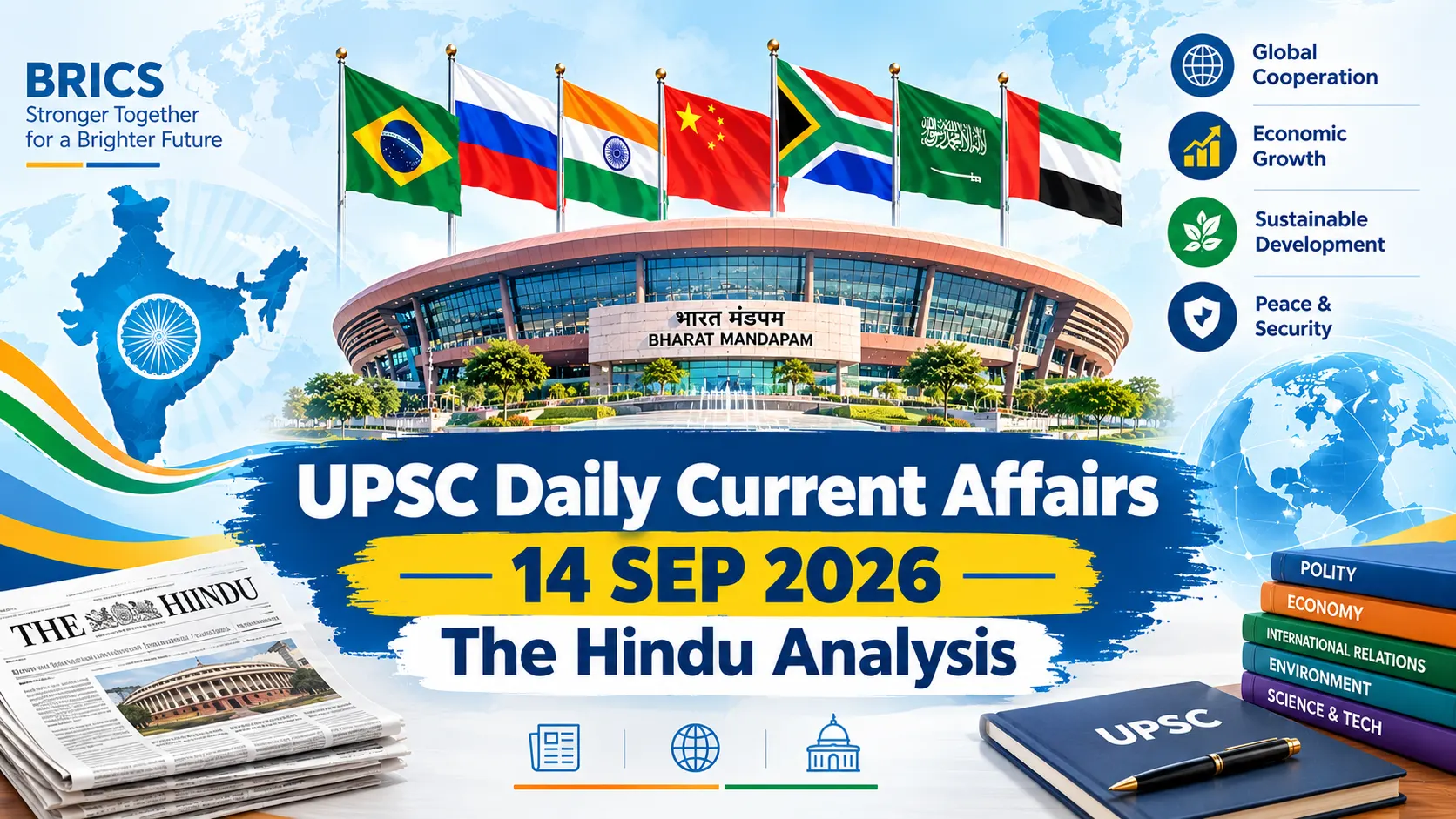
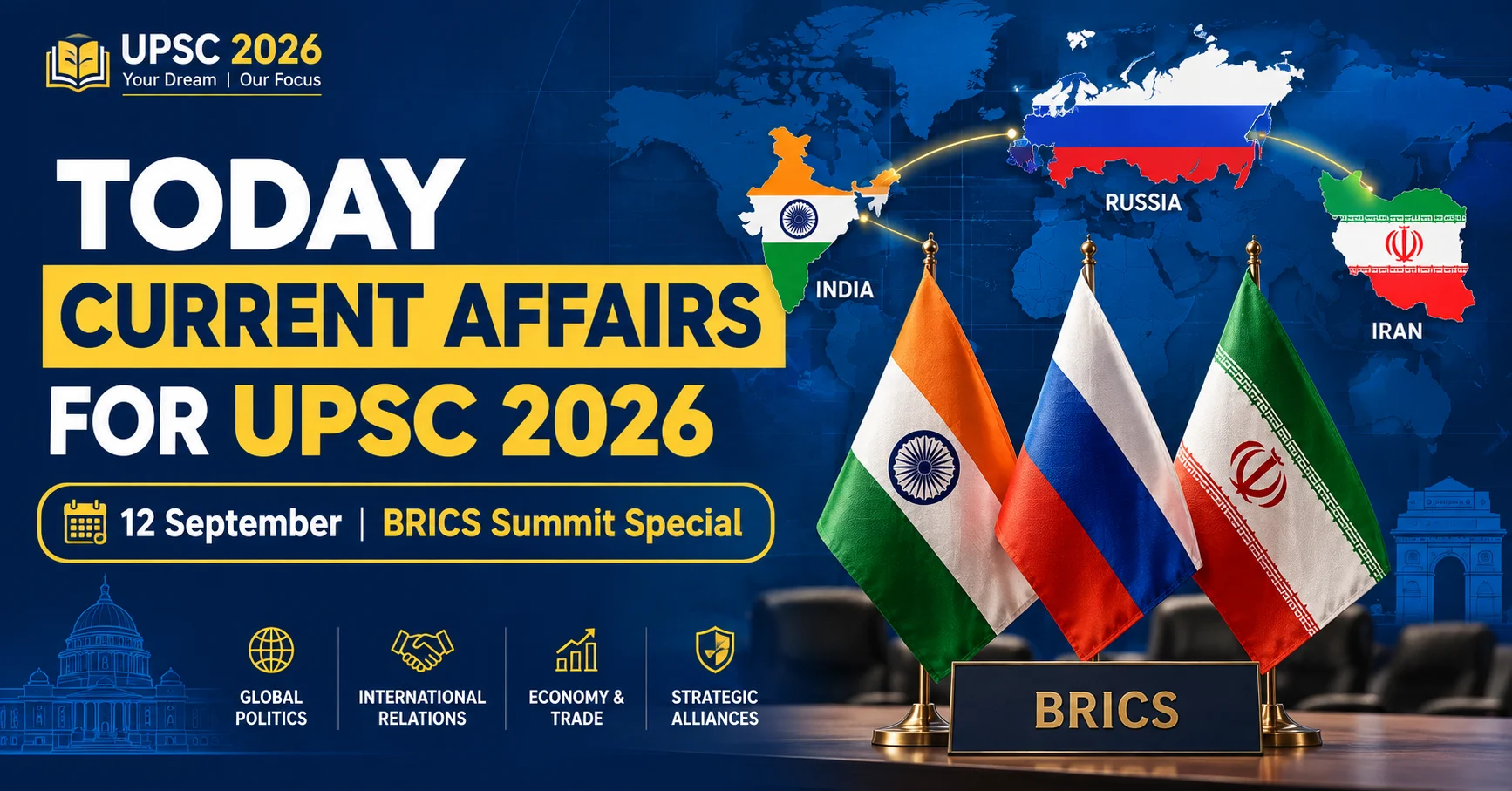
This UPSC Daily Current Affairs brief covers the most important national and international developments reported on 13th and 14th September 2026, directly relevant for UPSC Prelims and Mains (GS Paper II). The centerpiece of the day is the conclusion of the 18th BRICS Summit in New Delhi and the adoption of the “New Delhi Declaration,” alongside major updates on the Red Sea security crisis, India’s evolving counter-terrorism doctrine, Pakistan’s shifting West Asian alliances, and reforms in India’s anti-doping framework. Each topic below is explained with background, exam-oriented facts, and analytical takeaways.
UPSC Daily Current Affairs | Overview
| S. No. | Heading | GS Paper / Relevance |
|---|---|---|
| 1 | BRICS Adopts the New Delhi Declaration | GS II – International Relations |
| 2 | BRICS BioDesign Initiative & Disease Surveillance | GS II – Health Diplomacy |
| 3 | Ramanathaswamy Temple in the News | Prelims – Art & Culture |
| 4 | PM Modi’s 10-Point Global Governance Reform Roadmap | GS II – International Institutions |
| 5 | MSMEs, Unilateral Tariffs & the Jaipur Consensus | GS II / GS III – Economy |
| 6 | Thirukkural Gifted to President Putin | Prelims – Art & Culture |
| 7 | BRICS and the New Development Bank (NDB) | GS II / GS III – International Economic Institutions |
| 8 | The Houthis vs Saudi Arabia – Red Sea Crisis | GS II – International Relations |
| 9 | India’s Counter-Terror Strategy – Operation PRAHAAR | GS III – Internal Security |
| 10 | Pakistan’s Westward Turn – Strategic Depth or Overstretch | GS II – India’s Neighbourhood |
| 11 | Anti-Doping Reforms & NADA | GS II – Governance / Sports Policy |
| 12 | BrahMos Defence Diplomacy | GS III – Defence & Security |
UPSC Daily Current Affairs | BRICS Adopts the New Delhi Declaration
Heading & Syllabus Mapping This topic falls under GS Paper II – International Relations, specifically India’s role in multilateral groupings and global governance reform.
Why in News?
At the 18th BRICS Summit held in New Delhi, member nations reached a last-minute consensus and adopted the “New Delhi Declaration.” The agreement came after months of difficult negotiations between Iran and the United Arab Emirates over how to describe the ongoing conflict in West Asia.
Core Facts & Background
- BRICS began in 2010 as a grouping of Brazil, Russia, India, China, and South Africa. It has since expanded to include Egypt, Ethiopia, Iran, Indonesia, and the UAE.
- The declaration calls for “maximum restraint” in the West Asia conflict without directly naming any single aggressor nation.
- It supports Palestinian statehood, criticises attacks on Gaza and Lebanon, and reiterates condemnation of cross-border terrorism, with a specific mention of the 2025 Pahalgam terror attack.
- The declaration also calls for comprehensive reform of the United Nations, including a bigger role for India and Brazil in the Security Council.
- It condemns unilateral coercive economic measures such as tariffs and sanctions, and pushes for trade settlement through national currencies.
- PM Modi described the 20-year-old bloc as “coming of age” with a “distinct identity,” pushing back against criticism that BRICS functions as an anti-Western platform.
- China will take over the BRICS chairmanship for the next term.
| Key Term | Meaning |
|---|---|
| Maximum Restraint | Diplomatic language avoiding direct blame while urging de-escalation |
| Troika System | Continuity mechanism where past, present and incoming chairs coordinate (proposed by PM Modi, similar to G20) |
| Unilateral Coercive Measures | Sanctions or tariffs imposed by one country without multilateral backing |
Pros & Cons
| Pros | Cons |
|---|---|
| Reflects India’s diplomatic skill in bridging Iran-UAE differences | Declaration avoids naming any country directly, diluting its strength |
| Strengthens Global South’s collective voice on UN reform | No binding timeline for institutional reforms |
| Builds consensus despite sharply differing member interests | Groups with divergent geopolitical identities may struggle for long-term cohesion |
Way Forward India should use its current diplomatic standing to push for a concrete, time-bound “BRICS Reform Road Map” as proposed by PM Modi, ensuring that broad statements translate into measurable institutional change at the UN, IMF, and World Bank.
UPSC Daily Current Affairs | BRICS BioDesign Initiative & Disease Surveillance
Heading & Syllabus Mapping GS Paper II – Health Diplomacy and International Cooperation in Science & Technology.
Why in News?
The Andhra Pradesh MedTech Zone (AMTZ) has been chosen to lead the new BRICS BioDesign Programme, launched in New Delhi to boost cross-border healthcare innovation.
Core Facts & Background
- The initiative connects researchers, healthcare professionals, and industry across BRICS nations to convert medical ideas into deployable, affordable technologies.
- It was launched by the Principal Scientific Adviser to the Government of India, alongside industry bodies like FICCI.
- Separately, BRICS leaders also welcomed the creation of a dedicated sub-working group for an Integrated Early Warning System, aimed at strengthening surveillance and response to mass infectious diseases and medical product regulation.
- This early-warning mechanism covers two broad areas: health infrastructure preparedness and local production of medical goods.
Pros & Cons
| Pros | Cons |
|---|---|
| Positions India as a hub for affordable MedTech innovation for the Global South | Implementation depends on consistent funding across member states |
| Early warning system can reduce pandemic response time significantly | Coordination among 11 diverse healthcare systems is administratively complex |
Way Forward Sustained investment in AMTZ-led programmes and faster ratification of the early warning framework by all member states will be key to translating this initiative into real pandemic preparedness.
UPSC Daily Current Affairs | Ramanathaswamy Temple in the News
Heading & Syllabus Mapping Prelims-oriented – Art & Culture.
Why in News?
PM Modi welcomed BRICS leaders against the backdrop of Tamil Nadu’s iconic Ramanathaswamy Temple, and a symbolic Modi-Xi handshake was framed by its 1,212-pillar corridor.
Core Facts & Background
- Located in Rameswaram, the temple is one of the four Char Dham shrines (the other three being Dwaraka, Puri, and Badrinath).
- It is the only Char Dham shrine dedicated to Lord Shiva and one of the 12 Jyotirlingas, and the only one of the twelve located in South India.
- It holds the record for the longest corridor among all Hindu temples in India, running 197 metres east-to-west and 133 metres south-to-north.
- The first stone structure was built by the Chola kings in the 12th century, with later additions by the Pandya dynasty and Vijayanagar rulers, including Krishna Deva Raya in 1513.
- The temple has 22 sacred wells whose waters are believed to have healing properties.
Way Forward Such cultural showcasing at global summits strengthens India’s soft power and highlights heritage sites for tourism and conservation focus.
UPSC Daily Current Affairs | PM Modi’s 10-Point Global Governance Reform Roadmap
Heading & Syllabus Mapping GS Paper II – Reform of international institutions.
Why in News?
PM Modi urged BRICS leaders to jointly prepare 10 concrete proposals for global governance reform, to be developed into a formal “BRICS Reform Road Map” by the next summit.
Core Facts & Background
- Modi called for a shift from developing nations being “rule-takers” to becoming “rule-shapers.”
- He identified three focus areas: representation (reform of the UN Security Council, IMF, and World Bank), responsiveness (faster institutional action), and rule-making (a greater say for the Global South in shaping norms for AI, cyberspace, and biotechnology).
- He proposed a Seafarers’ Emergency Support Network to help maritime workers facing distress abroad, and a secure digital repository to track BRICS decisions and their implementation status.
- Modi also proposed a BRICS Troika mechanism, similar to G20’s system of past-present-incoming chair coordination, to ensure continuity of the group’s agenda.
Pros & Cons
| Pros | Cons |
|---|---|
| Gives BRICS a structured reform agenda instead of vague aspirations | Reform of UNSC has been discussed for decades with little real progress |
| Seafarer support network fills a genuine welfare gap | Implementation requires consensus among members with competing interests |
Way Forward The proposed BRICS Reform Road Map should include measurable milestones and a review mechanism at every future summit to ensure accountability.
UPSC Daily Current Affairs | MSMEs, Unilateral Tariffs & the Jaipur Consensus
Heading & Syllabus Mapping GS Paper II/III – Economy and Trade.
Why in News?
The New Delhi Declaration devoted significant focus to Micro, Small and Medium Enterprises (MSMEs) and raised concerns over the global rise of unilateral tariff measures.
Core Facts & Background
- India chaired the first-ever BRICS MSME Forum and Third SME Working Group meeting in Agra, releasing a report titled “Advancing MSME Competitiveness in BRICS: Strengthening Access to Finance & Technology and Sustainable Growth.”
- The declaration expresses concern that unilateral tariff and non-tariff measures distort trade, are inconsistent with WTO rules, and disproportionately hurt developing and emerging economies.
- BRICS welcomed the Jaipur Consensus, which studies setting up an Invoice Discounting Mechanism for member MSMEs — helping small businesses unlock working capital and strengthen participation in international trade.
- The bloc reaffirmed support for reforms at the WTO, IMF, and World Bank, and backed the accession bids of Ethiopia and Iran to the WTO.
| Term | Explanation |
|---|---|
| Invoice Discounting | A financing method where a business gets early access to funds tied up in unpaid invoices, improving cash flow |
| Unilateral Tariffs | Trade tariffs imposed by one country without multilateral agreement, often to protect domestic industry |
Pros & Cons
| Pros | Cons |
|---|---|
| Invoice discounting can directly ease MSME cash-flow problems | Mechanism is still at a “study” stage, not yet operational |
| Collective BRICS voice adds pressure for WTO reform | Tariff wars by major economies remain outside BRICS’s direct control |
Way Forward India should push for early operationalisation of the Invoice Discounting Mechanism and use its MSME Forum leadership to build a permanent BRICS trade-finance facility for small businesses.
UPSC Daily Current Affairs | Thirukkural Gifted to President Putin
Heading & Syllabus Mapping Prelims-oriented – Art & Culture.
Why in News?
PM Modi presented Russian President Vladimir Putin with a Russian translation of Thiruvalluvar’s classical Tamil work, the Thirukkural.
Core Facts & Background
- Thirukkural is a Sangam-era text (composed between 300 BCE and 500 BCE) authored by poet-philosopher Thiruvalluvar, also known as “Valluvar.”
- It consists of 1,330 couplets (“kurals”), each of seven words, arranged into 133 chapters of 10 couplets each.
- It is divided into three books: the Book of Virtue (morality, 38 chapters), the Book of Polity (materialism/socio-economic values, 70 chapters), and the Book of Love (25 chapters).
- The text discourages divisions based on religion, caste, or race, asserting that morality and kindness are essential to a meaningful life.
- It defines God as “pure intelligence” and omniscient, embodying wisdom, compassion, and love.
Way Forward Cultural diplomacy gestures like this strengthen India’s civilisational soft power on the global stage and highlight ancient Tamil literature to international audiences.
UPSC Daily Current Affairs | BRICS and the New Development Bank (NDB)
Heading & Syllabus Mapping GS Paper II/III – International Financial Institutions.
Why in News?
As BRICS marked its 20th year, discussions focused on how India should use the New Development Bank to maximise the group’s economic potential without over-empowering any single member.
Core Facts & Background
- The NDB was established in 2015, headquartered in Shanghai, with founding members Brazil, Russia, India, China, and South Africa.
- Its mandate is to mobilise resources for infrastructure and sustainable development projects across BRICS and other emerging economies.
- China and India together account for around 50% of the NDB’s active portfolio, while transport infrastructure is the largest funded sector.
- The bank has approved over $130 billion across 139 projects since inception, but disbursement has been comparatively slow — only around $30 billion disbursed so far.
- The NDB carries a AAA/AA+ credit rating, but sanctions on Russia and geopolitical constraints have limited its ability to raise capital easily.
- India has been pushing for a long-delayed rupee-denominated bond, expected in 2026.
- The NDB is distinct from the BRICS Contingent Reserve Arrangement (CRA) — the NDB finances development projects, while the CRA is a safety-net mechanism for balance-of-payments crises.
Pros & Cons
| Pros | Cons |
|---|---|
| Offers an alternative financing avenue independent of Western-led institutions | Limited paid-up capital restricts lending capacity |
| Greater local-currency lending reduces dollar-dependence risk | China’s economic weight could translate into disproportionate influence |
| Strengthens India’s strategic autonomy in global finance | Needs deeper local-currency instruments and stronger institutional capacity |
Way Forward India should push for greater NDB capitalisation, expanded local-currency lending, and wider membership, while continuing parallel engagement with the World Bank and IMF to avoid over-reliance on any single institution.
UPSC Daily Current Affairs | The Houthis vs Saudi Arabia – Red Sea Crisis
Heading & Syllabus Mapping GS Paper II – International Relations and Maritime Security.
Why in News?
The Iran-aligned Houthi militia in Yemen has rapidly expanded territorial control along the Red Sea coast, capturing key cities and reigniting conflict with Saudi Arabia, while a Saudi oil pipeline was shut down after drone strikes.
Core Facts & Background
- The Houthi movement, rooted in the 1979 Iranian revolution’s influence on Zaydi Shia communities in northern Yemen, has grown since the early 1990s into a well-armed territorial force with sustained Iranian support.
- In early September 2026, Houthi forces captured the Red Sea cities of Mokha and Dhubab, and seized the Perim Island in the strategic Bab el-Mandeb Strait.
- More than 20% of the world’s seaborne oil trade passes through the Strait of Hormuz, and the Bab el-Mandeb/Red Sea corridor typically carries 12–15% of global trade.
- Saudi Arabia shut down its 1,200-km East-West oil pipeline — which normally moves 4–5 million barrels of oil per day (about 4–5% of global supply) — after it came under drone attack, forcing reliance on the Red Sea route instead.
- With reduced access through Hormuz (due to earlier Iran-related tensions) and now Red Sea disruptions, Saudi Arabia faces pressure on two of the world’s most critical maritime chokepoints simultaneously.
- The U.S. has said it will offer intelligence support to Saudi Arabia but will not intervene militarily for now.
Pros & Cons (Risk Analysis)
| Concern | Implication |
|---|---|
| Control of Bab el-Mandeb by a non-state armed group | Threatens global shipping and oil price stability |
| Loss of pipeline capacity | Forces reliance on already congested maritime routes |
| Iran-backed proxy expansion | Raises broader concerns about regional escalation |
Way Forward International diplomatic pressure, coordinated naval security patrols, and renewed ceasefire negotiations are essential to prevent further disruption to one of the world’s most vital energy and trade corridors.
UPSC Daily Current Affairs | India’s Counter-Terror Strategy – Operation PRAHAAR
Heading & Syllabus Mapping GS Paper III – Internal Security and Counter-Terrorism.
Why in News?
Marking 25 years since 9/11, an opinion piece in The Hindu reviewed how India’s counter-terrorism strategy has evolved from a passive, reactive approach to a proactive one, referencing India’s newly unveiled national policy, “PRAHAAR.”
Core Facts & Background
- India unveiled PRAHAAR on 23 February 2026 as its first comprehensive National Counter-Terrorism Policy and Strategy, adopting a coordinated “whole-of-government” and “whole-of-society” approach.
- India’s strategy has historically evolved through key milestones: the 1999 IC-814 hijacking, the 2001 Parliament attack leading to “Operation Parakram,” the 2008 Mumbai attacks, the 2016 Uri surgical strikes, the 2019 Balakot airstrikes, and the 2025 Pahalgam attack that triggered Operation Sindoor.
- The new doctrine marks a shift from “absorb the attack and respond diplomatically” to “prevent, punish, and when necessary, strike terrorist infrastructure across the border.”
- At the 18th BRICS Summit, the Pahalgam terror attack was explicitly referenced in the New Delhi Declaration, reflecting growing international consensus against cross-border terrorism.
| Earlier Approach | New Approach |
|---|---|
| Defensive, reactive after attacks | Proactive, pre-emptive |
| Fight mainly inside India | Target terrorist infrastructure beyond the border when required |
| Diplomatic-only response | Combined diplomatic + military + intelligence response |
| Handled mainly by individual agencies | Whole-of-government coordinated approach |
| Focus on conventional threats | Covers conventional + cyber + drone + technology-enabled threats |
Way Forward Effective implementation of PRAHAAR will require sustained inter-agency coordination, technology-driven intelligence gathering, and continued international pressure on states that harbour terror networks.
UPSC Daily Current Affairs | Pakistan’s Westward Turn – Strategic Depth or Overstretch
Heading & Syllabus Mapping GS Paper II – India’s Neighbourhood and Regional Geopolitics.
Why in News?
A defence cooperation agreement signed between Pakistan and Kuwait in August 2026 highlighted Pakistan’s expanding strategic footprint across West Asia, building on its role in the Saudi Arabia-Türkiye-Pakistan defence arrangement (the “Makkah Agreement”).
Core Facts & Background
- The Makkah Agreement, signed on 7 August 2026, stipulates that an armed attack on one member is treated as an attack on all three countries — Saudi Arabia, Türkiye, and Pakistan.
- Pakistan is simultaneously trying to be Saudi Arabia’s security partner, Türkiye’s strategic ally, Iran’s friend, and a facilitator between Iran and the United States — roles that can become contradictory when regional tensions rise.
- The renewed Houthi-Saudi conflict presents an early test of the Makkah pact, since Pakistan would need to weigh its collective-defence commitments against its separate relationship with the Houthis’ main backer, Iran.
- For India, Pakistan’s growing embedding in West Asian security structures could provide it strategic depth, but also risks strategic overstretch, diverting resources away from its traditional focus on the India front.
Pros & Cons (For Pakistan)
| Pros | Cons |
|---|---|
| Access to Saudi financial resources and Turkish defence technology | Risk of being pulled into multiple regional conflicts simultaneously |
| Enhanced regional relevance and defence-industrial cooperation | Contradictory alliance commitments (Saudi vs Iran) could become unmanageable |
Way Forward India should avoid viewing Pakistan’s West Asian outreach purely negatively, and instead continue deepening its own strong economic and strategic ties with Saudi Arabia, the UAE, and other Gulf states as a counterbalance.
UPSC Daily Current Affairs | Anti-Doping Reforms & NADA
Heading & Syllabus Mapping GS Paper II – Governance and Sports Policy.
Why in News?
At least 13 doping positives were reported ahead of the Commonwealth Games and the upcoming Asian Games, prompting fresh concern over India’s doping culture and calls for reform of the National Anti-Doping Agency (NADA).
Core Facts & Background
- India has topped global doping charts for three consecutive years, and the Athletics Integrity Unit (AIU) has downgraded India due to a high doping risk.
- NADA, which holds primary anti-doping responsibility in India, remains understaffed despite increasing the number of tests and intelligence-based raids.
- Key reform needs include: proper implementation of the National Anti-Doping (Amendment) Act, 2025 to strengthen NADA’s powers, greater operational independence from government control, increased budget allocation, and cutting off the supply chain of banned substances.
- India has become a hub for trade in performance-enhancing drugs sourced internationally, with at least one Indian national serving a jail term abroad for illegally importing such substances.
Pros & Cons
| Pros | Cons |
|---|---|
| Increased testing shows growing seriousness about the issue | NADA remains understaffed and under-resourced |
| New Amendment Act could empower stronger enforcement | Implementation and independence from government oversight remain incomplete |
Way Forward As India prepares to host the 2030 Commonwealth Games and pursues an Olympic bid, urgent, well-funded, and independent anti-doping enforcement is essential to protect the country’s sporting reputation.
UPSC Daily Current Affairs | BrahMos Defence Diplomacy
Heading & Syllabus Mapping GS Paper III – Defence and Security.
Why in News? During bilateral meetings on the sidelines of the BRICS Summit, PM Modi’s discussions with several world leaders put a spotlight on India’s growing defence exports, particularly the BrahMos supersonic cruise missile system.
Core Facts & Background
- The Philippines, which became India’s strategic partner in August 2025, is the first foreign customer for BrahMos, under a $375-million deal, with deliveries and training currently underway.
- Malaysia has held exploratory discussions on acquiring the BrahMos system, though no final decision has been made.
- India also deepened defence and security cooperation with Kazakhstan, Nigeria, and African partners including the African Union chairperson, alongside broader talks on trade, technology, and connectivity.
Way Forward Continued diplomatic engagement around BrahMos exports strengthens India’s position as a credible defence exporter and expands its strategic footprint across Southeast Asia and Africa.
UPSC Daily Current Affairs | FAQs
Q1. What is the New Delhi Declaration?
It is the joint statement adopted by all BRICS member nations at the 18th BRICS Summit held in New Delhi, addressing issues like West Asia tensions, UN reform, unilateral tariffs, and terrorism.
Q2. What is the BRICS BioDesign Initiative?
It is a healthcare innovation programme led by India’s Andhra Pradesh MedTech Zone (AMTZ) aimed at advancing cross-border medical technology development across BRICS nations.
Q3. Why is the Ramanathaswamy Temple significant?
It is one of the four Char Dham shrines, the only one dedicated to Lord Shiva among them, and holds the record for the longest temple corridor in India.
Q4. What is Operation PRAHAAR?
PRAHAAR is India’s first comprehensive National Counter-Terrorism Policy and Strategy, unveiled on 23 February 2026, adopting a coordinated whole-of-government approach to counter terrorism.
Q5. What is the Makkah Agreement?
It is a defence pact between Saudi Arabia, Türkiye, and Pakistan (signed August 2026) under which an attack on one member is treated as an attack on all three.
Q6. What is the New Development Bank (NDB)?
Established in 2015 and headquartered in Shanghai, the NDB is a BRICS-founded institution that finances infrastructure and sustainable development projects in emerging economies.
Q7. Why is the Bab el-Mandeb Strait important?
It is a critical maritime chokepoint connecting the Red Sea to the Gulf of Aden, through which a significant share of global oil and trade shipments pass.
Q8. What is the Thirukkural?
It is an ancient Tamil ethical text composed by Thiruvalluvar, consisting of 1,330 couplets divided into three books covering virtue, polity, and love.
Previous Post >>