Today Current Affairs For UPSC 2026 | 12 September | Daily News Analysis
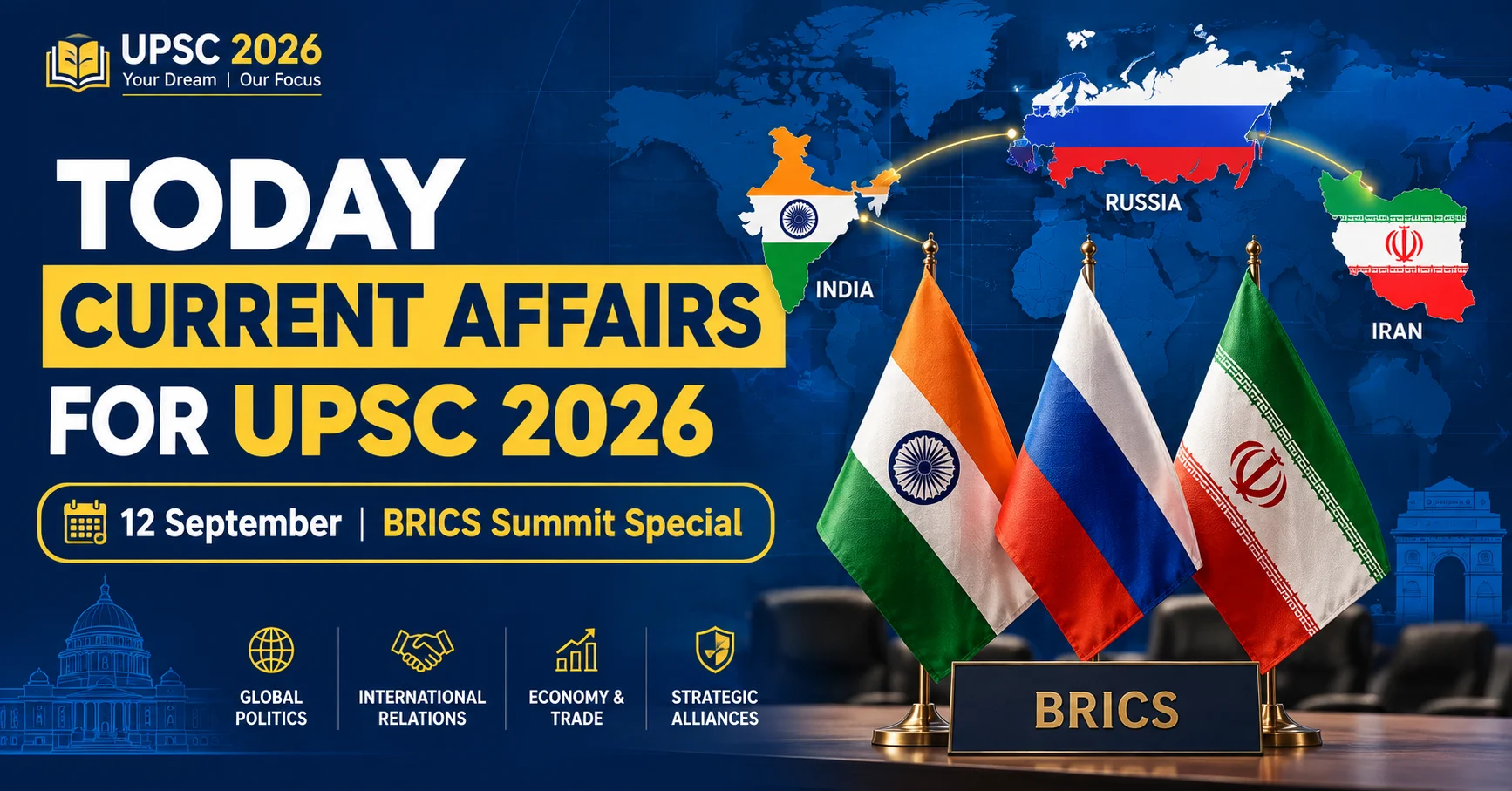
By -Virendr@ > Ahead of the 18th BRICS Summit in New Delhi, 12 September 2026 has turned into a heavy news day for UPSC aspirants. On the diplomatic front, Prime Minister Narendra Modi held back-to-back bilaterals with Russian President Vladimir Putin and Iranian President Masoud Pezeshkian, while India and Canada signalled that their relationship is “well beyond reset” with a fresh push on trade, uranium and critical minerals. On the economic side, a sharp opinion piece questioned whether BRICS’s New Development Bank and Contingent Reserve Arrangement have actually reduced dependence on the dollar-led financial order, even as BRICS Finance Ministers flagged concerns over “unilateral” tariffs. Domestically, the Supreme Court pushed back on India’s road safety record and FSSAI’s food-label rollout, while the Consumer Affairs Ministry tightened e-commerce rules. On the science and technology front, the Finance Minister warned about agentic AI risks in fintech, Anthropic revealed it had blocked AI misuse attempts linked to bioweapons research, and experts called for a legal framework to protect genetic data. This note breaks down every one of these stories the way UPSC Prelims and Mains actually test them.
Today Current Affairs For UPSC 2026 | Overview
| # | Topic | Newspaper Page | GS Paper Relevance | One-Line Focus |
|---|---|---|---|---|
| 1 | Modi–Putin & Modi–Pezeshkian Bilaterals | Page 1 | GS II (IR) | Russia-Ukraine dialogue, India-Iran ties, BRICS diplomacy |
| 2 | India–Canada Relations & CEPA | Page 5 | GS II (IR) | Trade reset, uranium deal, Nijjar-related friction |
| 3 | ‘Safe System’ Approach to Road Safety | Page 6 | GS II / GS III | Why judicial orders alone can’t cut road deaths |
| 4 | New Development Bank (NDB) & De-dollarisation | Page 6 | GS II / GS III | Why BRICS institutions still lean on the dollar system |
| 5 | BRICS Statement on Tariffs & Local Currency Trade | Page 9 | GS II / GS III | FMCBG flags “unilateral” tariffs, local-currency push |
| 6 | Bharat Innovates Deep-Tech Expo | Page 9 | Prelims | 37 deep-tech innovations showcased alongside BRICS |
| 7 | FSSAI Front-of-Pack Labelling (FoPL) | Page 10 | GS II / GS III | SC seeks timeline for food warning labels |
| 8 | E-Commerce Consumer Protection Rules 2026 | Page 10 | GS II / GS III | New disclosure & grievance-redressal norms |
| 9 | Overseas Lithium Blocks & E-Waste Recycling | Page 11 | GS III / Prelims | India’s critical mineral diversification strategy |
| 10 | Agentic AI Risks in Fintech | Page 11 | GS III | FM Sitharaman’s warning on AI in financial systems |
| 11 | AI Bioweapon Safeguards | Page 12 | GS III | Anthropic blocks AI misuse in bio-research |
| 12 | Genetic Data Protection | Page 13 | GS III | Experts call for a legal framework on genetic privacy |
Today Current Affairs For UPSC 2026 | Modi–Putin and Modi–Pezeshkian Bilaterals
Heading & Syllabus Mapping: GS Paper II — International Relations; India’s bilateral relations with Russia and Iran; effect of policies of developed and developing countries on India’s interests.
Why in News? Ahead of the BRICS Summit, PM Modi held separate meetings with Russian President Vladimir Putin and Iranian President Masoud Pezeshkian in New Delhi, where discussions ranged from the Russia-Ukraine war to the West Asia crisis and closer economic cooperation.
Core Facts & Background
- Putin was the first foreign leader to arrive for the BRICS Summit and held wide-ranging bilateral talks with Modi covering trade, energy, defence, technology and connectivity.
- Modi reiterated India’s long-standing call for an early end to the Russia-Ukraine conflict through dialogue and diplomacy, and offered India’s willingness to assist peace efforts.
- Both sides discussed expanding industrial cooperation in railways and tunnelling, building a steel value chain, and creating more employment opportunities for Indian skilled professionals in Russia.
- Separately, China signalled its own interest in a “long-term” and strategic view of ties with India, adding another layer to the diplomatic backdrop of the summit.
- With Pezeshkian, Modi discussed the West Asia conflict, energy security, maritime safety and trade connectivity, while welcoming Iran’s continued participation in BRICS forums.
- Iran pushed for greater use of national currencies in bilateral trade to manage currency risk, and proposed a joint BRICS insurance company with an initial capital of around $10 billion for infrastructure and energy projects.
- India and Russia are working toward a bilateral trade target of $100 billion by 2030, alongside cooperation on critical minerals and maritime security.
Pros & Cons
Pros
- Strengthens India’s strategic autonomy by allowing simultaneous engagement with Russia, Iran, China and Western partners.
- Diversified energy partnerships reduce India’s vulnerability to global supply shocks.
- Keeps India positioned as a credible voice for dialogue in both the Russia-Ukraine and West Asia conflicts.
Cons
- Balancing ties with Russia and Iran alongside Western partners (especially the US) is diplomatically delicate given sanctions regimes.
- Ambitious trade targets ($100 billion by 2030) require sustained follow-through that has historically been slow to materialise.
- Iran’s push for a BRICS insurance company and local-currency settlement adds complexity without a clear implementation roadmap yet.
Way Forward India should continue backing dialogue-based resolution of both conflicts, diversify energy and critical mineral sourcing, deepen India-Russia cooperation beyond traditional defence ties, and use BRICS pragmatically for trade and connectivity gains — all while preserving its strategic autonomy across a multipolar world.
Possible UPSC Mains Question: “India’s engagement with Russia, Iran and China reflects its strategy of strategic autonomy in a changing multipolar world.” Discuss.
Today Current Affairs For UPSC 2026 | India–Canada Relations and the CEPA Push
Heading & Syllabus Mapping: GS Paper II — Bilateral, regional and global groupings; effect of policies of developed countries on India’s interests.
Why in News? In an interview, Canadian High Commissioner Christopher Cooter said India-Canada ties are “well beyond reset,” with both governments working to relaunch a Comprehensive Economic Partnership Agreement (CEPA), rebuild security dialogue, and resolve fallout from the Hardeep Singh Nijjar case.
Core Facts & Background
- Relations had deteriorated sharply after Canadian allegations connected to the 2023 killing of Hardeep Singh Nijjar; both sides are now working to rebuild diplomatic, security and economic engagement.
- India and Canada are targeting conclusion of CEPA by the end of 2026, aiming to more than double bilateral trade — reported figures point to a target in the range of USD 50–70 billion by 2030.
- A major outcome already in place is a roughly USD 2.6 billion long-term uranium supply contract with Cameco, strengthening India’s nuclear fuel security and supporting its target of 100 GW nuclear capacity by 2047.
- Both countries signed MoUs on critical mineral supply chains and clean-energy cooperation (solar, wind, storage, bio-energy), and Canada announced it will join the International Solar Alliance (ISA) and the Global Biofuels Alliance (GBA).
- India and Canada set up their first-ever Defence Dialogue, reconstituted the India-Canada CEO Forum, and revived the India-Canada Parliamentary Friendship Group.
- Other announcements include a trilateral India-Canada-Australia MoU under the ACITI technology partnership, an AICTE-Mitacs deal for 300 fully-funded research internships for Indian students, and a Joint Pulse Protein Centre of Excellence at NIFTEM-Kundli.
- On security, India continues to seek action against pro-Khalistan extremist networks operating from Canadian soil, and has shared information regarding gangster Lawrence Bishnoi’s alleged criminal links; the wider issue of transnational crime remains a sensitive point between the two sides.
Pros & Cons
Pros
- Uranium supply deal directly supports India’s nuclear energy expansion and clean-energy transition.
- CEPA, if concluded, could significantly boost trade, investment and market access for both economies.
- New institutional mechanisms (Defence Dialogue, CEO Forum, Parliamentary Friendship Group) create durable channels for cooperation beyond any single political cycle.
Cons
- The Nijjar investigation and concerns over Khalistani extremism remain unresolved irritants that could resurface and derail progress.
- Large Indian student population in Canada faces rising education costs and immigration pressures, straining people-to-people ties.
- Trade negotiations have collapsed before; repeated instability risks discouraging long-term business confidence.
Way Forward Keep the Nijjar investigation legally separate from the broader bilateral relationship, strengthen regular security and intelligence cooperation against extremism and organised crime, conclude CEPA through structured negotiations, and expand genuine student and research mobility partnerships to anchor the relationship for the long term.
Possible UPSC Mains Question: “India-Canada relations are moving from diplomatic confrontation towards pragmatic cooperation.” Examine the key obstacles and opportunities in rebuilding the bilateral relationship.
Today Current Affairs For UPSC 2026 | The ‘Safe System’ Approach to Road Safety
Heading & Syllabus Mapping: GS Paper II (governance issues) / GS Paper III (infrastructure & disaster/safety management).
Why in News? The Supreme Court recently asked the Road Transport Ministry to consider measures for habituating the use of seat belts, helmets and child restraints, after data showed India has only about 1% of the world’s vehicles but accounts for nearly 11% of global road traffic deaths.
Core Facts & Background
- In 2024, two-wheeler riders accounted for 46.2% of road deaths and pedestrians for 20.6%, underlining how vulnerable road users bear the brunt of India’s road safety crisis.
- Major contributing factors include poor compliance with helmets and seat belts, overspeeding, patchy use of child restraints, weak post-crash investigation, and chronic shortages of traffic police personnel.
- The Motor Vehicles (Amendment) Act, 2019 introduced several safety mechanisms, but national-level data still doesn’t show the scale of improvement India needs.
- The Supreme Court referred the current petition to the Centre rather than issuing direct interventionist orders, effectively acknowledging that road safety has “outgrown judicial fiat.”
- Analysts argue for a “Safe System” approach — one that assumes people will sometimes make mistakes, and therefore designs roads, vehicles and enforcement systems to reduce both the chance and severity of crashes, rather than relying purely on individual behaviour change.
- Faster access to trauma care (the “golden hour” principle) is highlighted as a critical but under-addressed factor in reducing crash fatalities.
Pros & Cons
Pros
- A Safe System approach can reduce fatalities even where 100% behavioural compliance is unrealistic.
- Addressing accident-prone “black spots” and unsafe road design yields measurable, scalable gains.
- Stronger post-crash trauma care can save lives even after a crash has occurred.
Cons
- Implementing safer road design and vehicle standards nationwide requires large, sustained investment.
- Chronic traffic police shortages limit day-to-day enforcement regardless of policy intent.
- Overemphasis on individual responsibility (helmets, seat belts) risks ignoring systemic issues like speeding infrastructure and poor road engineering.
Way Forward India needs a multi-layered strategy combining safer roads, safer vehicles, speed management, strict enforcement, responsible road-user behaviour and quick trauma care — with priority given to strengthening traffic policing, fixing black spots, and building a sustained road-safety culture.
Possible UPSC Mains Question: “India’s road-safety crisis cannot be solved through judicial directions or individual behaviour alone.” Discuss the need for a Safe System approach to reduce road fatalities.
Today Current Affairs For UPSC 2026 | New Development Bank (NDB) and the De-Dollarisation Debate
Heading & Syllabus Mapping: GS Paper II / GS Paper III — International financial institutions, BRICS, global economic governance.
Why in News? As India prepares to host the 18th BRICS Summit, a widely-discussed op-ed questioned whether BRICS’s flagship institutions — the New Development Bank (NDB) and the Contingent Reserve Arrangement (CRA) — have genuinely created an alternative to the Western-led financial order.
Core Facts & Background
- The NDB, launched in 2015, was meant to offer developing countries financing without the political strings often attached to World Bank loans, with greater use of local currencies.
- Despite this founding goal, around half of the NDB’s outstanding bonds are still denominated in US dollars, with the Chinese yuan making up most of the rest; local-currency lending stood at only about 22% by mid-2025, well below its own 30% target.
- The NDB’s first rupee-denominated bond was still in the planning stage as of September 2025, a decade after the bank opened for business.
- The NDB also relies on major Western credit-rating agencies (S&P, Fitch, Moody’s), and froze operations related to Russia in 2022 after Russia’s invasion of Ukraine — a move seen as reflecting the bank’s continued dependence on the existing Western-anchored financial system.
- The NDB’s total project approvals reached about $39 billion by the end of 2024.
- The CRA, a $100 billion reserve pool created in 2015 to help members handle balance-of-payment crises without turning to the IMF, has never been activated in a decade — partly because any member seeking more than 30% of its allotted share must first enter an IMF programme, tying the “alternative” back to the very institution it was meant to bypass.
- BRICS members remain divided on de-dollarisation itself: India opposes a common BRICS currency, South Africa is cautious about rapid de-dollarisation, China prefers a gradual internationalisation of the yuan, and Russia has said it does not seek to “abandon the dollar” outright.
- When the US threatened a 10% tariff surcharge on countries seen as aligning with “anti-American” BRICS policies, the bloc did not mount a strong, unified response — illustrating the limits of BRICS as a cohesive strategic bloc.
Pros & Cons
Pros
- NDB still provides useful infrastructure and development financing for the Global South, supplementing (not necessarily replacing) the World Bank.
- Even modest local-currency lending growth reduces some forex-conversion risk for developing economies.
- BRICS expansion (including Iran, Egypt, Ethiopia, UAE) shows genuine interest among Global South countries in alternatives to Western-led institutions.
Cons
- Heavy dollar-denomination of NDB bonds undermines the bank’s own de-dollarisation rhetoric.
- The CRA’s total inactivity in a decade, plus its IMF-linked design, shows it functions more as a “promissory” institution than an independent safety net.
- Lack of a unified BRICS position on the dollar, and a muted collective response to US tariff threats, expose real limits to BRICS’s strategic cohesion.
Way Forward BRICS could focus on gradually increasing the NDB’s local-currency lending share, building genuinely independent credit-rating and crisis-support capacity, making the CRA operationally meaningful, and pushing for greater representation of emerging economies within the IMF and World Bank rather than only trying to build parallel institutions from scratch.
Possible UPSC Mains Question: “BRICS has created alternative financial institutions, but its dependence on the existing Western-led financial architecture remains significant.” Examine the reasons and suggest a way forward for India.
Today Current Affairs For UPSC 2026 | BRICS Finance Ministers Flag “Unilateral” Tariffs
Heading & Syllabus Mapping: GS Paper II / GS Paper III — International trade, WTO, global economic cooperation.
Why in News? BRICS Finance Ministers and Central Bank Governors (FMCBG) issued a joint statement voicing concern over the “unilateral imposition” of tariffs and non-tariff trade measures, while also calling for practical progress on local-currency cross-border payments.
Core Facts & Background
- The statement came after the second FMCBG meeting of India’s 2026 BRICS chairship, held in Mumbai on September 9–10, following the first meeting in Jaipur on August 12.
- BRICS said unilateral tariffs and non-tariff barriers distort trade, increase uncertainty, and disproportionately affect Emerging Markets and Developing Economies (EMDEs) — without directly naming the United States.
- The grouping reaffirmed support for an open, transparent, inclusive, non-discriminatory, rules-based multilateral trading system with the WTO at its core.
- On payments, BRICS acknowledged progress by the BRICS Payment Task Force (BPTF) in exploring practical, low-cost, fast and safe solutions for cross-border payments in local currencies — while explicitly recognising there is “no one-size-fits-all approach,” since member countries have different national priorities.
- India used its BRICS chairship to establish a Task Force on Growth and Development, structured around three workstreams: Resilience, Innovation & Cooperation, and Sustainability — meant to give BRICS and other emerging economies a platform to discuss growth models suited to their own contexts.
- The statement also touched on reform of multilateral lending institutions such as the World Bank and IMF.
Pros & Cons
Pros
- A collective statement gives EMDEs greater negotiating weight in global trade discussions.
- Progress on local-currency payment systems can reduce transaction costs and dollar dependence over time.
- The Task Force on Growth and Development gives India a chance to shape a shared BRICS development agenda during its chairship.
Cons
- The statement stops short of naming the US directly, limiting its diplomatic and deterrent impact.
- “No one-size-fits-all” language, while pragmatic, also signals a lack of binding commitment among members.
- Payment interoperability and local-currency settlement remain at a discussion/task-force stage rather than functioning at scale.
Way Forward BRICS should work toward building interoperable cross-border payment systems, expanding practical (not purely symbolic) use of local currencies, continuing to anchor trade disputes within WTO-based rules-driven mechanisms, and pushing structurally for reform of the IMF and World Bank rather than only issuing statements of concern.
Possible UPSC Mains Question: “BRICS’ call against unilateral tariffs and its push for local-currency settlements reflect the search for a more resilient global economic order.” Discuss the opportunities and limitations of this approach for India.
Today Current Affairs For UPSC 2026 | Bharat Innovates Deep-Tech Exposition (Prelims Focus)
Heading & Syllabus Mapping: Prelims — Science & Technology, government initiatives.
Why in News? India showcased 37 deep-tech innovations at the “Bharat Innovates Exposition” held at Bharat Mandapam from September 11–12, on the sidelines of the BRICS Summit.
Core Facts & Background
- The exposition was organised by the Education Ministry in coordination with the External Affairs Ministry.
- Highlighted innovations include an advanced floating solar PV platform for complex water bodies, a full-stack marine robotic platform for critical infrastructure inspection, a rare-earth-free e-powertrain, an AI-enabled cervical cancer screening tool delivering risk assessment in under 60 seconds, and an AI-enabled foetal monitoring platform.
- The event aims to connect Indian innovators with investors, business leaders and industry representatives from BRICS member countries, facilitating B2B engagements, technology partnerships, investment discussions, and international market access.
Quick Prelims Points
- Number of innovations showcased: 37
- Venue: Bharat Mandapam, New Delhi
- Organising ministries: Education Ministry + External Affairs Ministry
- Notable innovation categories: floating solar PV, marine robotics, rare-earth-free e-powertrain, AI-based healthcare screening
Today Current Affairs For UPSC 2026 | FSSAI Front-of-Pack Labelling (FoPL): Supreme Court Seeks a Timeline
Heading & Syllabus Mapping: GS Paper II (health governance) / GS Paper III (food security, public health).
Why in News? The Supreme Court has put FSSAI’s two-phase rollout of front-of-pack warning labels (FoPL) under scrutiny, warning that the second phase could be “indefinitely postponed” without a clear timeline.
Core Facts & Background
- FSSAI’s proposed rollout would initially apply warning labels to packaged foods high in two or more nutrients of concern — added fat, added sugar and salt — with a second phase extending this to products high in even one such nutrient.
- The case arose from a PIL filed by the non-profit “3S and Our Health Society,” represented by advocate Rajiv Shankar Dvivedi, seeking mandatory front-of-pack warnings on foods high in sugar, salt and saturated fats.
- The Court questioned why a two-nutrient threshold should apply first, noting that even excess levels of a single nutrient could pose health risks, and observed that petitioners argue the two-nutrient requirement lacks strong scientific basis.
- The Bench (Justices J.B. Pardiwala and K. Vinod Chandran) acknowledged that children are particularly vulnerable to “impulse or uninformed dietary decision-making,” and asked the Union government to incorporate nutritional literacy into school curricula.
- The Court directed FSSAI to file an affidavit within 10 days detailing its response and clarifications, with the matter posted for September 28.
- The Court also flagged industry concerns that ultra-processed foods should not be placed on the same footing as minimally-processed packaged foods, given their differing nutritional profiles.
Pros & Cons
Pros
- Clear front-of-pack warnings can help consumers make quicker, more informed dietary choices.
- Nutritional literacy in schools can build long-term healthy eating habits among children.
- A phased approach gives both consumers and the food industry time to adapt.
Cons
- An unclear timeline for phase two risks the warning system losing credibility or being delayed indefinitely.
- Treating all high-in-one-nutrient products the same as ultra-processed foods could unfairly penalise minimally processed packaged foods.
- Industry reformulation of products to meet new labelling thresholds takes time and cost, which could affect smaller manufacturers disproportionately.
Way Forward FSSAI should adopt a scientifically justified, clearly defined and time-bound approach for both labelling phases, differentiate between ultra-processed and minimally processed foods based on actual nutritional profiles, and pair front-of-pack warnings with sustained school-level nutrition education.
Today Current Affairs For UPSC 2026 | E-Commerce Consumer Protection Rules, 2026
Heading & Syllabus Mapping: GS Paper II (consumer protection, governance) / GS Paper III (digital economy).
Why in News? The Union Consumer Affairs Department notified the Consumer Protection (E-Commerce) Amendment Rules, 2026, tightening disclosure and grievance-redressal requirements for e-commerce platforms, effective from January 1, 2027.
Core Facts & Background
- The rules address emerging problems in digital marketplaces: dark patterns, hidden or unfair charges, lack of transparency, and weak grievance redressal.
- E-commerce entities must now disclose their legal name, principal office address, addresses of all branches, website details, customer-care contact details, and details of a designated Grievance Officer.
- For imported goods, platforms must disclose the importer’s details and the country of origin — aimed at helping consumers make informed purchasing decisions.
- The rules set specific grievance-redressal timelines: complaints must be acknowledged within 48 hours and resolved within one month.
- “Dark patterns” refer to interface designs that push or manipulate consumers into choices they might not otherwise make (for example, hidden add-on charges or pre-selected options that increase a final bill).
Pros & Cons
Pros
- Greater disclosure requirements improve price transparency and consumer trust in online transactions.
- Structured grievance timelines make platforms more accountable for timely complaint resolution.
- Country-of-origin disclosure on imported goods supports informed consumer choice and can indirectly support domestic manufacturing awareness.
Cons
- Compliance costs may be higher for smaller e-commerce players compared to large platforms.
- Effective enforcement of “dark pattern” restrictions requires strong monitoring capacity, which regulators may lack initially.
- A January 2027 effective date leaves a transition period during which existing practices may continue unchecked.
Way Forward Ensure the rules are backed by strong enforcement rather than remaining only on paper, use technology to track repeated dark-pattern violations, keep disclosures simple and visible for consumers, and build broader consumer awareness of their new rights and grievance channels.
Possible UPSC Mains Question: “The growth of e-commerce has created new forms of consumer vulnerability.” Examine how stronger regulation of dark patterns, disclosures and grievance redressal can improve consumer protection in India.
Today Current Affairs For UPSC 2026 | Overseas Lithium Blocks and E-Waste Recycling
Heading & Syllabus Mapping: GS Paper III — Critical minerals, energy security, infrastructure / Prelims.
Why in News? The Union Mines Ministry is in talks with Australia and Chile to acquire lithium blocks, while also seeking five additional lithium blocks in Argentina, as India steps up efforts to secure supplies of this critical mineral.
Core Facts & Background
- India has limited domestic lithium reserves and has already acquired five lithium blocks in Argentina; it is now seeking five more blocks there.
- Talks with Australia and Chile are underway at both the government-to-government level and among private entities.
- The government is encouraging Indian private companies to explore mineral-rich countries, acquire mining rights, mine resources abroad, and supply the extracted minerals back to India.
- E-waste recycling is being promoted as a secondary source of critical minerals: 125 entities have registered under the government’s ₹1,500-crore e-waste recycling incentive package, of which 58 projects have been cleared.
- These 58 cleared projects are expected to recover around 96 kilotonnes of critical minerals annually.
- Officials noted that about 25–30% of India’s critical mineral needs could potentially be met through e-waste recycling.
Pros & Cons
Pros
- Diversifying lithium sources across Argentina, Australia and Chile reduces India’s dependence on any single supplier or region.
- E-waste recycling turns a growing waste stream into a genuine strategic resource, supporting a circular economy.
- Overseas mineral assets support India’s EV, battery, and renewable-energy manufacturing ambitions.
Cons
- Overseas mining assets require significant capital, technical expertise and long gestation periods before yielding usable output.
- India still lacks strong domestic refining and processing capacity, meaning even secured raw ore may need external processing.
- E-waste recycling infrastructure is still at an early, scaling-up stage relative to India’s total mineral demand.
Way Forward India should keep diversifying overseas lithium and critical mineral sources, support Indian firms in acquiring and developing foreign mineral assets, scale up e-waste recycling and urban mining, and — crucially — build domestic refining and processing capacity so raw ore doesn’t just shift the dependency problem elsewhere.
Possible UPSC Mains Question: “India’s critical-mineral security requires both overseas resource acquisition and domestic recycling.” Discuss the need, opportunities and challenges of this strategy.
Today Current Affairs For UPSC 2026 | Agentic AI Risks in Fintech
Heading & Syllabus Mapping: GS Paper III — Science & Technology, Awareness in IT and AI; Economy (financial sector regulation).
Why in News? Union Finance Minister Nirmala Sitharaman warned that frontier AI labs are “racing straight to self-improving superintelligence,” raising serious concerns over AI safety and systemic financial risks, while addressing the valedictory session of the Global Fintech Fest (GFF) 2026 in Mumbai.
Core Facts & Background
- Sitharaman called on the fintech industry to build systems that are “fast yet accountable, autonomous yet reversible, and innovative without diluting consumer trust.”
- She stressed that AI may assist judgement, but responsibility must remain human and institutional — institutions must know where AI is used, what decisions it influences, what data it relies on, and what harm could arise if it fails.
- AI systems tied to higher-risk use cases should undergo greater scrutiny before deployment and throughout their operational lifecycle; the more serious the consequences of a decision, the stronger the need for review, explanation and appeal mechanisms.
- She cautioned against framing the choice as simply “AI adoption vs AI avoidance” — institutions overly dependent on legacy systems risk becoming less capable and competitive, while unmanaged AI adoption risks amplifying systemic financial risk.
- Sitharaman highlighted the “dual nature” of emerging technologies, particularly agentic AI and quantum computing, questioning how financial institutions can balance efficiency gains with growing systemic risk.
- Agentic AI, she noted, has moved beyond giving recommendations to taking autonomous actions — compressing processes that once took days into mere seconds.
- She also pointed to tokenisation as a technology that has already reduced unnecessary intermediaries and enabled near-instantaneous asset transfers.
Pros & Cons
Pros
- Agentic AI and tokenisation can dramatically increase efficiency and speed in financial services.
- Risk-based scrutiny (higher scrutiny for higher-risk AI use cases) is a practical, proportionate regulatory approach.
- Framing the challenge as “responsible adoption vs avoidance” avoids both reckless deployment and paralysis-driven inaction.
Cons
- Autonomous AI actions in finance could amplify errors or failures across many institutions simultaneously (systemic risk).
- Regulatory and audit capacity for agentic AI is still developing, creating a gap between technology deployment speed and oversight readiness.
- Institutions relying too heavily on legacy systems risk falling behind competitively, creating pressure to adopt AI faster than safety frameworks can keep up.
Way Forward Financial regulators and institutions should build AI systems that are accountable, reversible and transparent, apply stricter checks to high-risk AI applications, maintain clear human oversight over serious decisions, regularly audit AI systems throughout their lifecycle, and build dedicated regulatory capacity for agentic AI and other emerging technologies.
Possible UPSC Mains Question: “The challenge before financial regulators is not whether to adopt AI, but how to ensure its responsible adoption without creating systemic risks.” Discuss.
Today Current Affairs For UPSC 2026 | AI Bioweapon Safeguards: Anthropic Blocks Misuse Attempts
Heading & Syllabus Mapping: GS Paper III — Science & Technology, security, biosecurity.
Why in News? AI company Anthropic reported that it had blocked attempts by bad actors to misuse its AI models for malicious activity, including cyberattacks, surveillance, and research that could have contributed to biological weapons.
Core Facts & Background
- Anthropic described the cases as among the “most notable and novel” examples of AI misuse it has identified to date, in its third report since March 2025 on AI misuse.
- One case involved gain-of-function research — genetically altering an organism to create a new or enhanced biological property — targeting the chikungunya virus, specifically aimed at increasing its transmissibility and immune-evasion properties.
- Anthropic said it has added stronger safeguards in its latest models to restrict biological research that could also be used to develop weapons, noting that as AI models grow more powerful, sophisticated cyberattacks no longer require advanced skills, and even lone individuals could pose threats that weren’t possible even a year earlier.
- The reported misuse was not limited to biology — it also spanned cyberattacks, surveillance, and the use of malicious code.
- Anthropic urged governments and other AI companies to identify and prevent similar abuse, framing this as a shared responsibility across the AI industry.
Pros & Cons
Pros
- Proactive disclosure and safeguard-building by AI companies can help prevent catastrophic misuse before it happens.
- Highlights the value of AI companies self-monitoring and publicly reporting misuse trends, aiding broader industry learning.
- Strengthened safeguards can be applied across future model generations, raising the baseline level of biosecurity across the AI industry.
Cons
- As AI capabilities improve, the barrier to sophisticated bio-research or cyberattacks keeps falling — a fast-evolving threat that safeguards must continuously chase.
- Reliance on individual companies for self-policing means outcomes vary depending on each company’s safeguards and disclosure practices.
- Biological and AI risks can easily cross borders, meaning unilateral safeguards by one company or country may be insufficient.
Way Forward There is a need for globally coordinated norms for AI-assisted biological research, stronger cooperation between AI companies, governments, scientific institutions and biosecurity agencies, mechanisms to detect harmful use early, and AI systems designed with safety and accountability built in from the start.
Possible UPSC Mains Question: “Artificial intelligence can democratise scientific research but may also lower the barrier to biological threats.” Discuss the challenges and safeguards needed to prevent AI-enabled biosecurity risks.
Today Current Affairs For UPSC 2026 | Genetic Data Protection
Heading & Syllabus Mapping: GS Paper III — Science & Technology (biotechnology), issues relating to privacy and data protection.
Why in News? At a panel discussion on “Gene Editing and Precision Medicine” during the Biotech Conclave 2026 in Chennai (organised by VIT Chennai in association with The Hindu), experts called for a dedicated legal framework to protect genetic information from misuse.
Core Facts & Background
- Panellists stressed that genetic testing is increasingly aiding diagnosis and treatment of genetic disorders, and that family history helps doctors decide when such testing is useful — red flags include consanguinity, sudden or unexplained deaths, or a high incidence of certain cancers within a family.
- Sequencing has become more accessible and common, sharply increasing the volume of genetic information being generated and stored.
- Experts warned that genetic information collected for treatment must not be repurposed for unrelated uses without proper safeguards, since without a legal framework, large genetic databases could be misused or accessed improperly.
- Genetic data is uniquely sensitive because it is not just about one individual — it can reveal information about family members too, making informed consent and strict limits on data use especially important.
- Social media has both increased public awareness of genetic testing and spread misinformation, sometimes leading families to make decisions without adequate scientific guidance.
- Experts flagged concerns around gene-editing and embryo therapy, calling for clear ethical and regulatory safeguards, especially given controversies globally around embryonic gene editing.
- Carrier screening — identifying people who may carry genes for inherited diseases — was recommended as a pragmatic step, citing the UAE’s mandatory premarital genetic screening for conditions like beta-thalassemia and sickle-cell anaemia as an example.
Pros & Cons
Pros
- Genetic testing and carrier screening can enable earlier diagnosis, better-targeted treatment, and prevention of certain inherited diseases.
- Precision medicine driven by genetic data has the potential to make treatment far more effective than one-size-fits-all approaches.
- A dedicated legal framework would give India clearer rules on consent, storage and secondary use of highly sensitive data.
Cons
- Absence of a specific legal framework currently leaves genetic databases vulnerable to misuse or unauthorised access.
- Genetic information affects entire families, raising complex consent questions beyond the individual being tested.
- Unequal awareness and access mean some families may make major decisions (including around gene editing) without adequate scientific guidance.
Way Forward India needs a dedicated regulatory framework governing collection, storage, sharing, consent and secondary use of genetic data; informed consent must be mandatory before collection and any secondary use; cybersecurity of genetic databases should be strengthened; ethical oversight for embryonic gene editing should be established; and genetic counselling plus public awareness should be expanded alongside affordable, scientifically validated screening.
Possible UPSC Mains Question: “Genetic data can transform healthcare but also create serious privacy and ethical risks.” Discuss the need for a robust regulatory framework for genetic information in India.
Previous Post >>