Today Current Affairs for UPSC 2026 | 01 Sept Daily News Analysis
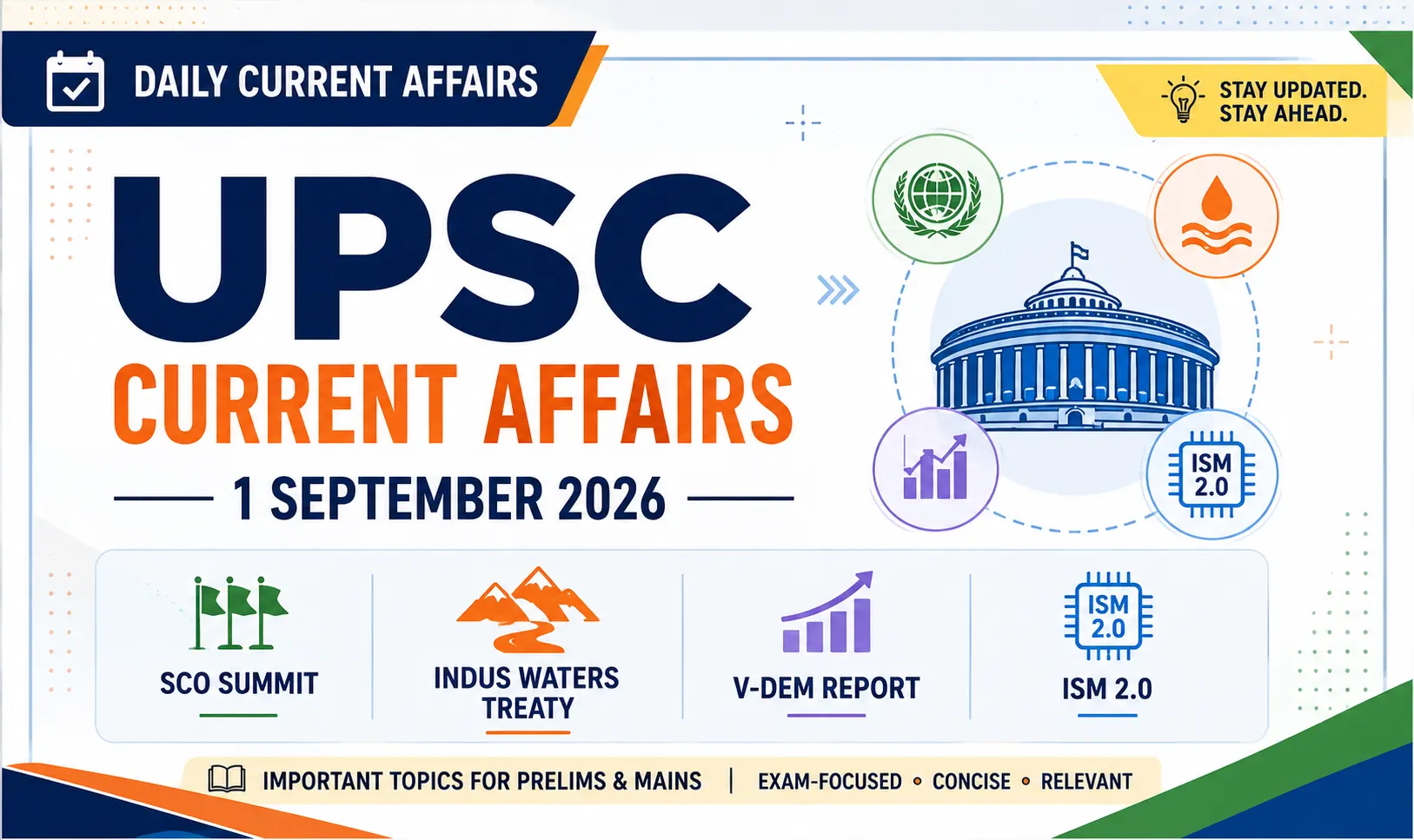
A single day’s newspaper rarely feels this loaded for a UPSC aspirant. On 1 September 2026, the headlines ranged from Prime Minister Modi’s meeting with Iran’s President on the sidelines of the SCO Summit, to India rejecting a Hague court ruling on the Indus Waters Treaty, to a democracy watchdog putting India’s score at its lowest since the Emergency. Add in vultures dying on power lines, a semiconductor mission getting a ₹1.28 lakh crore boost, and NASA testing a radiation vest on the Moon — and you have a genuinely GS I, II and III mix in one day. Here is a clean, exam-oriented breakdown of every topic, organised the way you’ll actually need it for Prelims and Mains.
Today Current Affairs for UPSC 2026 | Overview
| Topic | GS Paper / Relevance | Why in News (Short) |
|---|---|---|
| India–Iran Ties at the SCO Summit | GS II — IR, Bilateral Relations | PM Modi met Iran’s President at the SCO Summit in Kyrgyzstan; urged peace and freedom of navigation in the Strait of Hormuz |
| AYUSH Medical Education Regulation | GS II — Health, Education | Private colleges run 86% of Ayurveda and 85% of homoeopathy seats; rapid growth flagged for quality/faculty gaps |
| Power Lines & Vulture Electrocution | GS III — Conservation, Biodiversity | Study flags electrocution from power infrastructure as a rising threat to India’s Critically Endangered vultures |
| Political Demography & Federalism | GS II — Federalism, Population | Natalism debate heats up ahead of Census 2027/delimitation; sharp state-wise fertility and median-age gaps |
| The Baltic Way & Gandhi’s Imprint | GS I — Modern World History | 37th anniversary of the 1989 Baltic Way human chain; Gandhian non-violence shaped the Singing Revolution |
| V-Dem Democracy Report on India | GS II — Polity, Institutions | V-Dem Institute rates India’s democracy score at its lowest since 1975; links to UN CERD’s electoral-roll concerns |
| Indus Waters Treaty & PCA Ruling | GS II — International Treaties | India rejects Hague Court of Arbitration’s ruling on IWT, citing lack of jurisdiction |
| INS Nipun (Diving Support Vessel) | Prelims — Defence | Navy commissions its second Nistar-class DSV, built indigenously by HSL Visakhapatnam |
| CERN’s Future Circular Collider | GS III — Science & Technology | CERN Director-General says India could be part of its next-gen 91-km collider project |
| India Semiconductor Mission 2.0 | GS III — Indigenisation, Tech | ₹1.28 lakh crore ISM 2.0 notified, covering six pillars of the semiconductor value chain |
| Ramon Magsaysay Awards 2026 | Prelims — Awards | Tommy Koh (Singapore), Bo Kyi (Myanmar) and Runa Khan (Bangladesh) named this year’s winners |
| AstroRad Radiation Shielding Vest | GS III — Space Technology | NASA/Artemis I data shows the AstroRad vest can cut astronaut radiation exposure by up to 60% |
Today Current Affairs for UPSC 2026 | India–Iran Ties at the SCO Summit and the Strait of Hormuz
Syllabus Mapping: GS Paper II — India and its Neighbourhood, Bilateral/Regional Groupings, Effect of Policies of Developed & Developing Countries on India’s Interests
Why in News?
On the sidelines of the SCO (Shanghai Cooperation Organisation) Summit in Kyrgyzstan, Prime Minister Narendra Modi held the first top-level meeting between India and Iran since the West Asia war began in February. He met Iranian President Masoud Pezeshkian in Bishkek and urged Tehran to ensure “peace, stability and freedom of navigation” in the Strait of Hormuz, even as fresh U.S.-Iran military exchanges were reported the same week.
Core Facts & Background
- President Pezeshkian blamed Israel and the U.S. for the ongoing conflict and asked India to use its “extensive contacts with various parties” to help the dialogue process.
- India’s stated position rested on three pillars: restoring lasting peace in West Asia, protecting freedom of navigation through Hormuz, and continued support for diplomatic solutions over military ones.
- The Strait of Hormuz is a narrow but critical waterway linking the Persian Gulf to the Gulf of Oman and the Arabian Sea — one of the world’s busiest routes for oil and gas shipments. Any disruption there pushes up global energy prices and directly hits India, which depends heavily on imported crude.
- Iran matters to India beyond the current crisis: it opens a connectivity corridor to Central Asia and Afghanistan through Chabahar Port, holds large oil and gas reserves relevant to India’s energy security, and — because of its close ties with Russia and China — engaging Tehran helps India keep its foreign policy balanced rather than one-sided.
- On the same trip, the PM also visited Uzbekistan, where 11 agreements were signed covering uranium supply, an expansion of India’s International North-South Transport Corridor-linked connectivity, critical minerals mining and processing, a jump in bilateral trade ambition from $1 billion to $5 billion by 2030, an ecological-restoration grant for the Aral Sea, defence, and cultural exchange. The visit underlined India’s twin interest in Central Asia — resource access and strategic depth, especially given the region is a “double landlocked” bloc.
- On the SCO itself: established in 2001 in Shanghai, its charter came into force in 2003, and its official languages are Russian and Chinese. The bloc’s membership has expanded from the original six (“TRUCKK” grouping) to include India and Pakistan (2017), Iran (2023) and Belarus (2024) — ten members in total today.
Pros & Cons
| Pros for India | Cons / Challenges |
|---|---|
| Direct diplomatic channel with Iran despite Western sanctions pressure | U.S. sanctions complicate India’s economic engagement with Tehran |
| Chabahar Port gives an alternative route bypassing Pakistan | Regional conflict can delay or raise costs of connectivity projects |
| Diversified energy and mineral partnerships (Iran, Uzbekistan) | India must simultaneously balance ties with Israel, the U.S. and Gulf Arab states |
| SCO platform strengthens India’s Central Asia outreach | Continuing instability around Hormuz threatens crude oil imports and shipping insurance costs |
Way Forward
India needs to keep dialogue open with Iran and all regional actors, actively protect freedom of navigation for international shipping, fast-track alternative connectivity routes like Chabahar, diversify its energy sources to cut vulnerability to Gulf disruptions, and maintain a genuinely balanced West Asia policy rooted in its own national interest rather than any single bloc’s position.
Today Current Affairs for UPSC 2026 | AYUSH Medical Education: Rapid Expansion, Weak Regulation
Syllabus Mapping: GS Paper II — Issues Relating to Development and Management of Social Sector/Services relating to Health, Education
Why in News?
Government data for 2024 shows that private, non-government institutions now run 86% of India’s Ayurveda colleges and 85% of homoeopathy colleges — a sign that private players, not the state, are driving the explosive growth of AYUSH medical education. This expansion is now under scrutiny for accompanying quality problems.
Core Facts & Background
- Between 2021 and 2024, permitted seats in AYUSH institutions rose 43%, and total admission capacity rose 25%, coinciding with the Centre’s AYUR-GYAN scheme allocation for AYUSH education, training, research, innovation and capacity-building rising nearly sixfold.
- AYUSH itself is an umbrella term covering Ayurveda, Yoga & Naturopathy, Unani, Siddha, and Homoeopathy.
- Concerns are not new: a 2005 CAG audit found insufficient hospital beds, outpatient services and staff widespread among homoeopathy colleges (bed occupancy ranging from 1% to as low as 71% at some hospitals of 100-bed capacity). A 2020 study in the Journal of Ayurveda and Integrative Medicine similarly found more than half the teaching-staff requirement missing at many institutions.
- The regulator, the National Commission for Indian System of Medicine (NCISM), has withheld or denied permission to institutions after inspections exposed gaps. As of 21 August, it had listed 17 Ayurveda colleges — all private — whose permissions were denied, several for “non-compliance with inspection process.”
- In the Hillside Ayurveda Medical College case (2023), the Karnataka High Court noted that institutions are sometimes “guilty of admitting excess students for financial gains.”
- The National Commission for Homoeopathy has given 41% of all homoeopathy colleges its lowest grade — including nearly half of all private institutions — pointing to a pattern of inadequate faculty, weak laboratories, poor clinical infrastructure, excessive student intake and even allegations of fictitious faculty.
Pros & Cons
| Pros of Private-Led Expansion | Cons / Regulatory Concerns |
|---|---|
| Rapidly increases seat availability for AYUSH aspirants | More colleges do not automatically mean better-trained doctors |
| Reduces pressure on limited government infrastructure | Persistent shortage of qualified faculty affecting training quality |
| Encourages competition and capacity-building in the sector | Poor clinical/lab infrastructure limits practical exposure |
| Aligns with rising domestic and global demand for AYUSH systems | Weak compliance with NCISM inspection norms; incentive to over-admit students for revenue |
Way Forward
The article’s own framing is instructive: the problem is not private participation itself, but expansion without matching quality control. Priorities going forward include strict pre-permission inspections, enforceable minimum standards for faculty, labs, hospitals and clinical training, real penalties for excess admissions and fake faculty listings, and stronger, better-resourced AYUSH regulators — with seat expansion tied to actual availability of teachers and infrastructure, not just demand.
Today Current Affairs for UPSC 2026 | Power Infrastructure and India’s Vulture Crisis
Syllabus Mapping: GS Paper III — Conservation, Environmental Pollution and Degradation, Biodiversity
Why in News?
For decades, the chief threat to India’s vultures was the veterinary painkiller diclofenac. A recent study — reported by The Hindu and based on findings in the Journal of Threatened Taxa — flags a second, escalating danger: electrocution from India’s rapidly expanding power infrastructure.
Core Facts & Background
- In the 1990s, India’s vulture population crashed by around 99.5% from roughly four crore birds in the 1980s, wiping out most of the white-rumped, Indian, and slender-billed vultures. The cause was diclofenac, which destroys vulture kidneys when they feed on treated cattle carcasses.
- The decline had real human costs: with fewer vultures cleaning up carcasses, feral dog populations and rabies outbreaks rose; a 2024 American Economic Review study estimated this pushed up human mortality by 4% and cost India $69.4 billion a year.
- India banned diclofenac for veterinary use, with additional bans in 2023 on similar NSAIDs — aceclofenac and ketoprofen.
- Electrocution is now emerging as a serious additional threat because of three factors: vultures have very wide wingspans, so they can touch two live conductors simultaneously; they prefer perching on elevated structures like poles and pylons; and people sometimes dump animal carcasses or food waste near electrical installations, drawing vultures straight into danger zones.
- A study near Dehradun found that relocating a livestock-carcass dump just 2.4 km away from high-tension power infrastructure may have saved vultures — including an Egyptian vulture and steppe eagles — from electrocution; notably, some of these deaths occurred on medium-voltage, not just high-voltage, lines.
- An official 2025 survey found vultures nesting at only about 50% of their historical nesting sites.
- India has four Critically Endangered vulture species: White-rumped Vulture (Gyps bengalensis), Slender-billed Vulture (Gyps tenuirostris), Indian/Long-billed Vulture (Gyps indicus), and Red-headed Vulture (Sarcogyps calvus). The Egyptian Vulture is rated Endangered.
Pros & Cons
| What’s Working | What’s Still a Problem |
|---|---|
| Diclofenac ban has removed the single biggest historical killer | Electrocution risk is under-documented since dead birds are often removed or scavenged |
| Additional NSAID bans (2023) show regulatory responsiveness | Power infrastructure expansion is outpacing bird-safety retrofitting |
| Vulture Conservation Breeding Centres and Safe Zones exist | Feeding-site placement near power lines remains poorly managed in many areas |
Way Forward
A one-drug-ban strategy is no longer enough. India’s 2020–2025 Action Plan for Vulture Conservation calls for an integrated approach: insulating conductors and increasing the gap between energised and grounded components, installing safe perches away from equipment, keeping carcass-dumping sites away from power infrastructure, monitoring veterinary NSAIDs for vulture toxicity, and expanding conservation-breeding centres and Vulture Safe Zones.
Today Current Affairs for UPSC 2026 | Political Demography, Federalism and the 2027 Census
Syllabus Mapping: GS Paper II — Federalism, Issues arising out of Design & Implementation of Policies; also links to Population and Associated Issues
Why in News?
With India’s first delimitation exercise since the pending Census now expected after 2026, questions of fertility, migration and ageing patterns across states are gaining fresh political urgency — a field the article calls natalism, or pronatalism.
Core Facts & Background
- Natalism is the belief system encouraging higher birth rates. Politicians across the spectrum — from Andhra Pradesh CM Chandrababu Naidu and Tamil Nadu’s DMK/Dravidian leaders to Tamil Nadu Vettri Kazhagam founder T.T.V. Dhinakaran — have publicly urged families to have more children, some citing demographic “vote share” anxieties.
- India’s total fertility rate (TFR) has fallen below the replacement level of 2.1 to about 1.9–2.0 children per woman, though the decline is uneven: NFHS-5 data shows Muslim fertility fell faster (from 4.4 in 1992 to 2.4 in 2019-21) than the majority religious group’s, narrowing historical gaps between communities.
- Migration adds another layer: roughly 45 crore Indians are internal migrants (2011 Census figure cited in the piece), and about a lakh Indians give up citizenship every year, generally moving from opportunity-poor to opportunity-rich regions.
- Median age varies sharply by state: Kerala’s is already around 37 years in 2026 and is projected to reach 47 by 2051, while Uttar Pradesh’s median age is only around 29.2 years in 2026, projected to reach just 31.7 by 2036 — making it one of India’s youngest states for decades to come.
- The political stakes: post-delimitation seat allocation is expected to follow updated population data. States with faster-declining fertility (mostly southern states) worry about losing relative political weight and Lok Sabha seats even though they contributed disproportionately to development and lower population growth — a genuine federalism dilemma. This intersects with the Finance Commission’s tax-devolution formula, where a state’s population share already carries significant weight (about 41% weightage cited).
- Global comparison: countries like Japan, South Korea, China and Italy have tried financial incentives, childcare support and parental leave to lift fertility, but with limited success — suggesting fertility decline is not purely a “money problem” but tied to housing, employment, education, gender relations and the cost of raising children.
Pros & Cons
| Arguments for Weighing Population Change Carefully | Arguments Against Pure Natalist Framing |
|---|---|
| Ageing states genuinely need higher fiscal/health investment for elderly care | Natalism is often oversimplified rhetoric — no country has reliably reversed sustained fertility decline through appeals alone |
| Younger states need job creation matching their working-age bulge | Framing fertility as “conspiracy” or “replacement theory” spreads misinformation instead of addressing real policy gaps |
| Updated Census data is essential for accurate representation | Politicising demography risks turning legitimate regional differences into permanent political antagonism |
Way Forward
The core suggestion is to treat political demography as a serious field of study rather than a marginal or conspiracy-adjacent topic. India needs a federal balance that achieves reasonably even development outcomes, growth, opportunities and political power across social groups and states — recognising that identity and demographic change are real and largely irreversible, and must be managed through sensitive policy design and imaginative federal thinking, not through blame or panic.
Today Current Affairs for UPSC 2026 | The Baltic Way, the Singing Revolution and Gandhi’s Global Imprint
Syllabus Mapping: GS Paper I — Modern World History (Effects of Events such as World Wars on Society); History of the World — Nationalism, Movements of Freedom
Why in News?
23 August 2026 marked the 37th anniversary of the Baltic Way — the 1989 human chain across Lithuania, Latvia and Estonia — reviving discussion on how Gandhian non-violence directly shaped the Baltic states’ peaceful campaign to break from Soviet rule.
Core Facts & Background
- The Baltic states gained independence after World War I but lost it in 1940 when the Soviet Union annexed them, following the 1939 Molotov-Ribbentrop Pact’s secret protocol dividing Eastern Europe into German and Soviet spheres.
- The Singing Revolution (1986–91) — a peaceful movement built around mass singing, protest songs and civic mobilisation during Gorbachev’s perestroika and glasnost — culminated in the Baltic Way: on 23 August 1989, around two million people formed a 675-km human chain from Tallinn through Riga to Vilnius, demanding freedom from Soviet rule. It is UNESCO Memory-of-the-World and Guinness-recognised as a landmark act of civil resistance.
- Gandhian influence was explicit and documented: Lithuanians and Latvians recalled watching Richard Attenborough’s 1982 film Gandhi broadcast on national television for 24 hours to educate citizens on non-violent resistance; facing Soviet troops, protesters repeated “We won’t fight,” “We follow Gandhi” and “We are peaceful people.”
- Latvian scholar Maija Kūle noted that, lacking home-grown theorists of non-violence, Baltic activists turned to global figures like Gandhi and Martin Luther King Jr. The late Lithuanian ideologue Gražina Miniotaitė similarly regarded Gandhi as the most successful thinker in combining non-violent theory and practice.
- Since 1992, the Baltic states have deepened Gandhian and cultural ties with India — cooperation now spans technology, sustainability, the blue economy and culture. India’s bilateral trade with Lithuania stood at roughly $490.61 million, with Latvia at $475.66 million and Estonia at $219.69 million in 2025–26.
- Personal India-Baltic Gandhian links go further back: Gandhi’s Lithuanian-born “soulmate” Hermann Kallenbach, Antanas Poška’s meetings with Gandhi, and continuing commemorations like the Gandhi-Kallenbach monument (established 2015) and annual Kallenbach Memorial Lectures.
Pros & Cons
| Significance / Positives | Limitations of the Comparison |
|---|---|
| Demonstrates the universal, exportable power of non-violent civil resistance | The Baltic movement operated under very different geopolitical conditions (a weakening USSR) than colonial India |
| Cements a genuine, decades-long India-Baltic diplomatic and cultural relationship | Modern commemorations risk becoming symbolic without translating into deeper strategic cooperation |
| Offers a rich, ready-made GS I answer-writing example on the global influence of Indian freedom movement ideas | — |
Way Forward
The Baltic Way stands as a live example of how moral authority — Gandhi’s satyagraha, mass mobilisation and non-cooperation — can outweigh military power. For India, sustaining and formalising these historical and cultural ties (via trade, memorials, lecture series and educational exchange) keeps this soft-power legacy relevant to contemporary diplomacy, not just history books.
Today Current Affairs for UPSC 2026 | V-Dem’s Democracy Index: India at Its Lowest Since 1975
Syllabus Mapping: GS Paper II — Indian Constitution, Comparison of Indian Constitutional Scheme with other Countries; Issues Relating to Development of Judiciary, Institutions
Why in News?
The Varieties of Democracy (V-Dem) Institute, based at the University of Gothenburg, Sweden, has rated India’s democracy index score at its lowest level since 1975 — the year the Emergency was imposed. The report’s findings align closely with concerns the UN Committee on the Elimination of Racial Discrimination (CERD) raised about the exclusion of large numbers of voters, particularly Muslims, during India’s electoral roll revisions.
Core Facts & Background
- V-Dem measures democracy using a multidimensional approach across categories such as electoral, liberal, participatory, deliberative and egalitarian democracy — not simply whether elections are held, but whether they are free and fair, whether institutions are independent, and whether citizens’ rights are protected.
- India’s electoral democracy score was 0.39 in 2025 — only marginally above the 0.38 recorded in 1975 — after peaking around 0.73 in earlier decades and declining steadily since the late 2000s. On this measure, India ranks 106th among 179 countries, with Denmark topping the list.
- Sharpest declines were recorded in: Election Management Body (EMB) autonomy and the conduct of free and fair elections; judicial compliance, corruption influencing judicial decisions, and judicial accountability; freedom of academic and cultural expression, including academic exchange, freedom to research and teach, and institutional autonomy; and media-related indicators — government censorship, media bias and harassment of journalists.
- Other indicators in decline include access to justice, rigorous and impartial public administration, private property rights and freedom of religion — most reaching their lowest points in 50 years.
- The UN CERD review — India’s first since 2007 — expressed being “gravely concerned” about reports of large-scale voter exclusion by law-enforcement officials, with particular reference to Muslims, in the context of the Special Intensive Revision (SIR) of electoral rolls.
Pros & Cons
| Institutional Strengths Cited Elsewhere | Areas of Documented Decline (per V-Dem) |
|---|---|
| India continues to hold regular, large-scale elections | EMB autonomy and free-and-fair election indicators falling |
| Judiciary retains formal independence in structure | Judicial accountability and corruption-influence indicators worsening |
| Vibrant civil society and media landscape exists on paper | Media censorship, bias and journalist harassment rising |
| Strong constitutional guarantees for academic and religious freedom | Academic freedom and institutional autonomy scores declining |
Way Forward
“Democratic backsliding” — a gradual weakening of democracy rather than a sudden collapse — happens through eroding institutions, shrinking civil liberties, media pressure and weaker checks and balances. Suggested corrective steps include: strengthening the autonomy and accountability of institutions like the Election Commission and judiciary; making electoral-roll revision transparent, with clear procedures, adequate notice, easy correction/appeal mechanisms and special attention to vulnerable groups; protecting space for opposition, civil society, journalists and academics; and reinforcing institutional checks between the executive, legislature and judiciary.
Today Current Affairs for UPSC 2026 | India Rejects Hague Court’s Indus Waters Treaty Ruling
Syllabus Mapping: GS Paper II — Bilateral, Regional and Global Groupings and Agreements Involving India and/or Affecting India’s Interests; International Treaties/Agreements
Why in News?
Hours after the Permanent Court of Arbitration (PCA) at The Hague ruled that the Indus Waters Treaty (IWT) remains “fully in force” and called on India to observe its obligations, India’s External Affairs Ministry flatly rejected the ruling, saying the tribunal itself was a “grave violation” of the treaty and has no jurisdiction over India’s sovereign decisions.
Core Facts & Background
- The IWT was signed in 1960 between India and Pakistan, with the World Bank playing a key facilitating role. Under it, the Eastern Rivers (Ravi, Beas, Sutlej) are allocated primarily to India, and the Western Rivers (Indus, Jhelum, Chenab) primarily to Pakistan, with specified rights reserved for India — including hydroelectric power generation, subject to treaty design conditions.
- India placed the treaty in abeyance on 22 April 2025, following the Pahalgam terror attack, and has maintained since that normal treaty cooperation is untenable in the context of continuing cross-border terrorism.
- The PCA’s ruling came on an “award” concerning the Ratle Hydro-Electric Plant (RHEP) on the Chenab river in Jammu & Kashmir, examining India’s grounds for placing the treaty in abeyance and concluding “none of these grounds could justify suspension or termination of the Treaty.”
- The Court also imposed interim measures — in a unanimous decision — prohibiting India from concreting the RHEP’s dam wall and power-intake structure above certain levels until 90 days after the Neutral Expert’s final decision, which is expected in July 2027.
- India’s rejection rests on procedural grounds: it says it has never recognised the existence of, or appeared before, this “illegally constituted” Court of Arbitration, arguing its very establishment breaches the treaty’s own dispute-resolution framework — which instead provides for a Permanent Indus Commission, a Neutral Expert, and only then (if unresolved) a Court of Arbitration under specific conditions.
- India maintains the court’s pronouncements — now or in future — will have no effect on India’s actions regarding its own projects on the Western Rivers.
Pros & Cons
| India’s Position — Strengths | Risks / Complications |
|---|---|
| Asserts sovereign control over hydropower development on Western Rivers | Sets up a prolonged, unresolved international legal dispute with Pakistan |
| Uses the treaty’s own dispute-hierarchy argument (Neutral Expert vs Arbitration Court) to challenge jurisdiction | Could affect India’s broader credibility in international treaty commitments if seen as selectively rejecting rulings |
| Links treaty status to genuine security concerns (cross-border terrorism) | Delays and raises costs for hydroelectric projects like Ratle due to ongoing legal uncertainty |
| Keeps leverage over a resource India considers strategically vital | Basin-wide water management coordination with Pakistan becomes harder amid the standoff |
Way Forward
Prelims-relevant facts to lock in: IWT signed 1960, facilitated by the World Bank; Eastern Rivers (Ravi, Beas, Sutlej) to India; Western Rivers (Indus, Jhelum, Chenab) to Pakistan with India’s specified rights; Ratle HEP is on the Chenab; and the Neutral Expert and Court of Arbitration are distinct dispute-resolution tracks under the treaty. On the policy side, the article’s framing suggests India and Pakistan should preserve technical and diplomatic channels for water issues, use dispute mechanisms strictly within the agreed treaty framework, and place greater emphasis on basin-level water management — especially given climate change’s effect on glacier melt and rainfall patterns — while protecting both national security and long-term water security.
Likely UPSC Mains Question: “The Indus Waters Treaty has survived several India-Pakistan conflicts, but the recent dispute raises questions about treaty obligations, international arbitration and national sovereignty.” Discuss.
Today Current Affairs for UPSC 2026 | INS Nipun: India’s Second Nistar-Class Diving Support Vessel
Syllabus Mapping: Prelims — Defence and Security; also touches GS III (Indigenisation of Technology, Atmanirbhar Bharat)
Why in News?
The Indian Navy commissioned INS Nipun at the Naval Dockyard, Mumbai, in a ceremony presided over by the Chief of the Naval Staff, Admiral Krishna Swaminathan.
Core Facts & Background
- INS Nipun is the second Diving Support Vessel (DSV) of the Nistar class — the first being INS Nistar.
- A DSV is a specialised naval ship built to support underwater operations: deep-sea diving, underwater inspection and intervention, salvage and recovery, submarine rescue, and other complex underwater missions.
- INS Nipun was indigenously designed and built by Hindustan Shipyard Limited (HSL), Visakhapatnam — reinforcing India’s Atmanirbhar Bharat push in defence shipbuilding.
- Its induction significantly enhances the Navy’s capability in deep-sea diving, underwater intervention and submarine rescue — an important part of overall maritime security and blue-water capability.
Pros & Cons
| Strategic Value | Points to Note |
|---|---|
| Strengthens India’s submarine-rescue and deep-sea response capability | Only the second vessel of its class — capacity is still limited relative to India’s coastline and undersea assets |
| Fully indigenous design/construction supports domestic shipbuilding industry | Continued investment needed to build a fuller fleet of specialised support vessels |
| Enhances readiness for underwater emergencies and salvage operations | — |
Way Forward
Continued development of indigenous underwater technologies, strengthening submarine rescue and deep-sea emergency response systems, further investment in diving, salvage and underwater surveillance capability, and greater participation of Indian industry in specialised naval shipbuilding are the natural next steps flagged around this commissioning.
Today Current Affairs for UPSC 2026 | CERN’s Future Circular Collider and India’s Growing Role
Syllabus Mapping: GS Paper III — Science and Technology, Awareness in IT, Space, Computers, Robotics, Nano-technology; Achievements of Indians in Science & Technology
Why in News?
Mark Thomson, Director-General of CERN (European Organization for Nuclear Research), visiting Mumbai for the India premiere of the documentary “The Peace Particle,” said CERN is actively exploring how India can be part of its future — including its next-generation mega-project, the Future Circular Collider (FCC).
Core Facts & Background
- CERN, located near Geneva on the France-Switzerland border, operates the Large Hadron Collider (LHC) — the world’s largest and most powerful particle accelerator, running through a 27-km underground tunnel that smashes two beams of subatomic particles together at near light-speed. The Higgs boson — the so-called “God particle” — was discovered using the LHC in 2012.
- The LHC was officially shut down on 29 June 2026 and will remain offline until 2030 while CERN builds the High-Luminosity LHC (HL-LHC) — an upgrade using previously unused technologies to deliver 10 times more brightness/data than the current LHC, aimed at studying the Higgs boson in greater detail and searching for new particles.
- Looking further ahead, CERN is exploring the Future Circular Collider (FCC) — a proposed 91-km ring, nearly 3.5 times the LHC’s length, expected to be operational by 2045-48 in its first stage; its final stage would collide electrons and positrons. The project is not yet approved, and CERN expects a decision by 2028.
- Thomson noted that despite major discoveries, scientists still don’t understand why the universe contains far more matter than antimatter, the nature of dark matter and dark energy, and why roughly 95% of the universe’s mass-energy remains unexplained.
- On India specifically, Thomson said India has “excellent technologies, is well-organised and has brilliant people,” and that CERN is actively looking at how India can be part of its future projects — spanning particle physics, detector technology, engineering, computing and data analysis.
Pros & Cons
| Benefits of Deeper India-CERN Engagement | Challenges |
|---|---|
| Access to advanced scientific infrastructure unavailable domestically | Mega-science projects require enormous, long-term funding commitments |
| Opportunities for Indian scientists/engineers to work with top global researchers | Benefits are long-horizon (FCC itself is decades away) |
| Boosts India’s capability in magnets, detectors, electronics, computing | Requires sustained government and institutional coordination to translate access into outcomes |
| Some spin-off technologies (medical imaging, advanced computing) have real-world civilian use | — |
Way Forward
Greater Indian participation in CERN’s future projects can mean access to frontier infrastructure, training of highly skilled scientific manpower, technology transfer, and stronger international research collaboration — all of which feed back into India’s own strategic technological capability, well beyond pure particle physics.
Today Current Affairs for UPSC 2026 | India Semiconductor Mission 2.0: ₹1.28 Lakh Crore Push
Syllabus Mapping: GS Paper III — Indigenisation of Technology, Infrastructure, Investment Models; Science and Technology
Why in News?
The Ministry of Electronics and Information Technology (MeitY) notified Phase 2 of the India Semiconductor Mission (ISM 2.0), with an outlay of ₹1.28 lakh crore targeting a much broader slice of the electronics manufacturing value chain than Phase 1 did.
Core Facts & Background
- ISM 2.0 rests on six pillars, and — notably — all categories are fungible, meaning the share of investment each pillar receives isn’t rigidly fixed:
- Semiconductor Design — support for chip design, especially for chips used in strategically important industries, with a focus on designs owned by Indian companies/entrepreneurs.
- Equipment & Materials — incentives for manufacturing semiconductor equipment and the specialised chemicals/gases used in chip production.
- Semiconductor Manufacturing (Fabs) — capital subsidies of up to 40% from the Centre to encourage more fabrication plants in India.
- Packaging & Testing — capital subsidy support for Assembly, Testing, Marking and Packaging (ATMP) facilities.
- Research & Development — financial support of up to 75% of project cost, aimed at developing indigenous semiconductor technologies.
- Talent Development — support at the same level as R&D, focused on building a skilled semiconductor workforce.
- Under ISM 1.0, the capital subsidy for chip projects was 50%; ISM 2.0 has reduced this to 40% for setting up fabs, reflecting increased global enthusiasm among private players and additional support now being offered directly by state governments (unlike Phase 1, which had no central land subsidy — land was purely a state-government responsibility).
- IT Minister Ashwini Vaishnaw framed the goal explicitly: “People should become dependent on our country, on our industry, on our production, on our design… That should be our goal as a country.”
- Semiconductors underpin smartphones, computers, automobiles, telecommunications, defence systems, AI hardware and consumer electronics — and because global supply chains are highly concentrated in a few countries, disruptions ripple across nearly every industry.
Pros & Cons
| Strategic Benefits | Persistent Challenges |
|---|---|
| Reduces India’s dependence on foreign semiconductor supply chains, aiding strategic autonomy in defence and telecom | Semiconductor fabs need enormous capital and highly specialised technology/expertise |
| Broadens support beyond fabrication alone (design, R&D, talent) — a more complete ecosystem approach | Reliable water and power supply remains a bottleneck for fab-heavy states |
| Can create high-skilled jobs and attract global supply-chain diversification away from concentrated hubs | India still faces stiff competition from established hubs in East Asia, the U.S. and Europe |
| R&D support up to 75% of project cost encourages genuine indigenous innovation | Skilled semiconductor engineering manpower remains in short supply domestically |
Way Forward
The stated priority is building a complete semiconductor ecosystem rather than chasing fabs alone — strengthening industry-university-research partnerships, increasing investment in indigenous chip design and R&D, developing dedicated semiconductor industrial clusters with reliable power/water/logistics, building a much larger pool of skilled professionals, and integrating semiconductor policy tightly with India’s electronics, AI, telecom and defence manufacturing strategies.
Prelims-style Question (from the source material): With reference to the India Semiconductor Mission 2.0 (ISM 2.0), consider the following statements:
- It offers a uniform 50% capital subsidy from the Centre for all new silicon wafer fabrication projects.
- The financial incentives under the scheme cover the broader semiconductor value chain, including chip design, equipment manufacturing, and talent development.
- The mission has been notified by MeitY with an overall outlay of approximately ₹1.27 lakh crore.
Which of the statements given above are correct? (a) 1 and 2 only (b) 2 and 3 only (c) 1 and 3 only (d) 1, 2 and 3
Answer: (b) 2 and 3 only — Statement 1 is incorrect since ISM 2.0 actually reduced the Central capital subsidy for silicon wafer fabs to 40% (from 50% under ISM 1.0).
Today Current Affairs for UPSC 2026 | Ramon Magsaysay Awards 2026: Winners and Significance
Syllabus Mapping: Prelims — Important Persons, Places, Awards (also relevant for GS I/II essay material on human rights and grassroots service)
Why in News?
This year’s Ramon Magsaysay Awards — often called Asia’s Nobel Prize — were announced, honouring a Singaporean diplomat, a Myanmar democracy activist, and a Bangladeshi humanitarian worker.
Core Facts & Background
- Tommy Koh (88, Singapore) — a lawyer and diplomat recognised for promoting international dialogue and the rule of law. He is best known for presiding over a UN conference of more than 150 countries that adopted the UN Convention on the Law of the Sea (UNCLOS) in 1982 — described by the awards body as a landmark “constitution for the oceans” defining territorial waters, coastal economic rights and dispute-settlement mechanisms.
- Bo Kyi (61, Myanmar) — honoured for a life spent resisting human rights violations by Myanmar’s military. He spent seven years in prison himself, and in March 2000 co-organised the Assistance Association for Political Prisoners, which documents political imprisonment, supports detainees and their families, and works to keep the visibility of the junta’s political prisoners internationally salient.
- Runa Khan (67, Bangladesh) — recognised for her “profound empathy for the poorest of the poor” in her country. Coming from an affluent family, she first served as a teacher to poor children in 1979, and in 2002 established “Friendship Bangladesh,” an organisation helping the most destitute deal with climate change, educate their children, empower women, create livelihood opportunities and bring social justice to excluded communities.
Pros & Cons
(Not directly applicable to an awards-based factual topic — instead, key exam-relevant significance points:)
- Highlights maritime law (UNCLOS), civil-political rights advocacy, and grassroots humanitarian work as three distinct but equally valued categories of public service recognised by the Magsaysay Foundation.
- Reinforces India-relevant linkages: UNCLOS underpins India’s own maritime boundary and Exclusive Economic Zone claims, making Tommy Koh’s UNCLOS work directly relevant to India’s maritime law preparation.
Way Forward
For Prelims, remember the award is Asia’s equivalent of the Nobel Prize, administered by the Ramon Magsaysay Award Foundation in the Philippines; for this year, associate Tommy Koh with UNCLOS/Singapore, Bo Kyi with Myanmar’s political-prisoner rights, and Runa Khan with poverty/climate humanitarian work in Bangladesh.
Today Current Affairs for UPSC 2026 | AstroRad: A Lighter Radiation Shield for Astronauts
Syllabus Mapping: GS Paper III — Science and Technology, Space Technology, Awareness in the Field of Space
Why in News?
Radiation remains one of the biggest obstacles to long-duration human spaceflight, since astronauts travelling beyond Earth’s protective magnetic field face heightened cancer and other health risks. An Israeli company’s radiation-shielding vest, AstroRad, has shown promising results in reducing that risk — based on data released from NASA’s Artemis I mission.
Core Facts & Background
- Earth’s magnetic field naturally shields us from most harmful radiation, but astronauts flying beyond it — to the Moon or eventually Mars — lose that protection. Adding conventional heavy shielding is impractical because every extra kilogram sharply raises launch costs.
- AstroRad was developed by the Israeli company StemRad — which originally built a similar suit for ground-based emergency responders — in partnership with Lockheed Martin.
- The vest targets the body’s most radiation-sensitive areas: chest, abdomen, pelvis, bone-marrow-rich zones, and organs like the heart and lungs. It uses hydrogen-rich polymers rather than dense materials like lead, because hydrogen nuclei are similar in mass to the radiation particles themselves and so transfer energy more efficiently during collisions — slowing the particles down more effectively for the same weight.
- NASA tested AstroRad aboard the International Space Station in 2019–20, gathering astronaut feedback on comfort and functionality to refine the design.
- An improved version flew on NASA’s Artemis I mission in 2022: the uncrewed capsule carried two human-shaped dummies, Helga and Zohar, both fitted with materials mimicking human tissue and radiation sensors — but only Zohar wore AstroRad, while Helga did not, allowing a direct comparison.
- Results, published in Science Advances on 12 August, and modelled against historical solar radiation events, found AstroRad could have reduced an astronaut’s effective radiation dose by 60% during the August 1972 solar storm and 40% during the October 1989 solar storm — equivalent to 193 and 131 fewer days of deep-space radiation exposure, respectively.
- Its key limitation: AstroRad is designed mainly to counter solar particle radiation from solar storms/flares, not galactic cosmic rays — extremely energetic particles originating outside the solar system, which remain much harder to block.
Pros & Cons
| Advantages | Limitations |
|---|---|
| Provides targeted protection to vital organs without the weight penalty of full-spacecraft shielding | Cannot adequately block galactic cosmic rays, a major long-duration mission risk |
| Tested and refined through real spaceflight data (ISS, Artemis I) | It is a supplementary tool, not a complete radiation-shielding solution |
| Could let astronauts continue limited work during a solar storm instead of full shelter-in-place | Effectiveness demonstrated so far is modelled against historical storms, not yet a live crewed mission |
Way Forward
For astronauts heading back to the Moon and eventually to Mars, the research team suggests AstroRad could let crews partially continue working through a solar storm rather than sheltering for its entire duration — a small but meaningful step toward safer interplanetary spaceflight. Long-term, missions will likely need a combination approach: spacecraft shielding, regolith- or water-based shielding, dedicated storm shelters, wearable protection like AstroRad, and better solar-radiation forecasting.
Top 5 FAQs
Q1. Why did India reject the Permanent Court of Arbitration’s ruling on the Indus Waters Treaty? India rejected the ruling because it says the Court of Arbitration itself was unlawfully constituted in breach of the treaty’s own dispute-resolution hierarchy (Permanent Indus Commission → Neutral Expert → Court of Arbitration), and India has never recognised or appeared before this body. India maintains it has “never recognised” this tribunal’s jurisdiction over its sovereign decisions on the treaty, which it placed in abeyance after the Pahalgam terror attack in April 2025.
Q2. What does V-Dem’s low democracy score for India actually measure? The V-Dem Institute’s score is not just about whether India holds elections — it evaluates multiple dimensions including Election Management Body autonomy, judicial independence and accountability, media freedom, academic freedom, access to justice and impartial public administration. India’s 2025 score of 0.39 is its lowest since 1975 (the Emergency year), reflecting declines across most of these indicators, not a single factor.
Q3. What is the difference between ISM 1.0 and ISM 2.0? ISM 1.0 focused mainly on chip fabrication with a 50% capital subsidy for chip projects and no central land subsidy. ISM 2.0 broadens the scope across six pillars — design, equipment/materials, fabrication, packaging/testing, R&D and talent development — with a reduced 40% capital subsidy for fabs but up to 75% support for R&D and talent development, and an overall outlay of ₹1.28 lakh crore.
Q4. Why is electrocution now considered a major threat to India’s vultures, alongside diclofenac? Vultures have very wide wingspans, allowing them to touch two live conductors simultaneously and get electrocuted; they also prefer perching on tall power infrastructure, and human carcass-dumping near electrical installations draws them into danger. While diclofenac poisoning caused the historic 1990s population crash, electrocution from expanding, often unsafe power infrastructure is now flagged as an urgent additional risk requiring separate mitigation (insulated conductors, safe perches, relocated feeding sites).
Q5. What is the connection between Gandhi and the Baltic Way? During the 1986-91 Singing Revolution, Baltic activists in Lithuania, Latvia and Estonia explicitly drew on Gandhian principles of non-violence, satyagraha and civil resistance — reportedly citing the 1982 film “Gandhi” (broadcast on Lithuanian television) as an influence, and using slogans like “We follow Gandhi” while facing Soviet troops. This non-violent resistance culminated in the 1989 Baltic Way human chain, seen as a key step toward the Baltic states regaining independence from the USSR in 1991.