UPSC Daily Current Affairs 4th September 2026 – The Hindu Editorial & News Analysis for UPSC
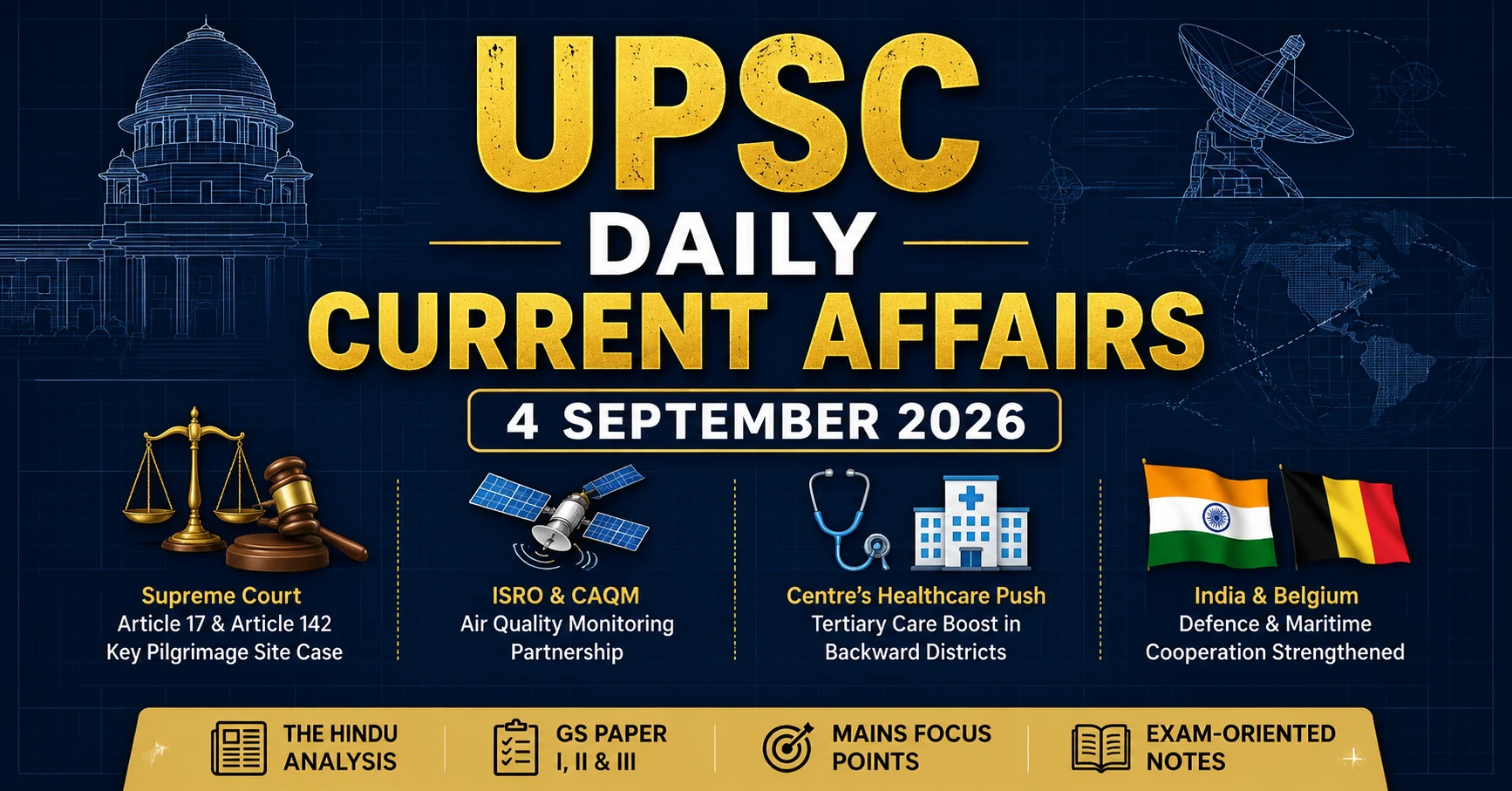
@Govbharti |Daily Current Affairs for 4 September 2026 based on The Hindu editorial and news pages — SC’s Bar Council ruling, CAQM-ISRO stubble tracking, court live-streaming curbs, newborn care, India-SCO ties, India-Belgium defence pact, GDP revision row, and more. Complete GS-mapped notes for UPSC Prelims & Mains.
UPSC Daily Current Affairs | OVERVIEW TABLE
| # | Topic / Heading | Newspaper Page | GS Paper / Relevance |
|---|---|---|---|
| 1 | Bar Council Has No Power to Punish Law Students: Supreme Court | Page 1 | GS II – Polity & Governance |
| 2 | Commission for Air Quality Management (CAQM) taps ISRO for Stubble-Fire Tracking | Page 1 | Prelims – Environment |
| 3 | Supreme Court Restricts Live-Streaming & Clipping of Court Proceedings | Page 6 | GS II – Polity & Judiciary |
| 4 | Newborn Care in India: “Hospital Plus Home” Strategy | Page 8 | GS II – Health & Social Justice |
| 5 | Forging Consensus: India at the SCO Summit, Bishkek | Page 8 | GS II – International Relations |
| 6 | India and Belgium Ramp Up Bilateral Defence Cooperation | Page 13 | GS II – International Relations |
| 7 | Congress Questions GDP Revision Methodology | Page 13 | Prelims/Mains – Indian Economy |
| 8 | “Raksha”: India’s New Defence Diplomacy Framework | Page 14 | GS III – Internal Security & Defence |
| 9 | “Supersized” El Nino to be Strongest Ever Recorded: WMO | Page 16 | GS I – Geography/Climatology |
| 10 | Why Accessible Rehabilitation is the Need of the Hour in India | Page 18 | GS II – Health & Social Justice |
| 11 | 40+ Crore Indians Caught in a Healthcare Affordability Gap: Panel Report | Page 18 | GS II – Health Policy |
| Bonus | Essay Pointers: Are Brands Overreacting to Manufactured Outrage? | Editorial | Essay / GS IV linkage |
Daily Current Affairs | 1. Bar Council Has No Power to Punish Law Students: Supreme Court
Heading & Syllabus Mapping: GS Paper II — Indian Polity, Judiciary, Fundamental Rights (Article 19(1)(a) & 19(1)(c))
Why in News?
The Supreme Court ruled that the Bar Council of India (BCI) and State Bar Councils have no jurisdiction to take disciplinary or punitive action against law students. The ruling came while hearing a plea filed by NALSAR University graduates after the BCI threatened action against students who protested the invitation of the Chief Justice of India as chief guest at their convocation.
Core Facts & Background:
- The dispute began when NALSAR students objected to inviting the CJI as chief guest, referencing his past oral remarks that compared certain sections of youth to “cockroaches” and “parasites.”
- The BCI issued letters to NALSAR’s administration and State Bar Councils seeking an inquiry and threatening to block the students’ future professional enrolment.
- A three-judge Bench headed by the CJI held that the Advocates Act, 1961 does not confer, expressly or impliedly, any disciplinary power on the BCI or State Bar Councils over students — such power is limited strictly to registered advocates.
- The Court clarified that BCI’s regulatory authority begins only after a person is formally enrolled as an advocate; until then, it is the university, not the Bar Council, that has jurisdiction.
- The BCI had already withdrawn its letters within an hour of issuing them, and the Court closed the matter while laying down this principle for future protection of students’ rights.
- In a related order the same day, the Court allowed a group of young lawyers to approach the Delhi High Court for an independent probe into an alleged assault on them at the BCI premises during a protest for reforms in the regulatory body.
Pros & Cons: Pros:
- Protects students’ freedom of speech and expression (Article 19(1)(a)) and freedom of association (Article 19(1)(c)) inside university campuses.
- Draws a clear jurisdictional boundary, preventing overreach by professional regulatory bodies into academic spaces.
- Strengthens the autonomy of universities in matters of student discipline.
Cons/Challenges:
- Raises questions on whether regulatory bodies like the BCI have any informal mechanism left to check conduct that may later affect enrolment eligibility.
- Highlights recurring institutional friction between statutory professional bodies and academic institutions.
Way Forward:
- Clear, written guidelines distinguishing the powers of universities and professional regulators over students.
- Institutional mechanisms within universities to handle disciplinary matters independently and fairly.
- Encouraging dialogue over intimidation when regulatory bodies disagree with student conduct.
Daily Current Affairs | 2. CAQM Taps ISRO to Improve Tracking of Punjab, Haryana Farm Fires
Heading & Syllabus Mapping: Prelims — Environment & Ecology; GS III linkage — Pollution Control Bodies
Why in News?
The Commission for Air Quality Management in NCR and Adjoining Areas (CAQM) announced it is in discussion with ISRO and Punjab authorities to develop better “ground-truthing” protocols for measuring stubble (paddy residue) fires ahead of the winter pollution season in Delhi-NCR.
Core Facts & Background:
- Stubble burning is the practice of removing paddy crop residue from fields to prepare land for sowing wheat, typically done from the last week of September to November, coinciding with the withdrawal of the south-west monsoon.
- It releases harmful pollutants such as methane (CH4), carbon monoxide (CO), volatile organic compounds (VOCs), and carcinogenic polycyclic aromatic hydrocarbons.
- Farm fires contribute no more than 15% of particulate matter pollution over a whole winter, but this share can spike to almost 44% during certain weeks when weak post-monsoon winds trap pollutants over the region.
- An ISRO Space Applications Centre study found farmers have shifted peak burning activity from around 1:30 p.m. in 2020 to around 5 p.m. in 2024, apparently to avoid detection by polar-orbiting satellites that pass over India at fixed times.
- This shift undermines the accuracy of official fire-count data, which mounting evidence suggests may be understating the real extent of stubble burning despite claims of a sharp reduction since 2021.
About CAQM (Prelims Facts):
- Initially formed via an ordinance in 2021, later replaced by the CAQM Act, 2021.
- The Act also dissolved the earlier Environment Pollution (Prevention and Control) Authority (EPCA), set up in 1998.
- Mandate: coordination, research, and policy execution to improve air quality; identifying and resolving issues affecting the Air Quality Index (AQI).
- Applicable to NCR and adjoining areas of Haryana, Punjab, Rajasthan, and Uttar Pradesh, wherever pollution affects NCR air quality.
- Composition: Chaired by a retired Government of India Secretary or a State Chief Secretary; members drawn from central ministries, stakeholder states, the CPCB, ISRO, and civil society.
Pros & Cons: Pros:
- Satellite-based, ISRO-assisted monitoring can significantly improve the accuracy of pollution-source data.
- Better ground-truthing can close loopholes farmers exploit to dodge fines.
Cons/Challenges:
- Satellite resolution and pass-timing limitations mean a large share of farm fires may still go undetected.
- Detection alone does not resolve the root economic causes pushing farmers toward stubble burning (short window between paddy harvest and wheat sowing, cost of alternatives).
Way Forward:
- Deploy more frequent satellite passes or higher-resolution monitoring in coordination with ISRO.
- Expand affordable access to crop-residue management machinery (Happy Seeder, etc.) and in-situ/ex-situ alternatives.
- Strengthen inter-state coordination between Punjab, Haryana, and the CAQM for real-time data sharing.
UPSC Daily Current Affairs | 3. Supreme Court Moves to Restrict Live-Streaming & Clipping of Court Proceedings
Heading & Syllabus Mapping: GS Paper II — Judiciary, Transparency & Accountability
Why in News?
Live-streaming and virtual hearings have brought unprecedented transparency to Indian courtrooms, but footage is increasingly clipped, stripped of context, and repackaged for social media clicks. The Supreme Court has moved through an interim order to restrict the unrestrained circulation of such footage.
Core Facts & Background:
- Since 2018, Supreme Court and various High Court benches have progressively expanded virtual hearings and live-streaming.
- The concern: courtroom moments — sometimes involving sensitive matters such as matrimonial disputes or child custody — are being turned into viral, decontextualised clips for entertainment or advertising-driven engagement.
- The order aims to balance the “open court” principle with the litigant’s right to dignity and privacy.
Benefits of Live-Streaming:
- Enhances judicial transparency.
- Strengthens accountability of the judicial process.
- Builds legal awareness among citizens.
- Reduces the information gap between courts and the public.
- Reinforces the constitutional “open court” principle.
Challenges Identified:
- Decontextualised clips distorting judicial proceedings.
- Sensitive matters (matrimonial, custody, sexual offence cases) being exposed publicly.
- Privacy concerns for litigants and witnesses.
- Commercialisation of courtroom content for views and revenue.
- Risk to judicial dignity from sensationalised framing.
- Risk of public misinterpretation of legal proceedings.
Way Forward:
- Formulate clear, uniform guidelines on what can/cannot be streamed or shared.
- Exclude sensitive categories — cases involving rape, children, sexual offences, and divorce — from live-streaming or public re-sharing.
- Encourage contextual, responsible reporting by media and social platforms.
- Prevent commercial misuse of courtroom footage.
- Promote digital literacy among the public on interpreting legal proceedings responsibly.
- Strike a balance between transparency and the fundamental right to privacy under Article 21.
UPSC Daily Current Affairs | 4. Newborn Care in India: The “Hospital Plus Home” Approach
Heading & Syllabus Mapping: GS Paper II — Health, Government Policies for Vulnerable Sections
Why in News?
Following a fire at a government women’s hospital in Amravati, Maharashtra (24 August 2026) that claimed three newborn lives, attention has returned to recurring clustered newborn deaths in India’s public neonatal care units — a pattern, not an isolated tragedy.
Core Facts & Background:
- India has achieved a major public-health success: institutional deliveries rose from 39% (2005-06) to 90% (2023-24) per the National Family Health Survey-6.
- However, this success has overloaded neonatal units. The number of women delivering in institutions rose from 109 lakh (2005) to 194 lakh (2024-25); sick newborns hospitalised in public Special Newborn Care Units (SNCUs) rose from 11.3 lakh (2021-22) to 14.45 lakh (2023-24) — a 28% jump in two years.
- Four structural reasons behind the crisis: (i) overcrowding, (ii) a changing case-mix with more high-risk and referred births reaching government hospitals, (iii) infrastructure failures (fire safety, oxygen supply — echoing the 2017 Gorakhpur oxygen tragedy), and (iv) infection/staffing gaps that let hospital-acquired infections spread.
- A proven alternative exists: the Gadchiroli field trial (Society for Education, Action and Research in Community Health – SEARCH) showed trained community health workers delivering home-based neonatal care (HBNC) cut neonatal mortality by 62.2% in a rural area (published in The Lancet, 1999). Between 1996-2003, 97% of low-birth-weight/preterm babies (birth weight above 1,800g, gestation over 34 weeks) were safely managed at home.
- India already has the workforce to scale this: around 8,00,000 ASHAs are trained in HBNC modules derived from the Gadchiroli model.
Suggested Three-Part Strategy (from the article):
- Decongest neonatal units — strengthen ASHA-led HBNC so stable newborns are safely cared for at home, freeing scarce SNCU beds.
- Strengthen neonatal care units — adequate nurse-to-baby ratios, functioning equipment, reliable power/oxygen backup, and rigorous infection control.
- Make neonatal units intrinsically safe — mandatory fire detection/suppression systems, electrical and oxygen-system safety audits, and emergency evacuation drills.
Pros & Cons: Pros:
- Home-based care reduces overcrowding without compromising outcomes for stable, low-risk newborns.
- Uses India’s existing ASHA network rather than requiring an entirely new system.
Cons/Challenges:
- ASHAs need adequate training, supervision, and support to safely triage which babies can go home.
- Facility-level safety failures (fire, oxygen, electrical) require capital investment, not just workforce reform.
Way Forward:
- Combine safer, decongested neonatal units with strengthened home-based newborn support — hospital plus home, not hospital versus home.
- Institutionalise mandatory safety audits across all public SNCUs.
- Scale the Gadchiroli-model HBNC training nationally through the existing ASHA cadre under MoHFW’s public health system.
(Mains Practice Question from the notes: “Institutional delivery alone cannot ensure reduction in neonatal mortality; it must be complemented by quality facility-based care and effective home-based newborn care.” Discuss. — 10 marks, 150 words)
UPSC Daily Current Affairs | 5. Forging Consensus: India’s Engagement at the SCO Summit, Bishkek
Heading & Syllabus Mapping: GS Paper II — International Relations, India and its Neighbourhood/Regional Groupings
Why in News?
Prime Minister Narendra Modi attended the annual Shanghai Cooperation Organisation (SCO) Leaders’ Summit in Bishkek, Kyrgyzstan, marking 25 years of the Eurasian grouping — his first such multilateral engagement since the US-Israel war on Iran began over six months ago.
Core Facts & Background:
- The Bishkek Declaration condemned US and Israeli attacks on Iran and supported Iran’s right to peaceful nuclear technology under the NPT.
- PM Modi’s speech focused on dismantling the ecosystem of terrorist financing, recruitment, radicalisation and safe havens, urging the SCO to avoid “double standards” on terrorism — a pointed reference to Pakistan.
- The declaration’s inclusion of strong language on “all forms” of terrorism, including cross-border terrorism, was welcomed by New Delhi.
- Pakistan has taken over the SCO chairmanship for the coming year.
- Compared to the high-profile optics of the 2025 Tianjin Summit (Modi-Putin-Xi handshake), this year’s summit was relatively subdued given ongoing US tariffs, the US-Iran conflict, and US sanctions on Russia — all of which have damaged economic and energy security, including the Hormuz Strait blockade risk.
- India will separately host the BRICS Summit in New Delhi on 12-13 September, attended by Russian President Putin, Chinese President Xi Jinping, and Iranian President Pezeshkian; India is keen to forge consensus on a joint declaration amid persistent UAE-Iran tensions.
- India’s ties with Central Asian Republics are being revived through PM Modi’s visits to Tashkent and Bishkek, focused on trade, critical minerals, tourism, and connectivity — including renewed emphasis on the International North-South Transport Corridor (INSTC) linking India, Iran, Azerbaijan, and Russia (via St. Petersburg).
- For India, the past year has been sobering: post-Pahalgam attack tensions with Pakistan, Pakistan’s diplomatic outreach to the US, and its new security pact with Saudi Arabia and Türkiye all necessitate broader Indian engagement across regional multilateral platforms.
Pros & Cons: Pros:
- Provides India a platform to press its anti-terrorism agenda on a multilateral stage that includes Pakistan.
- Strengthens India’s Central Asia connectivity ambitions via INSTC and related trade corridors.
Cons/Challenges:
- SCO’s consensus-based structure limits India’s ability to isolate Pakistan diplomatically within the grouping.
- Geopolitical strain from US-Iran tensions complicates India’s balancing act between Western partners and SCO/BRICS partners like Russia and Iran.
Way Forward:
- Broaden India’s engagement with regional multilateral organisations (SCO, BRICS, and others) rather than relying on any single platform.
- Use the upcoming India-hosted BRICS Summit to build consensus among divergent members (e.g., UAE-Iran tensions).
- Continue investing in Central Asian connectivity projects like INSTC to diversify trade routes.
UPSC Daily Current Affairs | 6. India and Belgium Ramp Up Bilateral Defence Cooperation
Heading & Syllabus Mapping: GS Paper II — Bilateral Relations; GS III linkage — Defence Indigenisation
Why in News?
Belgian Prime Minister Bart De Wever visited New Delhi, where the two countries signed three government-level defence agreements and announced a new fast-track trade and investment mechanism, deepening bilateral ties beyond traditional trade.
Core Facts & Background:
- Agreements signed: a Letter of Intent on Defence Cooperation, an MoU between Belgian Security & Defence Industry and the Society of Indian Defence Manufacturers, and an MoU between the CBI and Belgian Federal Police on combating transnational organised crime, cybercrime, and related matters.
- At least 10 private defence agreements are expected to be sealed during the visit, including production of Belgian military items such as rockets in India.
- Both leaders called for cooperation on safety and security of maritime routes and unimpeded maritime shipping, referencing tensions in West Asia and Ukraine.
- A Defence Attache will be appointed at the Indian Embassy in Brussels.
- The two sides announced establishment of a fast-track trade mechanism and a Consular Dialogue between New Delhi and Brussels, with a target to double bilateral trade over the next five years.
- Both PMs paid tribute to the over 9,000 Indian soldiers who perished in Flanders Fields during the First World War, and issued a joint statement on eliminating terrorism in all its forms.
- PM Modi called for dialogue and diplomacy to end the ongoing conflicts in Ukraine and West Asia.
Pros & Cons: Pros (Significance):
- Supports India’s defence Atmanirbharta by combining Belgian technology with Indian manufacturing capability (co-development and co-production).
- Strengthens resilient supply chains for critical minerals and semiconductors.
- Enhances maritime security cooperation, protecting global trade routes and India’s economic interests.
- Boosts India’s broader Europe engagement and strategic autonomy.
Cons/Challenges:
- Technology-transfer restrictions in sensitive defence areas may limit the depth of co-production.
- Balancing strategic cooperation with Belgium’s own European geopolitical priorities can be complex.
- Supply-chain dependence may simply shift from one external source to another rather than being eliminated.
- Converting signed MoUs into actual projects, investment, and production remains the real test.
Way Forward:
- Move systematically from MoUs → joint R&D → co-development → co-production → exports.
- Build stronger India-EU cooperation on critical minerals, semiconductors, and clean energy.
- Improve investment facilitation and regulatory coordination between the two countries.
- Expand joint military exercises, maritime cooperation, and counter-terrorism coordination.
- Ensure technology partnerships feed into the Make in India initiative and global value-chain integration.
UPSC Daily Current Affairs | 7. Congress Questions GDP Revision, Seeks Explanation on Methodology
Heading & Syllabus Mapping: Prelims/Mains — Indian Economy, National Income Accounting
Why in News?
The Congress party raised four questions to the Government over the latest GDP estimates, alleging a cumulative downward revision of ₹43 lakh crore in the estimated size of the Indian economy over the past four years, and demanding clarity on the new calculation methodology.
Core Facts & Background:
- The controversy follows the Government’s announcement of 7.8% real GDP growth for the April-June 2026 quarter.
- Congress leader Jairam Ramesh questioned why GDP estimates for all four years since 2022-23 were revised substantially downward, who was consulted in framing the new methodology, and why the deflator used for real GDP appears to understate inflation’s impact.
- Citing calculations by former Finance Secretary Subhash Chandra Garg, Ramesh argued that nominal growth for the April-June 2026 quarter would have been closer to 2.6% (not the reported 10.3%) had the earlier GDP base not been revised downward.
- Garg’s analysis: the earlier (2011-12 base) estimate for April-June 2025 GDP stood near ₹86.05 lakh crore, but subsequent revisions brought a comparable earlier-year figure down to around ₹80 lakh crore, which inflates the apparent percentage growth for the current quarter when compared against the new (lower) base.
- Congress leader K.C. Venugopal made a political attack, describing PM Modi as “a creator of a manipulated world.”
- The Government has cited concerns previously raised by former Chief Economic Adviser Arvind Subramanian and the IMF regarding India’s national accounts methodology, and Congress is demanding greater transparency on it.
Pros & Cons (Analytical View): Arguments for closer scrutiny:
- Large revisions to historical base data can materially change the interpretation of “real” growth performance.
- Transparency in the deflator/methodology used strengthens public trust in official statistics.
Arguments favouring Government’s position:
- Periodic base-year and methodology revisions are a normal statistical practice used by most economies to reflect the changing structure of the economy.
- One-off political framing of technical revisions can obscure genuine debate over methodology.
Way Forward:
- The National Statistical Office should publish a detailed, transparent explanatory note on methodology changes and their year-on-year impact.
- Independent expert review (as suggested by past CEAs and IMF observations) can help build cross-party confidence in GDP data.
- Regular parliamentary briefings on national accounts methodology could reduce politicisation of technical statistical exercises.
UPSC Daily Current Affairs | 8. “Raksha”: India’s New Framework for Defence Diplomacy
Heading & Syllabus Mapping: GS Paper III — Internal Security, Defence & Strategic Affairs
Why in News?
Defence Minister Rajnath Singh released “Raksha,” a comprehensive strategic framework laying out India’s roadmap and vision for defence diplomacy and global defence partnerships over the next 10 years.
Core Facts & Background:
- The document seeks to strengthen India’s strategic engagement with friendly nations by aligning national security objectives with proactive international cooperation.
- It lays down an actionable vision for promoting long-term stability, strengthening partnerships, and advancing India’s role in an evolving global security environment.
- Key pillars identified include: deepening bilateral and multilateral defence partnerships, expanding joint military exercises, and enhancing capacity-building initiatives with friendly countries.
- A major focus is promoting indigenous defence exports under the Make-in-India initiative, positioning India as a reliable global defence manufacturing partner by expanding international cooperation around indigenously developed defence technologies.
- Maritime security is another key pillar, emphasising India’s role as a net security provider and first responder in the Indian Ocean Region (IOR), underlining India’s commitment to peace, stability, and security in this strategically important maritime region.
Pros & Cons: Pros:
- Provides a long-term (10-year), structured roadmap instead of ad-hoc defence diplomacy.
- Strengthens India’s positioning as a net security provider in the Indian Ocean Region.
- Boosts defence exports under Make in India, aiding domestic defence manufacturing growth.
Cons/Challenges:
- Translating a strategic framework into concrete bilateral outcomes requires sustained diplomatic and financial follow-through.
- Balancing simultaneous partnerships with multiple, sometimes rival, global powers requires careful strategic calibration.
Way Forward:
- Set measurable milestones and periodic review mechanisms for the 10-year Raksha roadmap.
- Align the framework with ongoing bilateral defence agreements (such as the India-Belgium pact discussed above) for consistency.
- Continue expanding defence export promotion bodies and simplify approval processes for indigenous defence manufacturers.
UPSC Daily Current Affairs | 9. “Supersized” El Nino to be Strongest Ever Recorded: WMO
Heading & Syllabus Mapping: GS Paper I — Geography, Climatology & World Physical Geography
Why in News?
The World Meteorological Organisation (WMO) said the El Nino weather phenomenon is set to intensify further into 2027 and could become the strongest ever recorded, raising risks of extreme weather into the next year.
Core Facts & Background:
- The WMO’s forecasts showed a near-100% likelihood that El Nino would persist through February 2027, fuelled by exceptionally warm Pacific Ocean temperatures — the first time the agency has expressed such a high degree of certainty.
- El Nino is a periodic warming of sea-surface temperatures in the eastern Pacific caused by weakening trade winds; it occurs every two to seven years and typically lasts up to 12 months, causing intense rains and droughts across Latin America.
- Normal Year mechanism: Equatorial trade winds push warm water westward toward Australia/Indonesia; heat over land creates a low-pressure zone there, while a high-pressure zone (aided by the cold Peru Current) forms over South America.
- El Nino Year mechanism: Trade winds weaken, allowing warm water to shift eastward toward South America. This reverses the pressure pattern — high pressure builds over the western Pacific/Australia (bringing drought there) while low pressure and warm conditions develop over South America (bringing heavy rains) and warmer winters affect North America.
- A very strong El Nino can significantly shift rainfall and temperature patterns worldwide, fuelling extreme weather such as droughts and typhoons.
- The WMO is stepping up preparedness and early-warning efforts to help states take early action.
Pros & Cons (Impact Analysis): Potential negative impacts:
- Disrupted monsoon patterns can affect India’s agriculture and water security.
- Increased risk of droughts in some regions and flooding in others globally.
- Heightened risk of extreme weather events — typhoons, heatwaves, and erratic rainfall.
Silver lining:
- Early and high-confidence WMO forecasting gives governments a longer lead time for disaster preparedness compared to past El Nino events.
Way Forward:
- Strengthen early-warning systems and climate-resilient agricultural planning, especially for monsoon-dependent economies like India.
- Build cross-border cooperation on disaster preparedness given El Nino’s global reach.
- Invest in climate-adaptive infrastructure ahead of the predicted 2027 peak.
UPSC Daily Current Affairs | 10. Why Accessible Rehabilitation is the Need of the Hour in India
Heading & Syllabus Mapping: GS Paper II — Health, Issues Relating to Development
Why in News?
Published ahead of World Physiotherapy Day (observed on 8 September; the 2026 theme focuses on the role of physiotherapy and physical activity in preventing, managing, and rehabilitating cardiovascular disease and stroke), the article highlights India’s growing but neglected need for accessible rehabilitation services.
Core Facts & Background:
- Rising burden of Non-Communicable Diseases (NCDs) and an ageing population are increasing the long-term need for rehabilitation, yet healthcare systems largely focus on prevention and treatment while rehabilitation is often treated as an optional, after-treatment service rather than an essential part of care.
- Global organisation World Physiotherapy’s profile of the Indian Association of Physiotherapists estimates 52,000 practising physiotherapists in India — equivalent to only 0.36 physiotherapists per 10,000 people, compared with over 10 per 10,000 people in Europe.
- Urban-rural gaps mean many people, especially in rural and low-income areas, cannot access regular rehabilitation and may go without treatment for extended periods due to travel and cost burdens.
- Rehabilitation is not limited to treating back pain or helping injured athletes — it plays a crucial role in recovery from stroke, heart disease, injury, surgery, and many other conditions.
Pros & Cons: Benefits/Significance:
- Restores functionality and independence, enabling people to return to work and normal life.
- Reduces disability, hospitalisation, complications, and caregiver burden.
- Strengthens Universal Health Coverage (UHC), which conceptually spans prevention → treatment → rehabilitation → palliative care.
Challenges:
- Severe shortage and uneven distribution of physiotherapists/rehabilitation professionals.
- Rural and remote areas have minimal rehabilitation infrastructure.
- High out-of-pocket expenditure and inadequate insurance coverage for rehabilitation services.
- Low public awareness means rehabilitation is often sought too late.
- Weak integration of rehabilitation into primary healthcare delivery.
Way Forward:
- Integrate rehabilitation services into Primary Health Centres / Ayushman Arogya Mandirs and all levels of the healthcare system.
- Expand tele-rehabilitation to reach rural and remote populations.
- Increase training and deployment of physiotherapists, occupational therapists, and speech therapists.
- Include essential rehabilitation services under UHC and health-financing mechanisms.
- Promote community-based rehabilitation and home-based care models.
- Reframe rehabilitation as part of a continuous “care continuum,” not merely post-treatment care.
UPSC Daily Current Affairs | 11. More than 40 Crore Indians Caught in a Healthcare Affordability Gap: Parliamentary Panel
Heading & Syllabus Mapping: GS Paper II — Health Policy, Government Schemes for Vulnerable Sections
Why in News?
A Parliamentary Standing Committee on Health and Family Welfare report — “Affordability and Accessibility of Healthcare Facilities in Public and Private Sector” — flagged that over 40 crore Indians (over a quarter of the population), the so-called “missing middle,” fall into a healthcare gap: too well-off for government subsidies, yet not financially secure enough to absorb rising private healthcare costs.
Core Facts & Background:
- The report — the Committee’s 176th Report, presented to Parliament on 7 August 2026 — makes 368 recommendations on affordability, accessibility, and regulation.
- More than 60% of inpatient care and 70% of outpatient care in India is delivered by the private sector, leaving households without comprehensive financial protection exposed to private-sector prices.
- Medicines alone account for nearly 30% of current health expenditure; this burden is especially heavy for people managing diabetes, hypertension, or cardiovascular disease, given India’s rising non-communicable disease burden.
- Government health expenditure stands at just 1.43% of GDP (roughly 1.4%), against the 2.5% target set under the National Health Policy, 2017. Health spending as a share of total government expenditure fell from 6.12% (2021-22) to 4.89% (2022-23), below the 5.02% recorded in 2019-20.
- Cost gap example: average out-of-pocket spending on childbirth is ₹37,630 in private facilities versus ₹2,299 in public facilities — more than 16 times higher.
- Government schemes such as Ayushman Bharat-PM-JAY provide hospitalisation protection to vulnerable households, but the “missing middle” often falls outside fully subsidised coverage, while private insurance can leave them facing premiums, exclusions, waiting periods, and co-payments.
- The Committee stressed that insurance alone cannot close the gap; it called for stronger public healthcare infrastructure, nationwide implementation of the Clinical Establishments Act, mandatory quality standards, and greater price transparency in private facilities. It also flagged retail pharmacy practices, including excessive trade margins and non-prescription sale of antibiotics, recommending stronger audits and enforcement.
Pros & Cons: Significance:
- Affordable healthcare prevents medical expenditure from pushing families into poverty (avoiding “catastrophic health expenditure”).
- Strong public healthcare reduces forced dependence on expensive private facilities.
- Affordable medicines and insurance reforms would meaningfully improve Universal Health Coverage (UHC).
Challenges:
- Rural-urban healthcare disparity remains stark.
- High medicine, diagnostic, and outpatient (OPD) costs are largely uninsured.
- Uneven quality and regulation across private hospitals.
- Existing insurance schemes mostly cover hospitalisation, leaving OPD and medicine costs inadequately covered.
- Shortage of healthcare professionals and public infrastructure persists nationwide.
Way Forward:
- Raise public health spending progressively towards the 2.5% of GDP target under NHP 2017.
- Strengthen Primary Health Centres (PHCs), Community Health Centres (CHCs), and District Hospitals.
- Expand financial protection specifically targeted at the “missing middle.”
- Regulate private hospital pricing and enforce price transparency.
- Expand access to affordable medicines through the Jan Aushadhi scheme.
- Shift from hospitalisation-centric insurance models toward comprehensive healthcare coverage that includes OPD and medicines.
Extra Prelims-Relevant Facts:
- Clinical Establishments Act, 2010 — governs registration and regulation of clinical establishments.
- AB-PMJAY — provides cashless hospitalisation cover to eligible beneficiaries.
- Links to SDG 3 (Good Health & Well-being) and the broader goal of Universal Health Coverage.
- Core concept to remember: Financial protection + Accessibility + Quality = Universal Health Coverage.
UPSC Daily Current Affairs | Bonus Essay/GS Pointers: Are Brands Overreacting to Manufactured Outrage?
Heading & Syllabus Mapping: Essay Paper; GS IV linkage — Ethics in Public/Corporate Life
Why in News?
Jewellery brand Giva withdrew an advertisement featuring actress Kriti Sanon after online criticism that the outfit was too revealing for a traditional festival (Raksha Bandhan), reviving debate on whether Indian brands are overreacting to “manufactured” social-media outrage.
Core Facts & Background (Issue):
- Social-media outrage increasingly influences corporate decisions and advertising choices in India.
- There is a growing risk that manufactured or algorithm-driven outrage — as opposed to genuine public sentiment — is triggering brand backlash and self-censorship.
- This raises a live debate between freedom of creative expression, cultural sensitivity, and commercial interests.
- Past precedents cited include a 2020 Tanishq advertisement depicting an interfaith baby shower, withdrawn after outrage, and a subsequent Fab India campaign controversy over the use of an Urdu phrase for a Hindu festival.
Pros & Cons: Benefits of consumer pushback:
- Greater consumer accountability keeps brands responsive to social sentiment.
- Encourages culturally sensitive and responsible advertising.
- Gives consumers a platform to challenge inappropriate representation and promotes corporate social responsibility (CSR).
Challenges:
- Manufactured or algorithm-amplified outrage can distort genuine public debate.
- Creates a “chilling effect” that discourages creative expression.
- Mob-driven pressure is not the same as legitimate regulatory scrutiny.
- Excessive caution may make brands avoid socially relevant or sensitive themes altogether.
- Outrage itself can become commercialised — driving views, engagement, and revenue for content creators regardless of the underlying merit.
Way Forward:
- Distinguish genuine public criticism from coordinated or manufactured outrage campaigns.
- Strengthen ethical and culturally sensitive advertising standards within the industry.
- Prefer law-based regulation over reactive withdrawal driven by online mob pressure.
- Promote digital and media literacy so audiences can critically evaluate viral outrage.
- Platforms should tackle harassment, misinformation, and coordinated manipulation while still protecting genuine free speech.
UPSC Daily Current Affairs | Current Affairs 3 Sept. 2026