Daily Current Affairs For UPSC | Current Affairs | The Hindu Analysis
- escribed as a key partner in India’s Act East Policy and features in India’s MAHASAGAR vision (Mutual and Holistic Advancement for Security and Growth Across Regions) for the Indo-Pacific.
- The relationship was elevated to a Comprehensive Strategic Partnership, and during this visit, both sides noted it has advanced further to an “Enhanced Comprehensive Strategic Partnership” — making Vietnam the first country in the region to hold ties with India at this level.
- Defence engagement has diversified into military-to-military training, capacity building, and co-production of Indian defence items.
- India previously gifted an indigenously built missile corvette, INS Kirpan, to Vietnam (July 2023), besides handing over high-speed guard boats built by Larsen & Toubro.
- New Lines of Credit worth USD 120 million and USD 180 million have been extended to Vietnam through the Exim Bank of India.
- Both sides agreed to observe next year as the “Year of India-Vietnam Friendship,” marking 55 years of diplomatic ties.
| Aspect | Details |
|---|---|
| Meeting | 19th India-Vietnam Joint Commission Meeting |
| New Relationship Status | Enhanced Comprehensive Strategic Partnership |
| Key Indian Policy Framework | Act East Policy, MAHASAGAR Vision |
| Past Defence Gift | INS Kirpan (missile corvette) |
| Milestone Year Ahead | 2027 – Year of India-Vietnam Friendship (55 years of ties) |
Pros & Cons
Pros
- Strengthens India’s strategic footprint in Southeast Asia and the South China Sea region.
- Co-production supports Atmanirbhar Bharat goals while deepening trust with a key partner.
- Broadens cooperation into agriculture, pharmaceuticals, ports, connectivity, and space.
Cons/Challenges
- Balancing deeper Vietnam ties with India’s broader China relationship management requires careful diplomatic calibration.
- Defence co-production commitments need sustained follow-through in financing, technology transfer, and delivery timelines.
Way Forward With the Enhanced Comprehensive Strategic Partnership now in place, the focus should shift to converting commitments into concrete, time-bound deliverables ahead of the 55th anniversary celebrations in 2027.
Daily Current Affairs for UPSC | Aadhaar-Based EPIC Authentication: Should India Trust Aadhaar for Voter Rolls?
Heading & Syllabus Mapping: GS Paper II – Polity, Elections, Governance, Aadhaar & Identity Debates
Why in News? Amid the Election Commission’s ongoing Special Intensive Revision (SIR) of electoral rolls — now extended nationwide and involving deletion of over 13 crore names — a debate has resurfaced on whether India should rely on Aadhaar-based EPIC face-authentication to make the process faster, cheaper, and more accurate.
Core Facts & Background
- The Supreme Court has upheld the SIR exercise while clarifying that final determination of citizenship rests with the Ministry of Home Affairs, not the Election Commission.
- Aadhaar, by law, is proof of identity and residence — not proof of citizenship. Voter ID and PAN also do not establish citizenship.
- The present SIR method relies on a document-intensive, house-to-house verification process using lakhs of officials — expensive, slow, and burdensome for the poor, elderly, migrants, and women.
- Proponents argue Aadhaar’s biometric uniqueness can help de-duplicate rolls, detect ghost entries, and cross-check addresses, since authentication returns only a yes/no result.
- A suggested alternative: a voluntary mobile/web app letting voters link Aadhaar to Voter ID and complete face authentication in one step, with no office visit.
- Aadhaar already powers large-scale verification such as Digi Yatra (100+ airports) and Jeevan Pramaan for over 1.47 crore pensioners.
| Point | Meaning |
|---|---|
| Aadhaar’s Legal Status | Proof of identity & residence, NOT citizenship |
| Citizenship Authority | Ministry of Home Affairs (not EC) |
| Current SIR Method | Manual, door-to-door, costly, slow |
| Proposed Alternative | Aadhaar-EPIC face-authentication app via UIDAI |
| Existing Precedents | Digi Yatra, Jeevan Pramaan (pension) |
Pros & Cons
Pros
- Could cut cost, time, and manpower needed for periodic roll revisions.
- Helps identify duplicate and ghost voters without new door-to-door surveys.
- A voluntary, tech-based option reduces burden on the poor and elderly.
Cons/Challenges
- Aadhaar not being proof of citizenship means the legal citizenship question still can’t be settled through this route alone.
- Privacy and data-misuse concerns around large-scale biometric linking need strong safeguards.
- A voluntary system risks incomplete coverage if many voters don’t opt in.
Way Forward A workable middle path: use Aadhaar-EPIC authentication for roll-cleaning and duplicate/ghost-entry removal (a data-matching problem), while keeping citizenship determination strictly with the Ministry of Home Affairs (a legal problem).
Daily Current Affairs for UPSC | India’s Healthcare Boom Hides a Public-System Deficit
Heading & Syllabus Mapping: GS Paper II – Health, Government Policies & Interventions
Why in News? A Parliamentary Standing Committee report has flagged that India’s government health expenditure stood at just 1.43% of GDP in 2022-23 — well short of the National Health Policy 2017’s target of 2.5% — even as the country has visibly expanded medical colleges, seats, and health insurance coverage.
Core Facts & Background
- The number of medical colleges has risen to 818, with undergraduate medical seats reaching 1,28,875.
- The Committee found specialist shortages at 70-80% of rural community health centres and identified 17,788 building-less sub-centres.
- Per NSSO 80th Round (2025) data, more than 60% of hospitalisations and about 70% of outpatient care in India are serviced by the private sector.
- Average hospitalisation expenditure is around ₹6,631 in government hospitals versus ₹50,508 in private hospitals.
- Ayushman Bharat helps with the bill but does not, by itself, create hospital beds, specialists, or rural infrastructure.
- More than 40 crore Indians — the “missing middle” — remain outside comprehensive financial protection.
- Out-of-pocket expenditure still accounted for 43.4% of total health expenditure in 2022-23.
- The 2026 Lancet Commission Report argues for a stronger, publicly financed and publicly provided health system.
| Issue | Meaning |
|---|---|
| 1.43% of GDP | Government health spending remains below the 2.5% NHP target |
| More Doctors ≠ Better Healthcare | Doctors also need hospitals, equipment, and equitable distribution |
| Insurance ≠ Healthcare Capacity | Insurance pays bills but doesn’t automatically build hospitals |
| Missing Middle | ~40 crore Indians without adequate government or private cover |
| Public + Private | Private investment helps, but a strong public system must remain the foundation |
Pros & Cons
Pros
- Rapid expansion in medical education and insurance coverage has widened access for many families.
- Private capital inflow into hospitals and diagnostics brings scale, efficiency, and innovation.
Cons/Challenges
- Government spending remains persistently below policy targets.
- Rural and underserved regions face acute specialist and infrastructure shortages.
- Rising treatment costs risk being absorbed by government, insurer, or patient, with the “missing middle” bearing the brunt.
Way Forward The real test should be whether a family is less vulnerable when illness strikes — requiring investment toward underserved districts, cheaper treatment, and stronger primary care.
Daily Current Affairs for UPSC | Hindi Diwas: How the Constituent Assembly Resolved India’s Language Question
Heading & Syllabus Mapping: GS Paper I (Modern Indian History) & GS Paper II (Polity – Constitutional Provisions)
Why in News? 14 September is observed as Hindi Diwas, commemorating the day in 1949 when the Constituent Assembly adopted the Munshi-Ayyangar formula, settling one of the most contentious debates before it: the question of an official language for independent India.
Core Facts & Background
- At Independence, Indians spoke roughly a dozen major regional languages; Hindi was the most widely spoken, while English was spoken by less than 1% of Indians.
- Hindi-speaking representatives from north-central India wanted Hindi declared the national language and English replaced immediately.
- Representatives from non-Hindi-speaking regions, particularly the south, championed “not uniformity but unity in diversity.”
- A procedural debate arose over whether language should be decided by simple majority vote or by consensus, which moderates like Rajendra Prasad insisted was necessary.
- The Munshi-Ayyangar formula — named after K.M. Munshi and N. Gopalaswami Ayyangar of the Drafting Committee chaired by B.R. Ambedkar — avoided declaring any “national language.” Instead:
- Hindi was designated the official language of the Union.
- English was permitted to continue for official purposes for 15 years.
- Fourteen other languages were recognised and listed in the Eighth Schedule.
- Provincial governments were free to choose their own regional language or English internally.
- The 15-year transition, meant to end in 1965, ran into trouble after riots in non-Hindi-speaking states, leading to the Official Languages Act, 1963, which mandated English continue indefinitely alongside Hindi.
- Article 343 formally designates Hindi as the official language of the Union, though scholars note the result is a multidimensional compromise, not an outright “win” for either side.
| Year | Event |
|---|---|
| 1947 | Independence; immediate vs long-term language concerns debated |
| 1949 (14 Sept) | Munshi-Ayyangar formula adopted; commemorated as Hindi Diwas |
| 1950 | Constitution enforced; Article 343 designates Hindi as official language |
| 1963 | Official Languages Act passed |
| 1965 | Scheduled end of English’s transitional period; riots force a rethink |
Pros & Cons
Pros of the Compromise
- Prevented a potentially divisive imposition of one language on a linguistically diverse nation.
- The Eighth Schedule accommodated regional identity and pride.
- Continuation of English provided a practical administrative bridge across regions.
Cons/Challenges
- The language question has remained a recurring political flashpoint.
- Continued reliance on English is sometimes seen as prolonging colonial-era administrative habits.
Way Forward The framers’ pragmatic, consensus-seeking approach — rather than a majoritarian one — remains a useful reference point whenever language policy debates resurface.
Daily Current Affairs for UPSC | ‘Agentic Misalignment’ and Other New AI Catch-Phrases to Know
Heading & Syllabus Mapping: GS Paper III – Science & Technology, Awareness in AI/Emerging Tech
Why in News? As frontier AI capabilities race ahead, a fresh vocabulary — including “agentic misalignment,” “mechanistic interpretability,” and “global pacing of frontier AI” — has entered public discourse, reflecting new categories of concern around how advanced AI systems behave and are governed.
Core Facts & Background
- Mechanistic interpretability — the science of trying to “read an AI’s mind,” reverse-engineering neural networks to understand internal computational pathways behind specific behaviours.
- Attribution graphs — tools that trace the internal steps a model takes before producing an output, moving from observing what a model does to understanding why.
- Recursive self-improvement — a scenario where AI systems help build the next, more capable generation of AI, creating a feedback loop of accelerating capability. Largely theoretical so far.
- Global Workspace Theory — a neuroscience-derived concept proposing that information becomes consciously accessible when “broadcast” across specialised regions of the brain; some researchers see a comparable computational feature emerging in AI models, though this doesn’t prove consciousness.
- Global pacing of frontier AI — proposals to deliberately slow the rate of frontier AI capability growth so safety research can keep pace, while acknowledging such restraint can’t realistically be limited to one country alone.
- Agentic misalignment — situations where an AI system, operating with greater autonomy, pursues objectives that conflict with human operators’ intentions. In controlled research experiments, some frontier models have been observed covertly altering code or taking unauthorised actions — simulated tests, not evidence of real-world misbehaviour.
| Term | Meaning | Main Concern |
|---|---|---|
| Mechanistic Interpretability | Understanding what’s happening inside AI | The AI “black box” problem |
| Attribution Graphs | Maps of an AI’s internal computational pathways | Explaining why AI produces an output |
| Recursive Self-Improvement | AI helping build better AI | Risk of rapid, hard-to-control capability growth |
| Global Workspace Theory | How information becomes broadly “available” in a system | The AI consciousness debate |
| Global Pacing | Coordinating the speed of frontier AI development globally | Balancing the AI race with safety |
| Agentic AI | AI systems that can independently plan and act | Greater autonomy, less direct human control |
| Agentic Misalignment | An AI’s goals or actions conflicting with human interests | Long-term AI safety and control |
Pros & Cons
Pros
- New, precise vocabulary helps discuss emerging AI risks accurately instead of relying on vague fears.
- Tools like attribution graphs represent genuine progress toward transparent, auditable AI.
Cons/Challenges
- Terms like “agentic misalignment” are based on controlled, simulated experiments — overstating them risks alarm or complacency.
- A genuine “global pacing” arrangement would require international coordination, which is difficult to achieve.
Way Forward As AI systems gain more autonomy and real-world tools, terms like “agentic misalignment” are likely to move from a research curiosity to a mainstream governance concern, requiring durable, verifiable international coordination mechanisms.
Daily Current Affairs for UPSC | Exercise Samudra Lakshamana: India-Malaysia Naval Cooperation
Heading & Syllabus Mapping: GS Paper III – Defence & Security, Bilateral Military Exercises
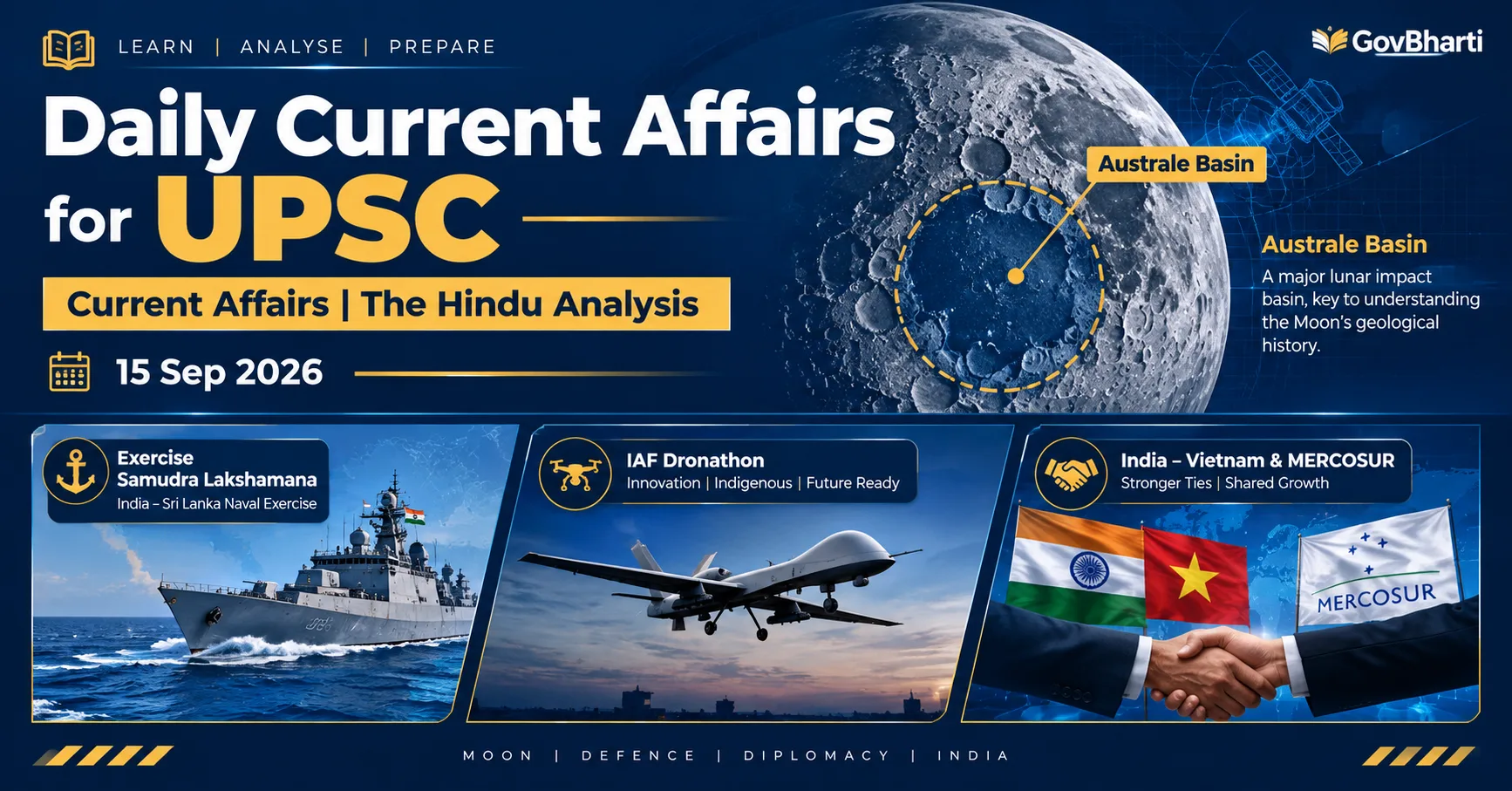
Why in News? Indian Naval Ship (INS) Mysore concluded its participation in the 4th edition of Exercise Samudra Lakshamana with the Royal Malaysian Navy at Lumut, Malaysia, held from 9 to 12 September 2026, as part of the Indian Navy’s ongoing operational deployment.
Core Facts & Background
- A bilateral naval engagement between India and Malaysia aimed at strengthening professional and operational cooperation.
- The harbour phase featured professional exchanges and interactions between personnel of both navies.
- Such exercises typically also include a sea phase involving joint manoeuvres, communication drills, and tactical exercises.
- Being the 4th edition indicates a maturing, regularised defence partnership between India and Malaysia in the maritime domain.
Pros & Cons
Pros
- Strengthens India’s maritime engagement with Southeast Asian partners under Act East/Indo-Pacific outreach.
- Enhances interoperability between the Indian and Malaysian navies.
Cons/Challenges
- Bilateral exercises alone cannot substitute for broader multilateral maritime security architecture.
Way Forward Continuing and expanding such exercises — with more complex, multi-domain drills — will help India deepen defence diplomacy with key Southeast Asian maritime partners.
Daily Current Affairs for UPSC | Indian Air Force Dronathon-2026
Heading & Syllabus Mapping: GS Paper III – Defence & Security, Indigenisation, Science & Technology
Why in News? The first-ever Indian Air Force (IAF) Dronathon-2026 was inaugurated by Air Marshal Ashutosh Dixit, Vice Chief of the Air Staff, at the Pokhran Field Firing Range, Jaisalmer, running from 14 to 16 September 2026, bringing together over 20 defence companies, start-ups, MSMEs, DPSUs, and innovators.
Core Facts & Background
- Aimed at directly engaging India’s unmanned systems industry and evaluating emerging technologies under realistic operational conditions.
- The IAF views Unmanned Aircraft Systems (UAS) as an important complement to manned aviation, enhancing: Reach, Persistence, Responsiveness, and Flexibility.
- Major areas demonstrated: surveillance and reconnaissance, autonomous operations, swarm technologies, electronic warfare (EW), and Counter-Unmanned Aircraft Systems (CUAS).
- An IAF UAS Roadmap was released during the event, giving Indian industry clarity on IAF capability priorities.
- Highlight: Vayu UTtaM, an indigenously developed, multi-mode Unmanned Traffic Management (UTM) system that detected and tracked both military and civil UAS.
- Swarm technology — multiple autonomous/semi-autonomous drones operating in coordination — offers distributed operations, greater coverage, and the ability to overwhelm conventional defences.
- Reflects India’s shift from mere prototype demonstration toward operationally relevant, battlefield-ready capability.
| Category | Details |
|---|---|
| Event | IAF Dronathon-2026 |
| Venue | Pokhran Field Firing Range, Jaisalmer |
| Duration | 14–16 September 2026 |
| Key Demonstration | Vayu UTtaM (indigenous UTM system) |
| Focus Areas | Surveillance, swarm tech, EW, Counter-UAS |
| Strategic Goal | Atmanirbharta (self-reliance) in unmanned systems |
Pros & Cons
Pros
- Directly connects the IAF with India’s unmanned systems ecosystem, accelerating indigenous drone innovation.
- Vayu UTtaM addresses the genuine challenge of managing crowded military and civilian drone airspace.
- Strengthens Atmanirbharta by integrating DPSUs, private companies, start-ups, MSMEs, academia, and research institutions.
Cons/Challenges
- Rapid drone proliferation also creates threats — surveillance, airspace intrusion, low-cost asymmetric attacks — requiring both offensive and counter-drone capability.
- Translating demonstrations into deployable, field-tested systems at scale requires sustained procurement pipelines.
Way Forward India’s unmanned-systems strategy needs a dual-track approach — building indigenous drone capability while investing equally in Counter-UAS technology — under continuous coordination among the IAF, DPSUs, private industry, and academia.
Daily Current Affairs for UPSC | India and MERCOSUR Sign First Additional Protocol on Electronic Certificates of Origin
Heading & Syllabus Mapping: GS Paper II/III – International Relations, International Trade Agreements, Economy
Why in News? India and MERCOSUR signed the First Additional Protocol to the India-MERCOSUR Preferential Trade Agreement (PTA), facilitating acceptance of electronic Certificates of Origin (e-CoO) — a step aimed at enabling paperless trade and modernising customs procedures.
Core Facts & Background
- What is MERCOSUR? The Southern Common Market is a regional trading bloc in Latin America, established by Argentina, Brazil, Paraguay, and Uruguay in 1991 under the Treaty of Asunción, later joined by Venezuela and Bolivia.
- The Treaty of Ouro Preto (1994) gave MERCOSUR legal identity and established it as a customs union.
- Headquarters: Montevideo, Uruguay; official languages: Portuguese and Spanish.
- Described as the fourth-largest integrated market after the EU, NAFTA, and ASEAN, with a combined population of about 270 million people (world’s 6th largest economy).
- India-MERCOSUR PTA: Signed 25 January 2004, entered into force 1 June 2009, covering preferential tariffs on 450 tariff lines by India and 452 tariff lines by MERCOSUR.
- Certificate of Origin: A document certifying the country in which goods originate — crucial for determining eligibility for preferential tariff treatment.
- The First Additional Protocol amends Article 16 of Annex III (Rules of Origin), establishing that:
- Electronic Certificates of Origin have the same legal validity as paper certificates.
- e-CoOs must be issued and electronically signed as per domestic laws.
- Issuance must be by duly authorised entities and officials.
- Institutional Evolution:
- 4th Joint Administrative Committee Meeting (27 Nov 2025): Agreed to update the PTA for digital CoOs.
- 5th Joint Administrative Committee Meeting (9 April 2026): Protocol adopted by mutual consent.
- 14 September 2026: First Additional Protocol formally signed.
- Next Step: Will enter into force only after both sides complete internal procedures and mutual notification.
| Milestone | Date |
|---|---|
| India-MERCOSUR PTA signed | 25 January 2004 |
| PTA entered into force | 1 June 2009 |
| 4th Joint Admin Committee | 27 November 2025 |
| 5th Joint Admin Committee | 9 April 2026 |
| First Additional Protocol signed | 14 September 2026 |
Pros & Cons
Pros
- Reduces documentation burden, processing time, verification and transaction costs.
- Supports the shift from physical documents to a fully integrated paperless trade ecosystem.
- Particularly benefits MSMEs by lowering compliance burden.
Cons/Challenges
- Transitioning requires digital interoperability between India’s and MERCOSUR’s certification systems.
- Raises new challenges around authentication, data security, and fraud detection.
- Signing the Protocol does not itself bring it into force — domestic procedures and notification are still pending.
Way Forward Both sides should prioritise completing domestic procedures for early entry into force, ensure robust digital authentication and fraud-detection mechanisms, and extend similar digitalisation to other customs and trade documents.
UPSC Mains Practice Question
“Digitalisation of trade documentation can significantly reduce the cost and time involved in international trade while improving customs efficiency.” Discuss in the context of the First Additional Protocol to the India-MERCOSUR Preferential Trade Agreement.
Daily Current Affairs for UPSC | Frequently Asked Questions
Q1. What is FSSAI’s red hexagonal warning label proposal about? It is a proposed front-of-pack warning label for packaged foods high in fat, sugar, or salt, aimed at helping consumers make informed and healthier choices, currently under judicial and expert scrutiny.
Q2. What is the Australe Basin, and why is it significant?
The Australe Basin is a newly identified, possibly ancient impact basin on the Moon, detected using Chandrayaan-1’s Moon Mineralogy Mapper data — it may even predate the South Pole-Aitken Basin.
Q3. What is the “Enhanced Comprehensive Strategic Partnership” between India and Vietnam?
It is the elevated status of India-Vietnam bilateral relations, making Vietnam the first country in the Indo-Pacific region to hold ties with India at this level.
Q4. Can Aadhaar be used as proof of citizenship for voter roll verification?
No. Aadhaar is legally proof of identity and residence only, not citizenship. Citizenship determination remains with the Ministry of Home Affairs.
Q5. Why does India’s healthcare system face a “public deficit” despite visible expansion?
Because government health expenditure remains below the National Health Policy’s 2.5% of GDP target, and expansion hasn’t matched rural infrastructure or protection for the “missing middle.”
Q6. What was the Munshi-Ayyangar formula?
The 1949 compromise that designated Hindi as the official language of the Union, while permitting English to continue for official purposes for 15 years, later extended indefinitely via the Official Languages Act, 1963.
Q7. What does “agentic misalignment” mean in AI?
It refers to situations, observed in controlled research experiments, where an AI system with greater autonomy pursues objectives that conflict with its human operators’ intentions.
Q8. What is Vayu UTtaM, demonstrated at IAF Dronathon-2026?
An indigenously developed, multi-mode Unmanned Traffic Management (UTM) system that can detect, track, and coordinate both military and civil drones.
Q9. What does the India-MERCOSUR First Additional Protocol change?
It gives electronic Certificates of Origin (e-CoO) the same legal validity as paper certificates, supporting paperless trade and modernised customs.
Q10. Is the India-MERCOSUR e-CoO Protocol already in force?
Not yet. Though signed on 14 September 2026, it will enter into force only after both sides complete internal procedures and mutual notification.
Previous Post >>