Daily UPSC Current Affairs | Today 20th September 2026 – The Hindu Analysis

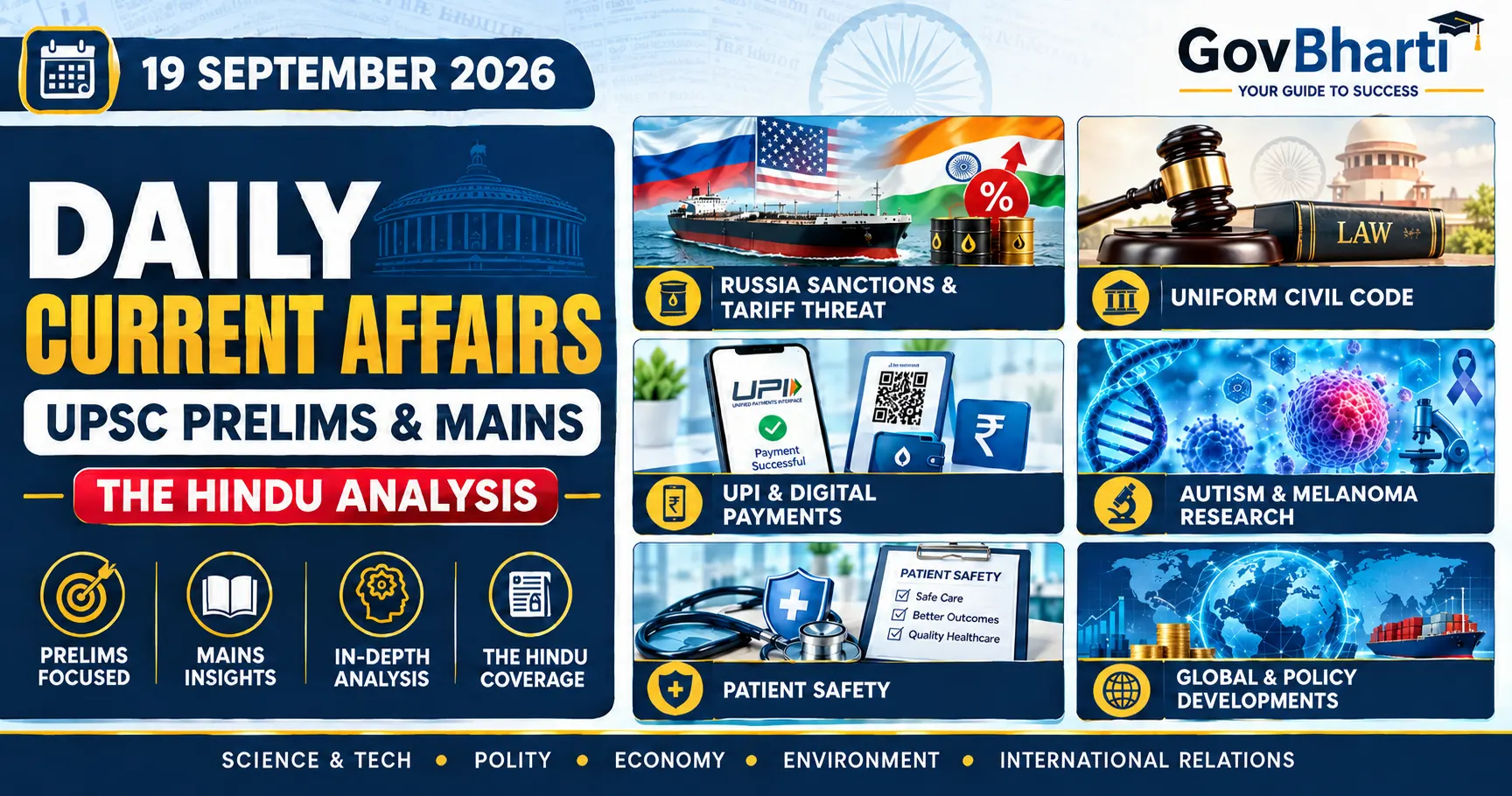
Today’s Daily UPSC Current Affairs digest covers seven high-value topics from The Hindu — India’s shifting oil import strategy amid US sanctions, the ethical debate around deep-sea mining, India’s rising deep-tech and semiconductor ecosystem, the JPC’s scrutiny of the FCRA Amendment Bill, the growing cheetah population at Kuno National Park, and the Marathi film Gondhal‘s selection for the 99th Academy Awards. A complete, exam-oriented breakdown for UPSC Prelims, Mains and interview preparation.
Daily UPSC Current Affairs | Overview
| Topic | GS Paper / Relevance | Why in News (One Line) |
|---|---|---|
| India’s Oil Import Data | GS II & GS III (IR, Economy) | Data shows India’s oil imports from Russia, Iran and Venezuela shifting sharply with US sanctions and tariffs |
| Deep-Sea Ecological Governance | GS III (Environment) | Editorial questions whether India should mine the deep ocean just because it has the technology to |
| Homegrown Innovation Ecosystem | GS II & GS III (S&T, Economy) | Op-ed tracks India’s rise in GaN semiconductors, patents and deep-tech startups |
| India Deep Tech Alliance | GS III (S&T, Economy) | IDTA members invested ₹2,170 crore in 56 deep-tech firms in one year |
| JPC on FCRA Amendment Bill | GS II (Polity, Governance) | First JPC meeting sees sharp questions on asset-takeover provisions in the FCRA Bill |
| Project Cheetah & Kuno National Park | Prelims & GS III (Environment) | Cheetah population reaches 56 after a new litter of four cubs is born at Kuno |
| Gondhal & 99th Oscars | Prelims & GS I (Art & Culture) | Marathi film Gondhal, based on a traditional Maharashtrian ritual, is India’s official Oscar 2027 entry |
Daily UPSC Current Affairs | India’s Oil Import Data (GS II & GS III)
Why in News?
For a decade, India quietly did what Washington asked — it cut oil purchases from countries the US wanted isolated. New data now shows a familiar pattern: the moment American pressure eases, India goes right back to buying from Venezuela, Iran and Russia. It’s a story less about oil and more about how a rising economy balances “strategic autonomy” with real-world energy security.
Core Facts & Background
Venezuela’s story is the clearest illustration. Its share in India’s oil import basket sat at a healthy 6.7% in 2017-18. Then, in January 2019, the first Trump administration widened sanctions to hit Venezuela’s oil sector directly, and the number collapsed — down to 5.9% the following year, then crashing to just 1.1% by 2020-21, and finally to zero for two straight years. It stayed near-zero even under President Biden. Only after Trump returned to office and partially lifted sanctions on Venezuelan oil companies in March 2026 — following a leadership change he is said to have orchestrated — did the tap reopen. By the April-July 2026 window, Venezuelan crude was back up to 4.8% of India’s import bill.
Iran’s trajectory is even starker. After Washington reimposed sweeping sanctions in November 2018 over Iran’s nuclear programme, its share fell to 1% and then to an outright zero — a freeze that lasted a full six years, from 2020 to 2026. It was only when Trump once again permitted limited Iranian oil sales on the global market in March 2026 that India cautiously re-entered, with Iran’s share inching up to 1.1% by mid-2026.
Russia offers the most dramatic swing of all. Russian crude had settled into a comfortable 30-40% share of India’s oil imports through mid-2025. Then, in August 2025, Washington slapped a punishing 50% tariff on India specifically as a penalty for buying Russian oil (up from 25%). India responded by cutting back, and Russia’s share fell to 19.3% by February 2026. But that same month, the US Supreme Court struck down the Trump tariff regime altogether — removing the penalty. India wasted no time: Russia’s share shot past 51% by July 2026, a jump that also coincided with the US strike on Iran, the closure of the Strait of Hormuz, and a spike in global oil prices that made discounted Russian crude even more attractive.
Through all of this, the government’s public line has stayed consistent — that India’s energy sourcing is guided purely by “national interest,” and that diversification protects both energy security and the wider economic relationship with Washington. This comes even as a proposed US Bill threatens tariffs of up to 100% on Indian imports over continued Russian oil purchases.
| Country | Peak Share (Pre-Sanctions) | Lowest Point | Latest Share (2026) |
|---|---|---|---|
| Venezuela | 6.7% (2017-18) | 0% (2021-23) | 4.8% |
| Iran | — | 0% (2020-26) | 1.1% |
| Russia | 30-40% (2024-25) | 19.3% (Feb 2026) | 51%+ (July 2026) |
Pros & Cons
The case for this flexible sourcing strategy is straightforward: cheaper crude from sanctioned economies has helped India manage its import bill and cushion domestic fuel prices, especially when global supply gets tight. It also signals genuine strategic autonomy — India isn’t simply outsourcing its energy policy to Washington’s sanctions list.
The flip side is real exposure. Every time India leans on Russian, Iranian or Venezuelan oil, it invites fresh friction with the US — tariff threats, trade-talk complications, and diplomatic strain — precisely when India needs American cooperation on defence, technology and market access. Over-reliance on any single discounted source (Russia’s 51% share is a good example) also recreates the very concentration risk that diversification was supposed to avoid.
Way Forward
The sustainable answer probably isn’t picking a permanent side but building enough refining and logistical flexibility to pivot quickly between sources as sanctions and tariffs shift — while investing seriously in renewable and domestic energy capacity so that geopolitical swings abroad matter a little less at home.
Daily UPSC Current Affairs | Deep-Sea Ecological Governance (GS III)
Why in News?
An op-ed in The Hindu poses an uncomfortable question just as India stands on the edge of a genuine deep-sea breakthrough: just because we now have the technology to mine the ocean floor, does that mean we should?
Core Facts & Background
India isn’t new to this frontier. It already holds three exploration contracts from the International Seabed Authority covering roughly 95,000 square kilometres across the Central Indian Ocean Basin, the Central Indian Ridge, and the Carlsberg Ridge. Surveys under these contracts have identified an estimated 366 million tonnes of polymetallic nodules — rich in nickel, copper, cobalt and manganese, all critical for batteries, electronics and clean-energy manufacturing.
The technical muscle behind this comes from the Deep Ocean Mission, which is developing deep-sea mining systems, underwater robotics, and the MATSYA-6000 — a human-rated submersible. The National Institute of Ocean Technology has already tested a mining machine at depths of around 5,270 metres. But the same mission has also mapped 19 seamounts and studied roughly 1,300 deep-sea organisms, of which nearly 23 species were entirely new to science.
That last fact is the crux of the article’s argument. India’s own biodiversity work keeps revealing life we didn’t know existed on the ocean floor — which means we genuinely cannot predict what large-scale mining disturbance would do to it. The author’s central point is that strategic importance (these minerals matter for India’s renewable-energy and EV ambitions) cannot automatically translate into ecological permission. Before extraction, India should be asking whether the minerals are truly necessary at this scale, whether alternatives or recycling could reduce demand, and whether a circular economy — the kind of thinking already embedded in India’s Mission LiFE — can shrink the need to dig at all.
Pros & Cons
In favour of moving ahead with deep-sea mining: it reduces import dependence on critical minerals, feeds directly into India’s renewable-energy and electric-mobility manufacturing goals, and positions India among the handful of nations capable of deep-ocean resource access.
Against it: the deep ocean remains one of the least understood ecosystems on the planet, irreversible damage is a real possibility, and treating “we can” as “we should” risks repeating the same extraction-first mistakes made on land and in shallow seas — just further from public view.
Way Forward
The article’s most striking suggestion is that India could lead by example — using the very knowledge gained through the Deep Ocean Mission to conclude that some poorly understood ecosystems are better left untouched. In that framing, restraint itself becomes a mark of scientific and civilisational maturity, not a missed economic opportunity.
Daily UPSC Current Affairs | Homegrown Innovation Ecosystem (GS II & GS III)
Why in News?
An op-ed argues that India’s innovation story is finally moving past the “back-office service provider” label — with public research, corporate R&D, and deep-tech startups now advancing together for the first time as three connected pillars rather than isolated efforts.
Core Facts & Background
The clearest proof point is Gallium Nitride (GaN) semiconductor technology — critical for advanced radar, next-generation communications, and defence systems. In March 2023, DRDO scientists at Delhi’s Solid State Physics Laboratory and the Gallium Arsenide Enabling Technology Centre in Hyderabad cracked GaN monolithic microwave integrated circuits domestically. What makes this striking is the backstory: this exact know-how was reportedly refused to India under the offset provisions of the Rafale jet purchase from France. DRDO is now actively transferring this GaN technology for commercial use in 5G/6G infrastructure, EV components, and renewable energy inverters — making India one of only seven countries (alongside China, France, Germany, Russia, South Korea and the US) to master it.
Patent numbers tell a similar story of momentum, but with an honest caveat. Filings jumped from 1,10,000 in 2024-25 to over 1,43,000 in 2025-26 — a 30.2% rise, with domestic applicants now behind nearly seven of every ten filings. Yet India’s total patents “in force” stand at just over 2,40,000, compared to China’s 5.7 million and the US’s 3.5 million — a gap that reflects both India’s historically low R&D spending (under 1% of GDP, against roughly 2.4% in China and 3.5% in the US) and low grant/commercialisation rates. There is a genuine bright spot, though: private R&D spending overtook combined government spending for the first time in 2024, and is projected to account for 55% of the total through 2025-26.
The telecom sector shows how this is translating into real standing. The Bharat 6G Alliance has filed more than 7,700 patents across 5G and 6G technologies (including over 4,400 foreign filings) and contributed nearly 3,000 technical submissions to the global 3GPP standards body last year — a 15-fold jump from 2020. In the WIPO’s 2025 Patent Cooperation Treaty rankings, Jio Platforms broke into the global top 20 for the first time, helping push India up over 300 places to 19th overall.
And then there are the startups turning lab breakthroughs into products: Pixxel Space (founded by BITS Pilani and IIT Madras alumni), building hyperspectral imaging satellites; Skyroot Aerospace and IIT Madras-nurtured Agnikul Cosmos, pushing reusable launch vehicles; ImmunoACT, incubated at IIT Bombay with the Tata Memorial Centre, whose NexCAR19 is India’s first indigenous CAR-T cell therapy — delivering effective cancer treatment at roughly a tenth of the usual cost; and Remidio Innovative Solutions, using smartphone-based retinal imaging and AI to fight preventable blindness from diabetic retinopathy and glaucoma.
Pros & Cons
The upside is a maturing ecosystem where government labs build foundational capability, universities nurture talent, and startups carry it to market — exactly the kind of pipeline that produces sustained, home-grown technological strength rather than one-off breakthroughs.
The challenges are just as real: India’s R&D spending is still far below competitors, patent grant and commercialisation rates lag badly, and there’s a persistent funding gap between a granted patent and the point where it finds its first paying customer.
Way Forward
The op-ed points to concrete next steps — standardising technology-transfer terms for publicly funded IP, expanding patent-examiner capacity to clear backlogs faster, and specifically funding that awkward middle stage between “patent granted” and “product sold.” Without addressing that gap, India risks generating impressive numbers on paper without matching commercial impact.
Daily UPSC Current Affairs | India Deep Tech Alliance ₹2,170 Crore Investment (GS III)
Why in News?
At the Semicon India 2026 event, the India Deep Tech Alliance (IDTA) announced that its members had collectively invested ₹2,170 crore in 56 Indian deep-tech firms over the past year — a concrete signal that India’s much-discussed “lab to market” pipeline is starting to actually move money.
Core Facts & Background
The IDTA’s members include both individual and corporate investors from India and abroad, and the Alliance was careful to clarify that each investment was made independently, based on each member’s own strategy — this was not a single pooled fund, but a coordinated reporting of individual bets. Energy and climate-related startups captured the largest single slice, receiving over 30% of the total capital (₹655 crore across eight firms). Quantum computing, robotics and space startups together took a nearly matching share, spread across 21 companies, while artificial intelligence startups received close to 30% of the capital — ₹639 crore going to 16 firms.
Principal Scientific Adviser Ajay Kumar Sood connected this directly to the government’s ₹1 lakh crore Research, Development and Innovation (RDI) scheme run by the Department of Science and Technology, calling the investment figures proof that the scheme’s vision is “beginning to translate into measurable action.” His framing was that public RDI funding and industry-led investment initiatives like the IDTA are meant to complement each other — strengthening the pathway that lets promising lab technologies move into the market and create long-term strategic and economic value for India.
| Sector | Share of Capital | Number of Firms | Amount |
|---|---|---|---|
| Energy & Climate-tech | 30%+ | 8 | ₹655 crore |
| Quantum, Robotics & Space | ~30% | 21 | — |
| Artificial Intelligence | ~30% | 16 | ₹639 crore |
Pros & Cons
This kind of coordinated, sector-diversified private investment is exactly what India’s deep-tech ecosystem has been short on — it de-risks early-stage ventures in capital-intensive fields like quantum and space that traditional venture capital often avoids. The concern is scale: ₹2,170 crore across 56 firms, while meaningful, is still modest set against global deep-tech investment flows, and sustained momentum will depend on whether this becomes an annual pattern or a one-time announcement.
Way Forward
The real test now is whether the RDI scheme’s much larger public funding pool and industry-led vehicles like the IDTA can genuinely work in tandem — turning early lab breakthroughs into companies that survive long enough to find their first real customers, rather than stalling at the pilot stage.
Daily UPSC Current Affairs | JPC on FCRA Amendment Bill (GS II)
Why in News?
The first meeting of Parliament’s Joint Committee examining the Foreign Contribution (Regulation) Amendment Bill, 2026, turned into a heated session — with ruling party MPs and the Opposition both pushing back on different parts of the government’s proposed changes.
Core Facts & Background
The 31-member panel is examining a Bill that reworks how India regulates NGOs and other bodies receiving foreign funding. The single biggest flashpoint is a new “designated authority” provision: if an organisation’s FCRA registration is cancelled, surrendered, or simply lapses, all its foreign contributions and any assets built from them would automatically vest in a government-appointed “designated authority” — without any prior hearing or judicial determination.
Opposition members, including the DMK’s P. Wilson and Trinamool Congress’s Menaka Guruswamy, argued this violates Article 300A of the Constitution, which protects against deprivation of property without due process. The current law does have a comparable “prescribed authority” — typically the Additional Chief Secretary or Principal Secretary (Home) of a State or Union Territory, as notified back in November 2018 — but that authority is explicitly a “passive custodian” with no power to take substantive decisions on the assets it holds. The Ministry pointed to real practical problems with this: States managing schools, hospitals and orphanages built with foreign funds face open-ended budgetary and manpower strain, since there’s no deadline for how long this custodianship can run, and the law is silent on how such assets — including places of worship — should eventually be disposed of.
Ruling party MPs, meanwhile, focused their questions on how foreign contributions are actually being utilised, with the Home Ministry’s presentation also drawing criticism for cataloguing contributions by religious group and highlighting that a majority of the funds tracked went to Christian organisations. The Ministry has framed the entire amendment as, at its core, a “national security” law — a framing that traces back to the original FCRA’s enactment in 1976, at the height of Cold War-era anxiety about foreign influence on Indian institutions.
Pros & Cons
The government’s case is that closing loopholes around cancelled FCRA licences prevents foreign-funded assets from sitting in limbo indefinitely, and adds accountability to how such funds and properties are ultimately used. Critics counter that handing a government authority sweeping power over assets without a hearing sets a dangerous precedent, and that singling out contributions by religious denomination risks turning a regulatory law into a tool for selective targeting of civil society groups.
Way Forward
A JPC’s recommendations are advisory, not legally binding, but they carry real institutional weight because they emerge from cross-party scrutiny. The likeliest middle path here is a version of the Bill that keeps the “designated authority” mechanism for genuinely lapsed or cancelled cases, but builds in a fixed timeline, a due-process safeguard, and clear rules for disposing of religious and community assets — addressing the Ministry’s practical concerns without opening the door to arbitrary takeovers.
A quick primer on JPCs: A Joint Parliamentary Committee isn’t a permanent constitutional body — it’s created through a motion in one House that the other House agrees to, whenever an issue (a major Bill, a financial scandal, or a governance question) needs scrutiny beyond normal parliamentary debate. It draws members from both the Lok Sabha and Rajya Sabha across parties, can summon experts and officials, and dissolves automatically once it submits its report. Past JPCs have examined the Bofors scandal (1987), the Harshad Mehta stock scam (1992), the Ketan Parekh scam (2001), the National Register of Citizens (2016), and the Personal Data Protection Bill (2019).
Two other JPCs are active through 2026 worth remembering for Prelims: a 31-member panel chaired by Aparajita Sarangi examining the 130th Constitution Amendment Bill (which proposes removing a Prime Minister, Chief Minister or Minister from office if held in custody for 30 consecutive days in serious criminal cases), and a 39-member panel headed by P.P. Chaudhary examining the “One Nation, One Election” Bills — the Constitution (129th Amendment) Bill, 2024 and the Union Territories Laws (Amendment) Bill, 2024.
Daily UPSC Current Affairs | Project Cheetah & Kuno National Park (Prelims & GS III)
Why in News?
Just a day after Project Cheetah marked its fourth anniversary, an Indian-born cheetah at Kuno National Park gave birth to four new cubs — a particularly emotional milestone, since her previous litter of four had been killed in a leopard attack months earlier. Union Environment Minister Bhupender Yadav announced the news, putting India’s total cheetah population at 56.
Core Facts & Background
Project Cheetah was launched on 17 September 2022 at Kuno National Park in Madhya Pradesh, aiming to reintroduce cheetahs to India nearly seven decades after the species went locally extinct in 1952. The reintroduction has come in three waves: eight cheetahs from Namibia in September 2022, of which three survive today but have together produced 22 India-born offspring (taking the Namibian lineage to 25 animals); twelve cheetahs from South Africa in February 2023, with eight survivors and 10 India-born offspring (18 in total, split between 15 at Kuno and 3 at Gandhi Sagar Sanctuary); and nine cheetahs from Botswana in February 2026 — six females and three males, brought in specifically to widen the genetic diversity of the Indian population.
According to the programme’s four-year review, 32 cubs have been born in India since it began, with natural breeding increasingly driving population growth rather than fresh imports — arguably the strongest sign yet that the reintroduction is taking root rather than staying dependent on constant restocking.
A quick Prelims-relevant refresher: the cheetah (Acinonyx jubatus) is the fastest land animal, built for speed rather than strength, and — unlike other big cats — cannot roar at all due to its fixed vocal structure, communicating instead through chirps, purrs, growls and hisses. Gestation runs 90-95 days, litters are typically 3-5 cubs, and while females are largely solitary except when raising young, males often form coalitions, usually with their brothers, to defend territory.
Kuno National Park itself sits in northern Madhya Pradesh near the Rajasthan border, spread across roughly 748 square kilometres of the Vindhyan landscape, with the Kuno River — a tributary of the Chambal — sustaining its savanna grasslands and dry deciduous forests. Its open terrain, ideal for a high-speed hunter like the cheetah, also supports Chital, Sambar, Nilgai, Chinkara and Wild Boar as prey species, alongside existing carnivores like leopards, Indian wolves, hyenas and jackals.
| Source | Year Introduced | Number Introduced | Currently Surviving | India-born Offspring |
|---|---|---|---|---|
| Namibia | September 2022 | 8 | 3 | 22 |
| South Africa | February 2023 | 12 | 8 | 10 |
| Botswana | February 2026 | 9 | — | — |
Pros & Cons
The programme’s strongest achievement is exactly what this news captures — natural, self-sustaining breeding on Indian soil, which was always the real test of success rather than simply the number of cheetahs imported. On the other side, survival rates from the original Namibian and South African batches (just 3 of 8, and 8 of 12, respectively) highlight how difficult adaptation to a new environment and threats like leopard predation remain.
Way Forward
With natural breeding now the primary driver of growth, the programme’s next challenge shifts from import logistics to long-term habitat management — expanding suitable landscapes like Gandhi Sagar Sanctuary, managing predator conflict with leopards, and maintaining the genetic diversity that the Botswana batch was specifically brought in to support.
Daily UPSC Current Affairs | Gondhal & India’s Oscar 2027 Entry (Prelims & GS I)
Why in News?
The Film Federation of India has picked the Marathi film Gondhal as India’s official entry to the Best International Feature category at the 99th Academy Awards — putting a centuries-old Maharashtrian ritual tradition on the world’s biggest cinema stage.
Core Facts & Background
Written and directed by Santosh Davakhar, Gondhal is set in rural Maharashtra and unfolds over a single night built around a traditional ritual performed for a newlywed couple. At its centre is Suman, a woman trapped in an oppressive marriage who plots both a murder and an escape with a forbidden lover — with the ritual’s devotion, deception, and fate blurring together as the story progresses. The film was chosen from a shortlist of 33 entries (including four Marathi and fourteen Hindi films) by the selection committee headed by P. Sheshadri, beating out Angh and Ikkis, which reportedly made the final three. Gondhal had already had its world premiere at the 56th International Film Festival of India in Goa in 2025, where Davakhar won the Silver Peacock for Best Director.
No Indian film has ever won in this Oscar category (previously called Best Foreign Film), with only three having received nominations across history — Mehboob Khan’s Mother India, Mira Nair’s Salaam Bombay, and Ashutosh Gowariker’s Lagaan. The 99th Academy Awards ceremony itself is scheduled for Sunday, 14 March 2027.
For Prelims purposes, the ritual itself matters as much as the film. Gondhal is a traditional Maharashtrian folk performance in which Gondhalis — the performers — sing, dance, and play traditional instruments while invoking and worshipping deities, typically a goddess. Historical accounts in the Maharashtra Gazetteer describe dancers performing before an image of the goddess with instruments like the drum and the tuntune, moving with a lighted torch before the performance closes with an aarti. The tradition is closely associated with family celebrations, weddings in particular, and its distinctly night-time character — darkness, firelight, drums, and devotional performance — is exactly what has made it lend itself so naturally to cinematic storytelling.
The film has also drawn comparisons to the Kannada hit Kantara, which similarly placed a regional ritual — the Bhoota Kola tradition of coastal Karnataka — at the heart of its narrative. It’s worth being precise here for exam purposes: Gondhal and Bhoota Kola are entirely distinct traditions from different states, and the comparison is useful only as a storytelling parallel, not as a claim that the two rituals are related.
Pros & Cons
A film built around an authentic regional ritual gives global audiences a genuine window into India’s cultural diversity beyond the usual Bollywood lens, and recognition like the Silver Peacock suggests real artistic merit behind the selection. The challenge, as India’s Oscar history shows, is that nomination and international recognition don’t come easily — India is yet to win in this category despite decades of strong entries.
Way Forward
Beyond the Oscar campaign itself, Gondhal‘s selection is a reminder of how much of India’s living folk heritage — performances like the Gondhal ritual that still take place at real weddings across rural Maharashtra — remains largely undocumented outside academic gazetteers, and how cinema can play a real role in both preserving and popularising it.
FAQs
Q1. Why has India’s Russian oil import share crossed 51% in 2026?
Because the US Supreme Court struck down the 50% penalty tariff on India in February 2026, removing the cost pressure that had earlier pushed India to cut back on discounted Russian crude.
Q2. What is the Deep Ocean Mission and what has NIOT achieved under it?
It’s India’s flagship deep-sea exploration and mining technology programme. Under it, the National Institute of Ocean Technology has tested a seabed mining machine at depths of around 5,270 metres, and the MATSYA-6000 human submersible is under development.
Q3. What is the India Deep Tech Alliance (IDTA)?
A grouping of individual and corporate investors, from India and abroad, who invest independently in Indian deep-tech firms; its members collectively put ₹2,170 crore into 56 firms over the past year.
Q4. What does the FCRA Amendment Bill’s “designated authority” provision propose?
That if an organisation’s FCRA registration is cancelled, surrendered, or lapses, its foreign contributions and related assets would vest in a government-appointed authority, without a prior hearing — a provision the Opposition argues violates Article 300A of the Constitution.
Q5. When was Project Cheetah launched and what is India’s current cheetah population?
Project Cheetah launched on 17 September 2022 at Kuno National Park. Following the birth of a new litter of four cubs in September 2026, India’s cheetah population stands at 56.
Q6. Why is Gondhal significant for India’s Oscar campaign?
It is India’s official entry to the Best International Feature category at the 99th Academy Awards (March 2027) and is built around the traditional Maharashtrian Gondhal ritual — a folk performance invoking deities through song, dance and torch-lit ritual.
Previous Post >>