Daily UPSC Current Affairs | Today 6 October 2026 – The Hindu Analysis
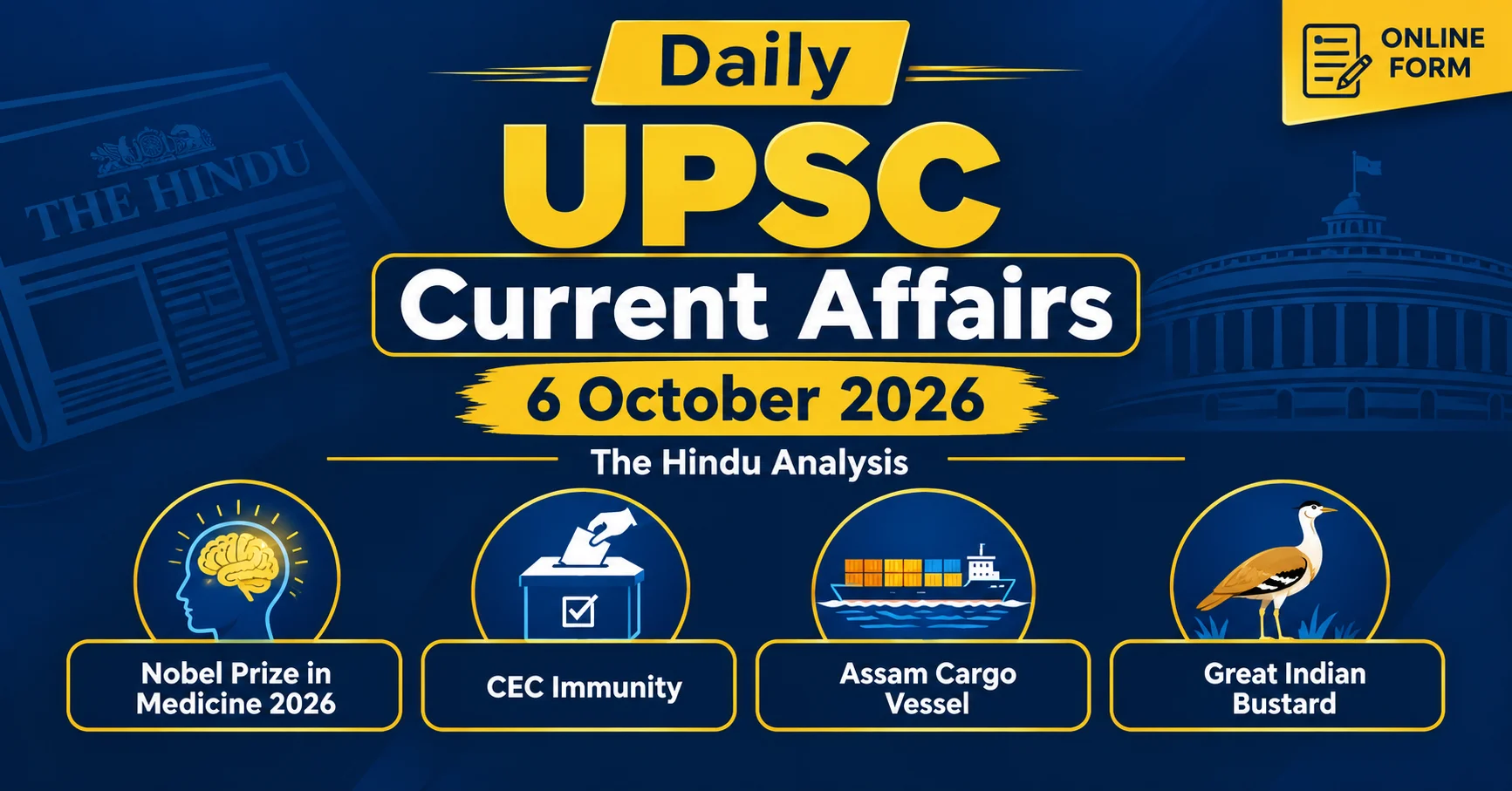
If you are preparing for UPSC, you already know that a good day of current affairs is not about reading everything. It is about knowing what matters and why. Today’s Hindu gives us a rare mix: a Nobel-winning laboratory technique, a constitutional debate about the Election Commission, a river route that had been silent for decades, and a federal fight over mineral money. Each story below is explained in plain language, with the syllabus link, background facts and a way forward, so you can revise quickly and still write a confident answer.
Some days the newspaper reads like seven different subjects sharing one cover, and 6 October 2026 is exactly that. This Daily UPSC Current Affairs post breaks down the Nobel Prize in Medicine, the Supreme Court’s remarks on CEC immunity, Assam’s first international cargo vessel since 1947, the Great Indian Bustard debate, the global jobs crisis, the Mines and Minerals Amendment Act 2026 and India-Switzerland ties, all explained for Prelims and Mains.
Daily UPSC Current Affairs | Overview
| Topic | GS Paper / Relevance | Why in News? |
|---|---|---|
| Nobel Prize in Medicine 2026: Optogenetics | Prelims (Science and Technology) | Karl Deisseroth, Peter Hegemann and Georg Nagel were honoured for discoveries that let scientists control nerve cells with light. |
| Removal and Immunity of the Chief Election Commissioner | GS II (Polity and Governance) | The Supreme Court distanced itself from Form 6 changes, issued notice to the Election Commission and took note of post-retirement immunity for top poll officials. |
| First International Cargo Vessel Leaves Assam | Prelims (Geography and Infrastructure) | A barge carrying methanol left Bogibeel Terminal for Bangladesh, the first such shipment from eastern Assam since 1947. |
| Bird Islands: Great Indian Bustard Conservation | GS III (Environment and Ecology) | Two male Great Indian Bustards were released at Desert National Park, while an editorial argues conservation must move beyond symbolism. |
| The Looming Crisis of World Unemployment | GS III (Economy) | Shashi Tharoor warns that about 1.2 billion young people in the Global South may chase only around 400 million jobs. |
| Mines and Minerals (Amendment) Act, 2026 | GS II (Polity and Federalism) | States are divided over new limits on their power to tax mineral rights and mineral-bearing land. |
| India-Switzerland Relations | GS II (International Relations) | The Swiss President’s visit brought five agreements and new talks on defence and nuclear energy, close to the first anniversary of the India-EFTA TEPA. |
Daily UPSC Current Affairs | Nobel Prize in Medicine 2026: How Light Learned to Control the Brain
Syllabus Mapping: Prelims | Science and Technology | Biotechnology and Neuroscience
Why in News?
Imagine switching a single group of brain cells on or off just by shining a light. That idea, which sounded like science fiction a few decades ago, has now won the 2026 Nobel Prize in Physiology or Medicine. The Nobel Assembly honoured Karl Deisseroth, Peter Hegemann and Georg Nagel for the discoveries that led to optogenetics. The announcement was made on Monday.
Core Facts & Background
Optogenetics is a technique in which scientists use light to control specific nerve cells (neurons). Normally, it is very hard to control one particular group of neurons inside the brain. Optogenetics lets researchers activate or inhibit them with light.
The story began with a tiny green alga called Chlamydomonas, which naturally responds to light. In the 1990s, Hegemann (now at Humboldt University, Berlin) and his team found that shining light on this alga rapidly triggered an electric signal inside its body. In 2000, he approached Nagel (University of Würzburg), who confirmed the idea experimentally. They identified two light-sensitive proteins, channelrhodopsin-1 and channelrhodopsin-2, which behave like tiny gates in the cell membrane. Channelrhodopsin-2 opened within about 0.2 milliseconds of being lit.
The chain of events is simple to remember: Light → channel opens → charged ions enter the cell → electrical signal → neuron becomes active.
Deisseroth (Stanford University, US) then moved the idea into neurons. His group published its first major result in 2005 using rat neurons, and the technique got its name in 2006. In 2007, they stimulated specific neurons in live mice using a slender fibre-optic cable, which made the mice’s whiskers move.
| Scientist | Institution | Role in the Story |
|---|---|---|
| Karl Deisseroth | Stanford University, US | Took the light-sensitive proteins into neurons and named the technique |
| Peter Hegemann | Humboldt University, Berlin | Found that light triggers an electric signal in the green alga |
| Georg Nagel | University of Würzburg | Confirmed the idea and helped identify the two channelrhodopsins |
The six steps of optogenetics:
| Step | What Happens |
|---|---|
| Step 1 | A genetic construct is prepared, with a promoter and a gene encoding the light-sensitive channel (opsin) |
| Step 2 | The construct is inserted into a virus |
| Step 3 | The virus is injected into the animal brain, and the opsin is expressed in targeted neurons |
| Step 4 | An optrode, a fibre-optic cable plus an electrode, is inserted |
| Step 5 | Laser light of a specific wavelength opens the ion channel in the neurons |
The Nobel Assembly noted that this work allowed neuroscience to move beyond observing correlations and actually test how particular neurons and circuits relate to behaviour and emotions.
Pros & Cons
| Strengths | Points to Keep in Mind |
|---|---|
| Targets only specific neurons instead of the whole brain | Needs a virus-based gene delivery step in the animal brain |
| Helps map networks behind pain, attention, sleep, memory and social behaviour | Needs an implanted fibre-optic cable to carry light inside the brain |
| Helps study schizophrenia, depression, Alzheimer’s and Parkinson’s | The experiments described are on rats and mice |
| Used to test treatments to restore vision and hearing loss |
Way Forward
The next logical step is to keep using optogenetics as a research tool for brain disorders and for testing treatments such as those aimed at vision and hearing loss. For exam writing, remember the headline idea: a technique that combines light and genes to study the brain.
Daily UPSC Current Affairs | Removal and Immunity of the Chief Election Commissioner Explained
Syllabus Mapping: GS II | Polity and Governance | Constitutional Bodies and Election Commission
Why in News?
How independent should the man who runs India’s elections be, and how accountable? That question landed in the Supreme Court this Monday. A three-judge Bench headed by Chief Justice of India Surya Kant heard two petitions seeking the suspension of Chief Election Commissioner Gyanesh Kumar. The petitions alleged bias, administrative unilateralism and procedural overreach during the Special Intensive Revision (SIR) of electoral rolls.
Core Facts & Background
The Court first made one thing clear: any changes made to Form 6, the form used to register new voters, were not made by the Court. It then issued notice to the Election Commission and said it wanted to see the EC’s responses first.
Senior advocate Vikas Singh, for the petitioner, asked the Court to suspend the CEC or take away his authority till the case was decided. Justice Joymalya Bagchi responded with a practical question: if the CEC is suspended, who will conduct elections? He also said petitions must keep the working of the Constitution in mind. The Bench added that it cannot be asked to presume that every EC order was issued unilaterally. Another senior advocate, Menaka Guruswamy, pointed out that about 30% of the electorate in Delhi and 25% in West Bengal had been deleted in the SIR process.
The most interesting part was about immunity. Justice Bagchi noted that the CEC and Election Commissioners keep their protection from legal proceedings even after leaving office, a protection not available even to judges. This comes from Section 16 of the CEC and other ECs (Appointment, Conditions of Service and Term of Office) Act, 2023, which says no court shall entertain civil or criminal proceedings against a person who is or was a CEC or EC for acts done in the discharge of official duty.
How can a CEC be removed? Under Article 324(5), the CEC is removed in the same manner and on the same grounds as a Supreme Court judge, that is, proved misbehaviour or incapacity. The process follows the Judges Inquiry Act:
| Stage | What Happens |
|---|---|
| Motion | Signed by at least 100 Lok Sabha or 50 Rajya Sabha members |
| Admission | Speaker or Chairman accepts or rejects it |
| Inquiry | A committee of a Supreme Court judge, a High Court Chief Justice and a jurist investigates |
| Vote | The report goes to Parliament, which needs a special majority |
| Special Majority | Not less than two-thirds of members present and voting, plus a majority of the total membership of the House |
| Final Step | The President issues the order of removal |
Pros & Cons
| Case for Immunity | Case for Greater Accountability |
|---|---|
| Protects the CEC from pressure, so the office stays independent | Protection continuing after retirement is wider than what judges enjoy |
| Guards against harassment through mistrust-driven litigation | Allegations of bias in a process as large as SIR need a proper hearing |
| Section 16 covers only acts done in official duty | Large-scale deletions of voters raise public trust concerns |
Way Forward
The Court has chosen a balanced path: examine the records, hear the EC first and act only on authenticated information. The larger lesson for aspirants is that independence and accountability must travel together. The removal procedure already exists in Article 324(5), and any debate on immunity should be read alongside it.
Daily UPSC Current Affairs | Assam’s First International Cargo Vessel Since 1947: Why Brahmaputra Matters Again
Syllabus Mapping: Prelims | Geography, Infrastructure and Inland Waterways | Also useful for GS II (India-Bangladesh Relations)
Why in News?
For decades, the Brahmaputra flowed past Assam’s towns without carrying a single international cargo vessel out of its eastern end. That changed on Monday. A barge carrying 540 metric tonnes of methanol left Bogibeel Terminal in Dibrugarh district for Dhaka, Bangladesh, marking the first international shipment from eastern Assam since Independence in 1947.
Core Facts & Background
Union Minister of Ports, Shipping and Waterways Sarbananda Sonowal flagged off the vessel DLB Patkai, pushed by the tug Kushal Konwar. The methanol was produced by the State-owned Assam Petrochemicals Limited in Namrup. The vessel is headed for Pangaon port in Narayanganj, Dhaka. It will travel about 768 km down the Brahmaputra (National Waterway-2) to the India-Bangladesh border, then continue along the Indo-Bangladesh Protocol Route. The total distance is about 1,300 km.
Officials said the shipment became possible after Customs and Immigration complexes were set up at Bogibeel and Dhubri.
| Place | Why Important? |
|---|---|
| Dibrugarh | Historic river port; the present cargo originated here |
| Bogibeel | Terminal from where the vessel departed |
| Dhubri | Western end of NW-2, close to Bangladesh |
| Narayanganj | Important river port in Bangladesh |
| Pangaon | Inland container terminal near Dhaka |
A quick timeline of the busy past and the long silence:
| Year | Event |
|---|---|
| 1856 | Government-run steamers reached Dibrugarh from Calcutta |
| 1882 | The Dibru-Sadiya Railway began operating from Dibrugarh ghat |
| 1913 | Steamers sailed to the town daily, carrying tea, timber and passengers |
| 1947 | Partition forced Assam’s goods to pass through East Pakistan, cutting the route |
| 1950 | An earthquake disturbed the riverbed |
| 1965 | The India-Pakistan war suspended cross-border river trade |
| 1972 | India and Bangladesh signed a river trade protocol |
| 1988 | The 891 km stretch from Sadiya to Dhubri was declared National Waterway 2 |
| December 2017 | Regular cargo service resumed, when cement moved from Pandu to Dhubri |
Sonowal described the shipment as a test of whether the Brahmaputra can serve as a commercially viable freight corridor linking the northeast to overseas markets.
Pros & Cons
| Advantages | Challenges |
|---|---|
| Every tonne moved by river means less fuel burnt and fewer trucks on the highway | The route depends on cross-border cooperation with Bangladesh |
| Class notes point out that land routes are costly, while inland waters bring costs down | Needs Customs and Immigration facilities at each port |
| Reopens a link that was closed for decades | A long history of disruptions shows the route needs steady upkeep |
| Connects the northeast to overseas markets |
Way Forward
India says it is working with Bangladesh, Nepal, Bhutan and Myanmar on regional waterway links. If the Brahmaputra route proves commercially viable, it can become a lasting alternative to road transport for the northeast. For exams, link the story with NW-2 (Sadiya to Dhubri), the Protocol Route and the 1947 Partition.
Daily UPSC Current Affairs | Bird Islands: Why Great Indian Bustard Conservation Must Go Beyond Symbolism
Syllabus Mapping: GS III | Environment and Ecology | Conservation, Endangered Species and Habitat Protection
Why in News?
Last week, two male Great Indian Bustards (GIB) were released into the wild at the Desert National Park, Jaisalmer, in a ceremony attended by the Union and Rajasthan Environment Ministers. A Hindu editorial uses the moment to ask a hard question: is India saving species or only staging events? Its answer is that landscapes, not species, ought to be the unit of conservation.
Core Facts & Background
The GIB conservation plan now has 97 birds, with nine more awaiting release. Of these, 57 are captive-bred and have produced 29 chicks this year and 24 last year. Those are encouraging numbers, but the wild population is only around 120, a species that has teetered on the brink of extinction for nearly half a century. Class notes add that it is Rajasthan’s state bird and is listed as critically endangered by the IUCN.
| Period | Population Picture |
|---|---|
| 1969 | About 1,260 birds |
| By 2000 | Around 600 |
| 2010s (Rajasthan) | 140 to 175 |
Why did the bird decline?
- Hunting: Hunters, royal ones included, prized the bird, and shooting reportedly lasted into the late 1970s.
- Loss of habitat: The rise of irrigation turned grasslands, once dismissed as “wastelands”, into irrigated, pesticide-soaked fields and roads.
- Power lines: The bustard is a heavy bird, flies at the same height as high-tension lines and has poor vision.
In 2021, the Supreme Court ordered that low-voltage lines in priority habitats be put underground. After criticism from renewable energy companies, who said it hurt the economics of solar power, the Court modified the order so that only the power lines in the bird’s critical habitat must go underground.
The editorial lists other examples of symbolic conservation: a tigress flown from Valmiki to Buxa, African cheetahs in enclosures, Gir’s lions confined to Saurashtra and straying into human habitations, and peepal and banyan being planted on the Delhi Ridge although ecologists say they do not belong to its dry ecology. It also notes that nearly 1,256 bird species, about 11.5% of the world’s total, are classified as threatened, with skylark numbers down nearly 80% and Indian rollers down 30% in 12 years.
Pros & Cons
| Benefits of the Current Effort | Challenges Still Standing |
|---|---|
| GIB is one of India’s most endangered birds, so every success counts | Power-line collisions |
| Captive breeding can increase the population | Conversion of grasslands into agriculture, pesticide use, roads and infrastructure |
| Protecting its habitat also protects the grassland ecosystem | Small and fragmented habitat and an extremely small remaining population |
| Cutting power-line collisions prevents avoidable deaths | Conflict between renewable-energy infrastructure and wildlife conservation |
| Landscape conservation benefits multiple species | Policies sometimes focus on individual species rather than ecosystems |
Way Forward
- Protect the entire grassland landscape, not merely individual birds.
- Manage power lines scientifically, with undergrounding or other measures focused on critical and high-risk habitats.
- Protect native grassland ecology and stop treating natural grasslands as “wastelands”.
- Involve local communities living around wildlife habitats.
- Plan conservation across large connected habitats rather than isolated protected pockets.
Daily UPSC Current Affairs | The Looming Crisis of World Unemployment: Is the Demographic Dividend at Risk?
Syllabus Mapping: GS III | Indian Economy | Employment, Demographic Dividend, Manufacturing and Services
Why in News?
The 21st century was supposed to belong to young people. Instead, a Hindu opinion piece by Shashi Tharoor warns that the world may be heading towards a silent jobs catastrophe. Citing a recent World Bank forecast and a warning from Bank President Ajay Banga, the article says that over the coming decade about 1.2 billion young men and women in the Global South will reach working age, but the global economy is projected to generate no more than 400 million viable jobs. That leaves a deficit of roughly 800 million opportunities.
Core Facts & Background
For decades, economists treated the demographic dividend as the main engine for lifting developing nations out of poverty. The idea was simple: as fertility falls, the share of working-age adults rises against dependents, which creates a window of high productivity and savings. That formula powered the East Asian economic miracle of the late 20th century. The article argues that this blueprint is now failing.
Why is it failing? The class notes explain it as a change of models:
| Old Model | New Model |
|---|---|
| Agriculture to factories to cities | Cities, automation and AI |
| Labour-intensive factories gave jobs to huge numbers of workers | Factories are becoming more technology-intensive and need fewer workers |
| Economy grew as workers moved up | Robots and AI replace routine work |
The article names premature deindustrialisation as a big worry. Normally a country moves from agriculture to manufacturing to services. But in some developing countries, manufacturing sectors are losing jobs before reaching the income levels that industrial economies once enjoyed, so people jump from farm to service work and miss the manufacturing phase that absorbs unskilled labour. The modern global economy increasingly rewards high-skilled, technology-driven work, which widens the gap for youth who lack digital infrastructure, quality vocational training or tertiary education.
India’s position: The article describes India as sitting at the centre of this dynamic, adding millions of young entrants to its workforce every year while its economy has struggled to match GDP growth with job creation. It points to persistent underemployment, low female labour force participation, and an agrarian sector that absorbs nearly half the population while producing just 16% of GDP (FY24). With a median age under 30, India must move towards labour-absorbing value creation, otherwise its demographic dividend could turn into a demographic disaster.
Pros & Cons
Because this is an economic warning rather than a policy, it is easier to read as risks and opportunities.
| Risks if Nothing Changes | Opportunities if Policy Responds |
|---|---|
| Frustrated, educated youth erode trust in governments | Health care and elder care can create millions of non-outsourceable jobs |
| Social polarisation and room for extremist or criminal ideologies | Tourism is labour-intensive and has a wide multiplier effect |
| Failure to create livelihoods can push forced migration towards the Global North | Agriculture can shift from low to high productivity through food processing, cold chains and agri-tech |
| Developing countries lose manufacturing jobs too early | Modern light assembly such as solar components and electric two-wheelers can still absorb labour |
Way Forward
The article and the class notes together point to six directions:
| Suggestion | What It Means |
|---|---|
| Health care | Hire and train doctors’ support staff, nurses, community health workers and elder-care specialists; this gives jobs, especially to women |
| Labour-intensive sectors | Move agriculture from low to high productivity; the class example is turning tomatoes into sauce, which creates jobs and income |
| Tourism | Restaurants, hotels, transport, local craft and shopping create a strong multiplier effect |
| MSMEs | Simplify regulation and strengthen institutions so small firms can launch, grow and hire |
| Human capital | Invest in skill development and education |
| Women’s employment | Raise women’s participation in the workforce |
The article also says the World Bank recommends unlocking private capital and clearing regulatory hurdles, and calls for global cooperation on affordable development finance and technology transfers.
Daily UPSC Current Affairs | Mines and Minerals (Amendment) Act, 2026: Why States Are Divided Over Mining Taxes
Syllabus Mapping: GS II | Polity and Governance | Centre-State Relations, Federalism and Fiscal Powers
Why in News?
Who gets to tax India’s mineral wealth, the Centre or the States? That question has split the country after Parliament passed the Mines and Minerals (Development and Regulation) Amendment Act, 2026. The law limits what States can tax, and the response from State governments depends on how much they earn from minerals and which party governs them.
Core Facts & Background
Under the amended Act, the Centre’s regulatory powers over mining now cover not only mines and mineral development but also mineral-bearing lands. It bars States from imposing fresh taxes on mineral rights and mineral-bearing lands, except under conditions set by the Union government. It also cancels mineral taxes imposed by States but not fully collected before the Act came into force.
The constitutional tangle:
| Provision | What It Says |
|---|---|
| Entry 23, State List | States can regulate mines and minerals, but this is subject to central legislation |
| Entry 54, Union List | Lets Parliament decide how far mining regulation goes in the public interest |
| Entries 50 and 49, State List | Give States the power to tax mineral rights and land |
The article says the amended provisions contradict the constitutional position laid down by the Supreme Court in 2024. The court held that States can tax mineral rights, subject to Parliament’s power to limit this in the public interest, while their power to tax mineral-bearing land cannot be curtailed through Parliament’s powers under Entry 54.
The Centre’s argument: Uneven and multiple State-level taxes raise the cost of domestic minerals, which pushes industries towards imports and adds a burden on the exchequer. The class notes sum it up as two aims: avoid multiple taxes and bring uniformity.
What is at stake for States:
| State | Mineral Receipts as Share of Non-Tax Revenue |
|---|---|
| Jharkhand | 85% |
| Odisha | 80% |
| Karnataka | 48% |
| Madhya Pradesh | 41% |
| Rajasthan | 39% |
| Telangana | About 11% |
| Chhattisgarh | About 6% |
How States are reacting:
- Karnataka, Telangana, Himachal Pradesh and Kerala are planning to challenge the law in the Supreme Court. Kerala adds that the treatment of mineral-bearing land gives the Centre wider power over areas such as coastal and forest regions.
- Jharkhand has raised objections, and its Chief Minister warned that lost mineral tax revenue could affect social-security schemes.
- Odisha, ruled by the BJP, rejected the demand for a special Assembly session and argued that the amendment would not harm its mineral revenues. Despite depending heavily on minerals, it has stayed away from opposing the law.
- There has been no comparable challenge so far from Madhya Pradesh, Rajasthan or Chhattisgarh.
The authors note that the political map of this dissent shows how mineral dependence and political alignment together shape whether a fiscal stake turns into an organised federal challenge.
Pros & Cons
| Central Government’s Point of View | State Governments’ Point of View |
|---|---|
| Avoids multiple, uneven taxes on minerals | Revenue falls, especially for mineral-rich States |
| Brings uniformity across the country | Past dues are invalidated, which hits potential revenue sources |
| Can lower input costs for manufacturers and reduce imports | Weakens fiscal powers and federalism |
| Supports national development goals | Seen as contradicting the Supreme Court’s 2024 position |
Way Forward
The authors describe India’s fiscal federal structure as asymmetric: it gives greater taxation powers to the Centre while placing greater spending responsibilities on the States, and the Centre has strong influence over borrowing and transfers. This Act adds another fault line to a list that already includes GST compensation, the terms of reference for Finance Commissions, the National Education Policy, the Citizenship Amendment Act and proposed changes to All-India Services rules. For exam answers, the sensible suggestion is a balance between national uniformity and State fiscal autonomy, ideally worked out through dialogue and, where needed, judicial review.
Daily UPSC Current Affairs | India-Switzerland Relations: New Agreements on Visas, Defence and Nuclear Energy
Syllabus Mapping: GS II | International Relations | Bilateral Relations, Trade Agreements and Mobility
Why in News?
Swiss President Guy Parmelin is in India for a three-day visit that coincides with the first anniversary of the Trade and Economic Partnership Agreement (TEPA) between India and the four-country European Free Trade Association (EFTA). After a bilateral meeting with Prime Minister Narendra Modi at Hyderabad House, both sides announced new areas of cooperation in defence and nuclear energy.
Core Facts & Background
The TEPA came into force on 1 October 2025. EFTA has four members: Switzerland, Norway, Iceland and Liechtenstein. Mr. Modi said the two countries identified new opportunities in military exchanges and defence production, and agreed to deepen cooperation in nuclear energy. They also signed an agreement on transport, mobility and infrastructure.
The two sides signed five agreements, including Memoranda of Understanding (MoUs) and Letters of Intent (LoIs):
| Agreement | Key Points |
|---|---|
| MoU on Migration and Mobility Partnership | Aims to build migration and mobility cooperation under equal treatment principles and to prevent irregular migration and human exploitation or trafficking |
| Multiple-entry visas | Visas valid up to 5 years, stays up to 6 months per visit, and renewable 1-year student permits |
| Agreement on Exchange of Young Professionals | Young people take up temporary employment in the other country; an exchange of 300 people annually per country, which may increase to 500 |
| LoI between DST and Swiss National Science Foundation | Promotes long-term cooperation between Indian and Swiss research communities |
| Transport, mobility and infrastructure agreement | Opens the door for Swiss infrastructure firms in India |
Mr. Modi invited Swiss infrastructure companies to invest in India on a large scale and take part in capacity building, design and manufacturing. A large Swiss business delegation accompanied the President. He noted there are still unfinished aspects of the TEPA, and said Switzerland hopes to conclude an investment protection agreement quickly, while also stressing progress on intellectual property protection.
Pros & Cons
| Opportunities | Points Still Open |
|---|---|
| Extended visas and student permits improve people-to-people ties | Some aspects of the TEPA remain unfinished |
| Youth exchange builds professional and language skills | The investment protection agreement has not yet been concluded |
| Research cooperation through DST and SNSF | Progress on intellectual property protection is still awaited |
| Defence and nuclear energy cooperation add a strategic angle | The youth exchange number may rise from 300 to 500 only if both sides agree |
Way Forward
The visit shows the TEPA moving from a trade document to a wider partnership. The next steps are to conclude the investment protection agreement, attract Swiss investment into Indian infrastructure and turn the new MoUs into regular programmes for students, professionals and researchers. For Prelims, remember the four EFTA members and the TEPA date, 1 October 2025.
FAQ
Q1. Who won the Nobel Prize in Physiology or Medicine 2026?
A1. Karl Deisseroth, Peter Hegemann and Georg Nagel won the 2026 Nobel Prize in Physiology or Medicine
for discoveries that led to optogenetics, a technique that lets scientists control selected nerve cells using light.
Q2. What is optogenetics in simple words?
A2. Optogenetics is a method in which light-sensitive proteins are placed in specific neurons,
so researchers can switch those neurons on or off with light. The key proteins, channelrhodopsin-1 and channelrhodopsin-2,
 were first found in a green alga called Chlamydomonas.

Q3. How can the Chief Election Commissioner be removed from office?
A3. Under Article 324(5), the CEC is removed in the same manner and on the same grounds as a Supreme Court judge,
 which means proved misbehaviour or incapacity. Parliament must pass a motion by a special majority after an inquiry,
 and the President then issues the removal order.

Q4. What does Section 16 of the 2023 Election Commissioners Act say?
A4. Section 16 says no court shall entertain civil or criminal proceedings against a person
who is or was a Chief Election Commissioner or Election Commissioner for acts done
in the discharge of official duty.

Q5. Why is the Assam to Bangladesh cargo shipment important?
A5. It is the first international cargo shipment from eastern Assam since 1947.
A barge with 540 metric tonnes of methanol left Bogibeel Terminal in Dibrugarh for Pangaon port near Dhaka, using National
 Waterway-2 and the Indo-Bangladesh Protocol Route, a journey of about 1,300 km.

Q6. Why is the Great Indian Bustard in danger?
A6. Its numbers have fallen because of hunting, loss of grassland habitat
to irrigation and farming, and collisions with high-tension power lines. The wild population is only around 120, even
though the conservation plan now has 97 birds.

Q7. What is the main concern in the Mines and Minerals (Amendment) Act, 2026?
A7. The Act bars States from imposing fresh taxes on mineral rights and mineral-bearing lands except under conditions
set by the Centre, and cancels some past taxes not fully collected. States worry about losing revenue and fiscal autonomy.

Q8. What did India and Switzerland agree on during the latest visit?
A8. They signed five agreements, including a Migration and Mobility Partnership, an exchange of young professionals
(300 people a year, rising possibly to 500), a research LoI between DST and the Swiss National Science Foundation,
 and cooperation in transport and infrastructure. They also discussed defence and nuclear energy.

Previous Post >>