UPSC Current Affairs Analysis
A single, exam-oriented digest of everything that matters from today’s newspaper for UPSC aspirants — space technology, wildlife conservation, biotechnology, foreign policy, women’s health policy, climate diplomacy, telecom disaster-preparedness, child rights, and energy security. Each topic is broken down by GS paper relevance, background, why it is in the news, its pros and cons, and the way forward, so that both Prelims facts and Mains-answer material are covered in one place.
Introduction
Some days pack an entire GS syllabus into a single newspaper edition, and 5th September 2026 is one of them. ISRO quietly notched up its 19th GSLV mission while a forgotten pond in Haryana’s Fatehabad district turned into a matter of life and death for three protected turtle species. Meanwhile, a small colonial spider from the Indian subcontinent is now being studied for its cancer-fighting potential, India’s Gulf diplomacy is being pushed to rethink decades-old caution, and government departments are quietly wrestling with everything from coal logistics to menopause care. Below is a complete, exam-focused breakdown of every story an aspirant needs to know today.
Overview: Today’s Current Affairs at a Glance
| Topic | GS Paper / Relevance | Why in News (One Line) |
|---|---|---|
| EOS-05 Satellite Launch | GS III (Space Tech) | ISRO’s GSLV-F17 placed its heaviest-ever satellite into a geosynchronous transfer orbit |
| Rare Turtles in Toxic Pond | Prelims (Environment) | Three Schedule I turtle species at risk in a polluted Haryana reserve |
| Stegodyphus Sarasinorum Venom | Prelims (Science & Tech) | Indian researchers mapped a social spider’s venom for anti-cancer compounds |
| The Gulf is Calling | GS II (International Relations) | Mecca Joint Defence Agreement signals a shifting West Asian security order |
| Bilateral Investment Treaty (BIT) Reset | GS II / GS III (Economy & Governance) | India is revising its 2015 Model BIT before Cabinet approval |
| Perimenopausal Policy | GS II (Social Justice / Health) | Tamil Nadu and Karnataka launch dedicated mid-life women’s healthcare policies |
| Global Methane Pledge | GS III (Environment) | UNEP report flags the 1.5°C breach; India remains outside the Pledge |
| Cell Broadcasting Service (CBS) | Prelims (Science & Tech / Disaster Management) | C-DOT confirms resumption of emergency alert broadcasting |
| NCPCR Child Labour Rescue | Prelims / GS II (Polity & Social Issues) | Over 3,800 children rescued under a nationwide rescue campaign |
| Coal Gasification Scheme | GS III (Economy / Energy) | ₹37,500-crore incentive scheme finds zero takers before its deadline |
| Coal Stock Management | GS III (Economy / Energy) | Thermal power sector struggles with uneven coal stock distribution |
UPSC Current Affairs Analysis | EOS-05 Satellite Launch
Heading & Syllabus Mapping: GS Paper III — Science and Technology (Space Programme)
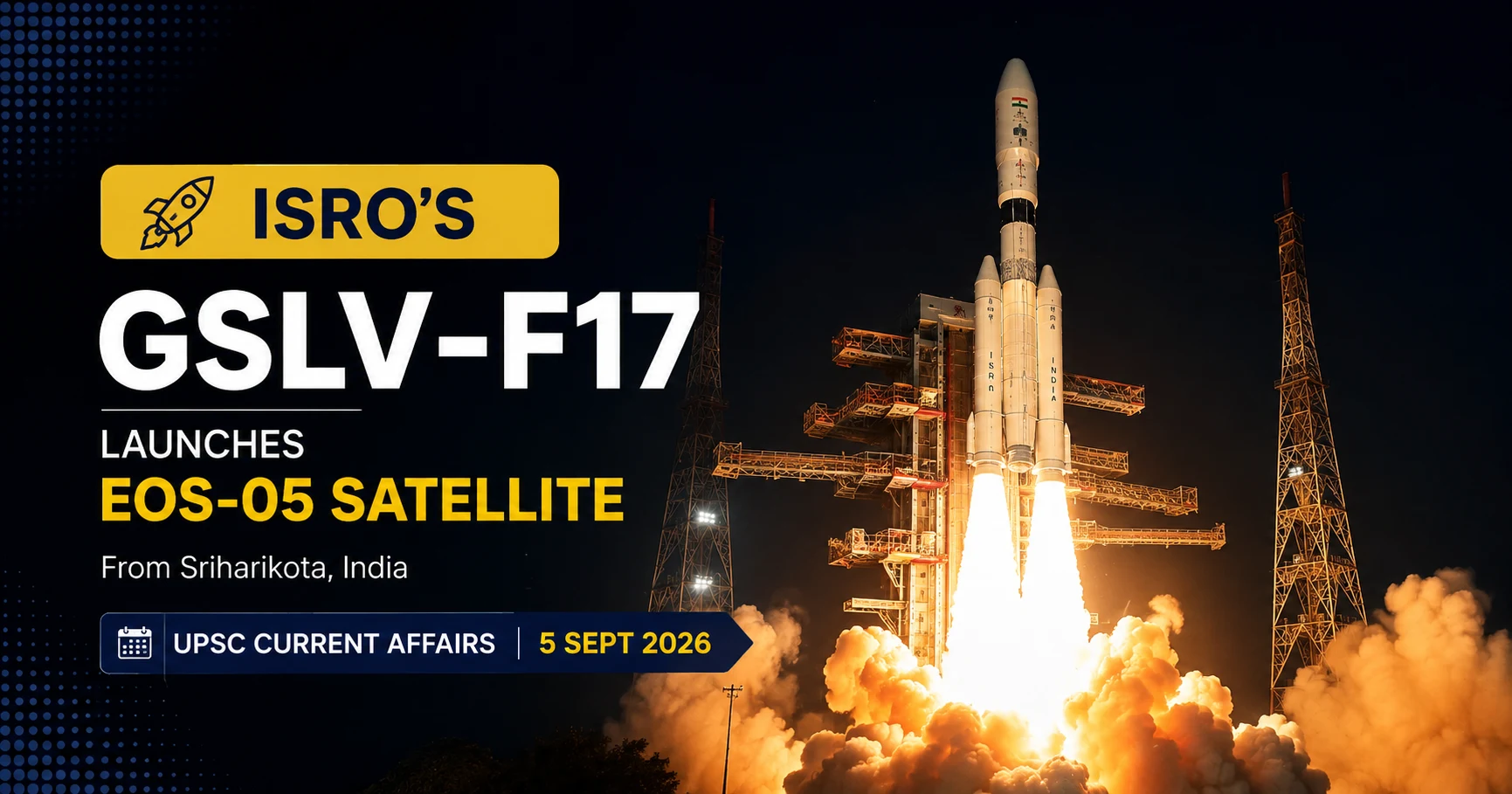
Why in News? In the early hours of Friday, ISRO’s GSLV-F17 rocket lifted off from Sriharikota and placed the EOS-05 satellite into a sub-geosynchronous transfer orbit roughly 36,000 km above the Earth. This was ISRO’s 19th GSLV flight and its 107th launch overall from the Sriharikota spaceport — and crucially, its first satellite mission since two consecutive failures earlier in the year.
Core Facts & Background EOS-05 is India’s first dedicated imaging satellite designed to operate from a geosynchronous orbit rather than the more commonly used low-Earth, Sun-synchronous orbit that most Indian remote-sensing satellites use. At 2,367 kg, it is the heaviest satellite ever carried by a GSLV. Its purpose is to deliver near real-time imagery for agriculture monitoring, environmental tracking, and disaster management, and it carries multi-band imaging capability with an expected operational life of nine years. The satellite replaces EOS-03, which was lost in an unsuccessful GSLV-F10 launch back in August 2021.
The distinction that aspirants must lock in for Prelims is orbital: a satellite in a geosynchronous orbit stays fixed over roughly the same geographic footprint as the Earth rotates, unlike a Sun-synchronous polar orbit where a satellite repeatedly passes over different longitudes at the same local solar time. The former is ideal for continuous monitoring of a fixed region; the latter is better suited to systematic, comparable imaging across the whole globe over several days.
Pros & Cons
- Pro: Near-continuous imagery of the Indian subcontinent supports faster disaster response and agricultural forecasting.
- Pro: Successful launch restores confidence in the GSLV programme after back-to-back setbacks.
- Con: A geosynchronous imaging satellite has a narrower monitoring footprint compared to polar-orbiting satellites that cover the entire globe.
- Con: The mission underlines India’s continuing dependence on a small number of high-value, high-risk launches, where a single failure erases years of preparation.
Way Forward ISRO plans to raise EOS-05 into its final geostationary platform in the coming days to begin full operational imaging. Analysts suggest the bigger institutional priority now is improving the GSLV’s reliability record so that India can build a constellation of geosynchronous-orbit observation satellites rather than relying on one-off missions.
UPSC Current Affairs Analysis | Rare Turtles in a Toxic Pond
Heading & Syllabus Mapping: Prelims — Environment & Biodiversity (Protected Species, Wildlife Protection Act)
Why in News? A pond inside the Shri Guru Gorakhnath Community Reserve in Kajalheri village, Haryana’s Fatehabad district, has turned toxic due to untreated sewage discharge — forcing an estimated 150–200 rare turtles to flee across agricultural fields in search of cleaner water, with many killed by traffic in the process.
Core Facts & Background The reserve, notified by the Haryana government in 2019, is home to the Indian softshell turtle, the red-crowned roofed turtle, and the Indian peacock turtle — all of which enjoy the highest level of statutory protection under Schedule I of the Wildlife (Protection) Act, on par with tigers and rhinoceroses. On the IUCN Red List, these species range from Vulnerable to Critically Endangered.
Environmentalists report that contaminated water is causing skin lesions, fungal infections, and blindness among the turtles. In the absence of proper fencing, stray dogs reportedly dig up turtle nests to eat the eggs, while cattle entering the pond trample nesting banks. A wildlife conservationist has sought registration of a criminal case under the Wildlife (Protection) Act against local officials, alleging administrative neglect. Officials, meanwhile, cite a shortage of funds for the delay in remedial measures, which include diverting sewage away from the pond, erecting fencing, and building raised mounds for safe nesting.
Pros & Cons
- Pro: The reserve’s Schedule I status gives conservationists a strong legal basis to demand accountability.
- Pro: A concrete action plan (fencing, sewage diversion, raised nesting mounds) already exists on paper.
- Con: Implementation has stalled for years due to alleged fund diversion and bureaucratic apathy.
- Con: Without urgent fencing and water treatment, all three protected species face local extinction from this specific habitat.
Way Forward Experts recommend immediate release of allocated funds, independent water-quality testing, and time-bound implementation of fencing and raised nesting mounds — ideally monitored by the Wildlife (Protection) Act framework rather than left to panchayat-level discretion.
UPSC Current Affairs Analysis | Stegodyphus Sarasinorum Spider Venom
Heading & Syllabus Mapping: Prelims — Science & Technology (Biotechnology, Bioprospecting)
Why in News? A team of Indian researchers, led by the Department of Zoology at Sree Neelakanta Government Sanskrit College, Kerala, has produced the first comprehensive molecular profile of the venom gland of Stegodyphus sarasinorum, a colonial spider species found across the Indian subcontinent — and identified compounds with anti-cancer potential. The study is published in Springer Nature’s peer-reviewed journal Scientific Reports.
Core Facts & Background What makes this spider scientifically interesting even before the cancer angle is its rare social behaviour: S. sarasinorum is among a small number of permanently social spider species known worldwide. It lives in permanent colonies, builds communal silk nests, and captures prey cooperatively — making it a valuable model for studying both spider behaviour and venom biology.
Using transcriptomic profiling, researchers identified 31 protein components; proteomic analysis added 32 more proteins; and Ultra High-Performance Liquid Chromatography-Mass Spectrometry (UHPLC-MS) detected 81 metabolites in total, including amino acids, biogenic amines, and organic acids. To test biological activity, venom gland extracts were applied to Dalton’s Lymphoma Ascites (DLA) cancer cells in laboratory experiments. The extracts showed dose-dependent cytotoxicity — meaning higher concentrations destroyed a greater proportion of cancer cells. Researchers, however, caution that findings require extensive validation before any clinical application.
For quick revision: Transcriptomics looks at which genes/RNA are active; Proteomics identifies the actual proteins present; Metabolites are small molecules produced within biological systems; Cytotoxicity is the ability to kill or damage cells.
Pros & Cons
- Pro: Opens a new, India-led avenue in bioprospecting for anti-cancer, antimicrobial and immune-related compounds.
- Pro: Builds a detailed molecular database that other researchers worldwide can use.
- Con: Results are still at the laboratory/cell-culture stage — years away from any drug development.
- Con: Venom-based drug discovery requires extensive toxicology and clinical validation, which is resource- and time-intensive.
Way Forward The study recommends further isolation and testing of individual bioactive compounds, along with expanded research into the venom biology of other lesser-studied Indian spider species as a broader bioprospecting strategy.
UPSC Current Affairs Analysis | The Gulf is Calling: India’s West Asia Dilemma
Heading & Syllabus Mapping: GS Paper II — International Relations (India and its Neighbourhood, Bilateral & Regional Groupings)
Why in News? An opinion piece by MP Shashi Tharoor argues that the signing of the Mecca Joint Defence Agreement — bringing together Saudi Arabia, Türkiye, and Pakistan in a collective defence arrangement — signals a structural shift in West Asia’s security architecture, and that India’s traditional strategy of “multi-alignment” and economics-first engagement with the Gulf may no longer be sufficient.
Core Facts & Background For decades, India treated West Asia primarily as an economic hinterland — a source of crude oil, a remittance corridor, and a destination for outbound labour — while carefully avoiding entanglement in regional rivalries between Riyadh, Tehran, Tel Aviv, and Abu Dhabi. This worked well while the United States acted as the region’s undisputed security guarantor. However, as Washington adopts a more selective, retreating security posture, Gulf states are actively seeking new, credible security partners rather than only economic ones. The Mecca Agreement is being read as one such structural realignment, linking Gulf capital with Turkish defence technology and Pakistani military manpower — right at India’s western maritime doorstep.
The argument’s core worry: if India continues to rely only on legacy diplomacy and transactional commerce, it risks marginalisation in a region essential to its energy security, trade routes, and the welfare of millions of Indians living in the Gulf.
Pros & Cons
- Pro (of deeper security engagement): Protects India’s energy security, safeguards the Indian diaspora, and secures critical maritime trade routes.
- Pro: Opens opportunities for Indian defence manufacturing exports and technology cooperation with Gulf states.
- Con (Challenges): Risk of getting entangled in West Asian conflicts involving Iran, Saudi Arabia, Israel, and Pakistan.
- Con: Limited resources for a sustained overseas naval and military presence, and the need to preserve strategic autonomy.
Way Forward The piece calls for India to expand its naval footprint through joint patrols, permanent logistics access arrangements, and interoperable surveillance networks with friendly Gulf states; deepen defence-manufacturing partnerships; and build flexible bilateral and “minilateral” security frameworks — without succumbing to rigid Cold-War-style alliances.
UPSC Current Affairs Analysis | Bilateral Investment Treaty (BIT) Reset
Heading & Syllabus Mapping: GS Paper II / III — International Relations & Indian Economy (Investment Model, Governance)
Why in News? India is revising its 2015 Model Bilateral Investment Treaty (BIT), and the revised text is expected to be placed before the Union Cabinet soon. The revision follows Finance Minister Nirmala Sitharaman’s 2025 Budget speech announcement of a review, prompted partly by several foreign investors suing India over past BIT breaches.
Core Facts & Background A BIT is an investment-protection agreement between two countries, and India’s Model BIT serves as the template for negotiating individual treaties. India’s current 2015 model has been criticised for tilting heavily toward protecting the state’s regulatory power at the cost of investor protection — discouraging foreign direct investment due to high regulatory risk, underdeveloped governance frameworks, and a slow judicial system.
The article raises a second, less-discussed dimension: the “democratic deficit” in treaty-making. Since international economic treaties affect citizens broadly, the argument goes, the “all-affected principle” of democracy demands wider participation — through Parliament, experts, industry, and civil society — rather than treaties being negotiated behind closed doors by the executive alone. Countries like the United Kingdom and Australia already mandate that a negotiated treaty text be placed before Parliament before ratification; India circulated its 2015 draft BIT for public comment in March 2015 and the Law Commission of India examined it in its 260th Report, though not all recommendations were adopted.
Pros & Cons
- Pro: Greater investor confidence from balanced treaty protections can attract more FDI.
- Pro: A consultative, transparent process strengthens democratic accountability in treaty-making.
- Con: Excessive investor protection can restrict the government’s policy and regulatory space.
- Con: Investment disputes under international arbitration can result in significant financial liabilities for the government.
Way Forward The article recommends a four-step consultative process: first, an internal expert team including international lawyers and economists; second, consultation with industry bodies, arbitrators and civil society; third, placing the draft BIT in the public domain for comments; and fourth, tabling the draft before Parliament for discussion before finalisation.
UPSC Current Affairs Analysis | Perimenopausal Health Policy
Heading & Syllabus Mapping: GS Paper II — Social Justice (Health, Women & Vulnerable Sections)
Why in News? Tamil Nadu and Karnataka have, within a short span of each other in August, announced dedicated perimenopause/menopause care policies — moving mid-life women’s health out of what the article calls the “neglect bin” of India’s healthcare system.
Core Facts & Background Women’s healthcare in India has traditionally focused almost entirely on the reproductive age group, leaving perimenopausal and menopausal needs largely unaddressed. Menopause is the permanent end of menstrual periods and reproductive ability, confirmed after 12 consecutive months without a cycle; it occurs when the ovaries naturally reduce production of the hormones oestrogen and progesterone. The perimenopausal period — the transition leading up to menopause — can bring irregular periods and bodily changes over several years, with common symptoms including hot flashes, sleep trouble, mood changes, joint pain, and fatigue.
Tamil Nadu’s Health Minister announced a perimenopausal care policy aimed at early identification of physical and mental health needs, with screening, counselling, and treatment services through Primary Health Centres (PHCs) and higher facilities. Karnataka introduced “Ruthu Thare” as the country’s first dedicated women’s health policy with a strong focus on perimenopause and menopause. Both states plan community-level outreach screening, women’s-health clinics, and referrals to district hospitals.
Pros & Cons
- Pro: Early identification and treatment of menopause-related problems can significantly improve women’s physical and mental well-being.
- Pro: Community-level screening improves accessibility for women who otherwise “just endure” symptoms silently.
- Con: Low awareness among women, families, and even medical professionals could limit uptake.
- Con: Implementation gaps at the PHC and community level could weaken outcomes, since the real test lies in execution rather than announcement.
Way Forward The article stresses that policy effectiveness will only be measured during implementation — recommending trained doctors, nurses, and ASHA workers, strengthened screening and counselling infrastructure at PHCs, wider community awareness campaigns, and reliable medicine and referral systems.
UPSC Current Affairs Analysis | Global Methane Pledge & India’s Climate Messaging
Heading & Syllabus Mapping: GS Paper III — Environment (Climate Change, International Agreements)
Why in News? The United Nations Environment Programme’s (UNEP) report, Limiting Overshoot, warns that the 1.5°C global warming limit under the Paris Agreement has effectively already been breached, and calls for urgent action on methane — even as India remains outside the Global Methane Pledge.
Core Facts & Background The report finds that even if all countries fully deliver on their current climate pledges, the world is still on track for 1.8°C of warming, and under current policies alone, 2.6°C by 2100. Since the 1.5°C limit has already been breached, the report proposes an “overshoot, peak, and decline” pathway — allowing temperatures to rise temporarily above 1.5°C while working to bring them back down by the end of the century.
A key new emphasis is on greenhouse gases beyond carbon dioxide — specifically methane, responsible for about 0.5°C of current warming and considered the most effective lever for slowing warming in the near term. Over 55 countries have joined the Global Methane Pledge, committing to cut anthropogenic methane emissions by at least 30% below 2020 levels by 2030 — but India is not among them.
The report has little to say on adaptation finance, reviving the familiar CBDR (Common But Differentiated Responsibilities) tension between developed nations, who emphasise mitigation, and developing economies like India, which argue they are already transitioning away from fossil fuels and deserve greater financial and technological support given their historically low per-capita emissions. Nepal’s Foreign Affairs Minister has separately urged major emitters — China, the US, and India — to consider the impact of rising temperatures on smaller, more vulnerable countries following a recent Bhotekoshi glacial disaster.
Pros & Cons
- Pro (of joining pledges like the Methane Pledge): Faster near-term cooling impact compared to CO2-only strategies.
- Pro: Strengthens India’s global climate leadership credentials ahead of COP31 in Türkiye this November.
- Con: India staying outside preserves policy flexibility but exposes it to criticism of being part of the emissions problem despite low per-capita emissions.
- Con: Relying solely on a “victim” narrative around climate vulnerability may weaken India’s negotiating position as scrutiny of major emitters, including India, increases.
Way Forward The article urges India to take global perceptions seriously, calibrate its messaging away from a purely victim-based narrative, and demonstrate credible domestic action on both mitigation and adaptation ahead of COP31.
UPSC Current Affairs Analysis | Cell Broadcasting Service (CBS) Resumption
Heading & Syllabus Mapping: Prelims — Science & Technology / Disaster Management
Why in News? The Centre for Development of Telematics (C-DOT) CEO has confirmed that the emergency Cell Broadcasting Service (CBS) — used to send alerts to telecom users during extreme weather and natural disasters — has “already resumed,” after being briefly suspended following an erroneous late-night alert sent in central Delhi.
Core Facts & Background CBS is developed by C-DOT and operated in coordination with State Disaster Management Agencies (SDMAs). The technical challenge is significant: a single alert message has to reach every telecom operator’s core network and every kind of radio equipment — Motorola, Siemens, ZTE, Huawei — and even different generations of radio technology within the same vendor. It reportedly took the team six months of work (300 to 350 “adapters”) to successfully deliver one test message.
The story also carries a telecom self-reliance angle: Germany-headquartered Utimaco, a global CBS technology provider, sued the Indian government in the Delhi High Court over its decision to award the CBS implementation project to the state-owned C-DOT instead. The court ruled in the government’s favour on the core issue, while leaving room for the company to pursue damages over alleged administrative irregularities. C-DOT, traditionally known for enabling rural telephone exchanges, has now been tasked with developing domestically manufactured alternatives to imported telecom gear.
Pros & Cons
- Pro: Enables mass, location-targeted alerts that can reach large populations instantly during cyclones, floods, or earthquakes.
- Pro: Strengthens indigenous telecom capability and reduces reliance on foreign vendors like Utimaco.
- Con: Technical compatibility challenges across different networks and legacy devices remain significant.
- Con: Risk of false alerts (as seen in the Delhi incident) can create public panic and erode trust in the system.
Way Forward Suggested measures include strengthening testing protocols before mass deployment, improving coordination between C-DOT, the Department of Telecommunications (DoT), the India Meteorological Department (IMD), and disaster-management authorities, and regularly testing the system without triggering public alarm.
UPSC Current Affairs Analysis | NCPCR Child Labour Rescue Campaign
Heading & Syllabus Mapping: Prelims / GS Paper II — Polity (Statutory Bodies) & Social Justice (Child Rights)
Why in News? The National Commission for Protection of Child Rights (NCPCR) has rescued over 3,800 children from child labour under a sustained “Pan-India Rescue and Rehabilitation” campaign launched on June 12 and continued until August 31, with over 575 FIRs registered in connection with these incidents.
Core Facts & Background The NCPCR is a statutory body constituted under the Commission for Protection of Child Rights (CPCR) Act, 2005, functioning under the Ministry of Women and Child Development. It is mandated to monitor the effective implementation of the POCSO Act, 2012, the Juvenile Justice (Care and Protection of Children) Act, 2015, and the Right to Free and Compulsory Education (RTE) Act, 2009. India acceded to the UN Convention on the Rights of the Child (CRC) in 1992, an international treaty obligating signatory states to protect children’s rights.
On composition: the Chairperson is appointed by the Central Government on the recommendation of a three-member committee chaired by the Minister of Education, for a term of 3 years or until age 65, renewable for not more than two terms. The Commission also has six members, at least two of whom must be women, drawn from fields like child health, juvenile justice, and elimination of child labour, serving similarly for 3 years or until age 60. Members can be removed by the Central Government on specific grounds such as insolvency, unsound mind, or moral-turpitude convictions — but only after being given an opportunity to be heard (the principle of audi alteram partem).
Beyond this campaign, NCPCR runs several ongoing initiatives: the POCSO e-Box, an online complaint system for reporting child sexual abuse; Samvardhan, a vulnerability-mapping programme to combat child trafficking; the MASI App (Monitoring App for Seamless Inspection) for real-time monitoring of Child Care Institutions; and the GHAR-GO portal (Go Home and Re-Unite) for tracking restoration and repatriation of rescued children.
Pros & Cons
- Pro: A coordinated, statutory-body-led campaign has produced measurable results — rescues, FIRs, and follow-up rehabilitation.
- Pro: Digital tools (MASI, GHAR-GO, POCSO e-Box) add real-time monitoring capability that manual systems lacked.
- Con: Rescue alone doesn’t guarantee long-term rehabilitation, education, or reintegration outcomes for these children.
- Con: Sustained success depends heavily on coordination between district magistrates, labour departments, and police — coordination gaps can undo field-level gains.
Way Forward NCPCR has requested states and Union Territories to furnish regular data on rescue operations, FIRs, rehabilitation, restoration, educational mainstreaming, and compensation, while intensifying identification and rescue operations at known child-labour and trafficking hotspots.
UPSC Current Affairs Analysis | Coal Gasification Scheme Finds No Takers
Heading & Syllabus Mapping: GS Paper III — Indian Economy (Energy Security, Government Schemes)
Why in News? The government’s ambitious ₹37,500-crore financial incentive scheme to promote coal gasification has received zero applications from any private or public player, despite the first submission deadline of September 7 fast approaching.
Core Facts & Background Coal gasification refers to converting dry coal or lignite fuel into synthetic gas (syngas) — used as an alternative fuel and helping reduce carbon emissions compared to direct coal burning. Syngas can support domestic production of methanol, fertilisers, hydrogen, and chemicals, thereby cutting India’s dependence on imports of LNG, urea, and methanol, and insulating the country from global price volatility and supply-chain disruptions.
The Union Cabinet approved this scheme (under the Request for Proposal issued July 7, 2026) targeting gasification of 75 million tonnes of coal and lignite, with support disbursed every two months to provide multiple opportunities for industry participation. However, given the scale of funds involved, preparing detailed Project Feasibility Reports (PFRs) and full project proposals takes considerable time — several industries have expressed interest in participating but haven’t yet submitted formal applications.
Pros & Cons
- Pro: Could meaningfully boost clean(er) energy production and reduce costly imports of LNG, methanol, and urea.
- Pro: Supports India’s broader energy-security and import-substitution goals.
- Con: High capital cost of gasification projects makes private players hesitant despite incentives.
- Con: Coal gasification, while cleaner than direct combustion, still generates carbon emissions, raising questions about its long-term climate compatibility.
Way Forward Suggested fixes include simplifying and de-risking the scheme’s regulatory and financial design, promoting more advanced/cost-effective gasification technologies, linking gasification with carbon capture, utilisation and storage (CCUS), and offering more stable, long-term policy assurances to attract serious private investment.
UPSC Current Affairs Analysis | Thermal Sector’s Coal Stock Management Dilemma
Heading & Syllabus Mapping: GS Paper III — Indian Economy (Energy Security, Infrastructure)
Why in News? India’s thermal power sector is grappling with a growing fuel-management dilemma: generators that responsibly maintain adequate coal inventories risk being penalised, as limited domestic supplies during shortages get redirected to plants that have fallen below prescribed stock norms.
Core Facts & Background Under the current Central Electricity Authority (CEA) framework, effective since December 6, 2021, plant-specific stocking norms were introduced to strengthen fuel security and inventory planning. Coal supply to plants is managed through two allocation windows — Window I covers linkages to central-government-owned generating companies and state utilities at notified prices, while Window II allows other producers, including those using imported coal, to procure coal through auctions at a premium over the notified price.
The core problem: emergency redistribution, meant only for genuine supply-chain disruptions (mine-side constraints, railway bottlenecks, force-majeure events, or sudden electricity-demand spikes), is instead becoming routine — diverting coal from well-managed “Plant A” (which maintained excess stock responsibly) to poorly-managed “Plant B” (running a coal deficit), thereby discouraging good inventory planning altogether. Notably, this is happening despite India’s coal production exceeding 1 billion tonnes in each of the last two financial years (1,047.52 MT in FY2024-25 and 1,040.08 MT in FY2025-26) — meaning the challenge isn’t a national shortage but inefficient allocation, transport, and conversion of coal into adequate plant-level inventories. As of the data cited, combined coal stock at thermal plants (pitheads plus in-transit) stood at roughly 148 MT.
Pros & Cons
- Pro: Emergency redistribution genuinely helps keep vulnerable, critical plants operational during real supply-chain shocks (like the COVID-19-era transport standstill).
- Pro: Coal linkages and Fuel Supply Agreements (FSAs) give generators greater long-term certainty over fuel availability.
- Con: Repeated, non-emergency redistribution creates a moral hazard, disincentivising plants from maintaining adequate buffer stocks in the first place.
- Con: Persistent railway and last-mile logistics bottlenecks remain unresolved despite record coal production.
Way Forward Industry experts recommend reserving emergency redistribution strictly for genuine disruptions, improving real-time monitoring of coal stocks and movement, strengthening railway and last-mile coal logistics, and tighter coordination between the Coal Ministry, Power Ministry, and Railways — alongside a gradual diversification of India’s electricity mix toward renewables and storage.
FAQs
Q1. Why is EOS-05 significant among ISRO’s satellites? EOS-05 is India’s first dedicated imaging satellite placed in a geosynchronous orbit rather than the usual Sun-synchronous polar orbit, and at 2,367 kg, it is the heaviest satellite ever launched by a GSLV.
Q2. Which turtle species are involved in the Haryana toxic pond issue, and what protection do they enjoy? The Indian softshell turtle, red-crowned roofed turtle, and Indian peacock turtle are involved; all three are protected under Schedule I of the Wildlife (Protection) Act, on par with tigers and rhinoceroses.
Q3. What makes Stegodyphus sarasinorum scientifically unique? It is one of the world’s few permanently social spider species, living in colonies, building communal nests, and hunting cooperatively — and its venom has now shown anti-cancer potential in lab tests.
Q4. What is the Global Methane Pledge, and has India joined it? It is a commitment by over 55 countries to cut anthropogenic methane emissions by at least 30% below 2020 levels by 2030. India has not joined the Pledge.
Q5. What is the “democratic deficit” concern in India’s BIT revision debate? It refers to the lack of adequate Parliamentary or public consultation before a bilateral investment treaty is negotiated and finalised, unlike countries such as the UK and Australia that mandate placing treaty text before Parliament.
Q6. Who constitutes the NCPCR, and under which Act was it formed? NCPCR was constituted under the Commission for Protection of Child Rights (CPCR) Act, 2005, comprising a Chairperson and six members, at least two of whom must be women.
UPSC Current Affairs Analysis | Previous Current Affairs