
UPSC Daily Current Affairs – 8 Sep 2026 | The Hindu Analysis
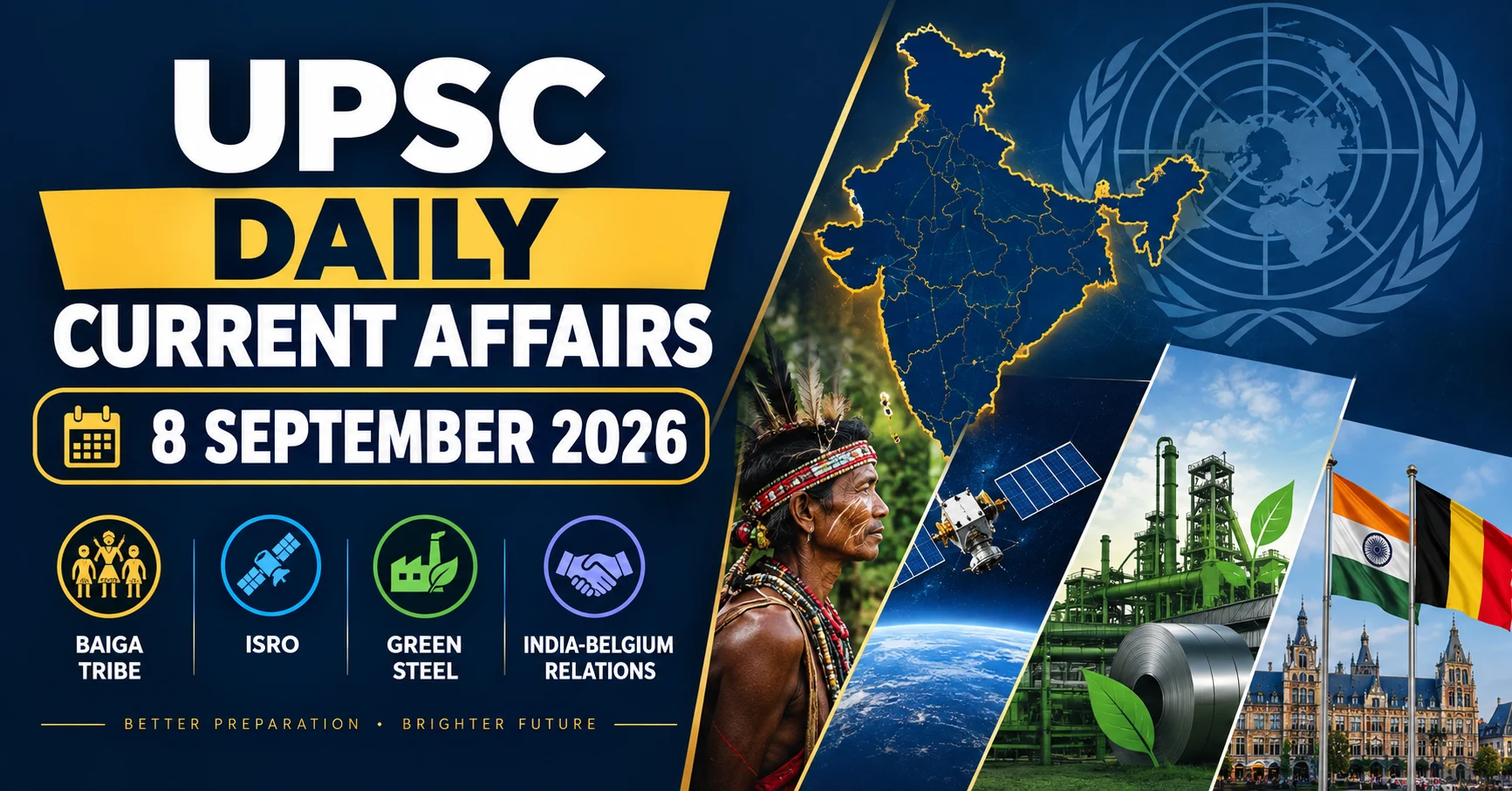
This UPSC Daily Current Affairs brief for 8th September 2026, based on The Hindu, is curated for UPSC Civil Services (Prelims & Mains), State PCS, and other competitive exam aspirants. It condenses the day’s most exam-relevant developments — covering tribal welfare, science & technology, foreign relations, public health law, environment, and geography — into structured notes with Prelims facts, editorial analysis, and Mains-oriented “Way Forward” points.
UPSC Daily Current Affairs | Overview
| S.No. | Topic | GS Paper / Category | Relevance |
|---|---|---|---|
| 1 | Baiga Tribe – Deaths of Children in Madhya Pradesh | Prelims (Society/Polity) | PVTG, tribal welfare schemes |
| 2 | MatsyaMetri App by CMFRI | Prelims (Science & Tech) | Government apps, fisheries |
| 3 | Are U.S. Tariffs Holding Back Indian Research? | GS-III (Economy) | R&D spending, trade shocks |
| 4 | India-Belgium Relations | GS-II (International Relations) | India-EU FTA, bilateral ties |
| 5 | ISRO and the Private Space Sector Debate | GS-III (Science & Tech) | Space policy, IN-SPACe |
| 6 | Deaths Due to Collapsing Structures | GS-III (Disaster Management) | Urban safety, data analysis |
| 7 | Are Nicotine Pouches Beyond the Law? | GS-II (Governance/Health Law) | Regulatory gaps, COTPA, PECA |
| 8 | Can Air-Cooling Handle Data Centre Heat? | GS-III (Science & Tech/Environment) | AI infrastructure, water stress |
| 9 | New UN World Map – Arunachal & Aksai Chin | Prelims (Geography/Polity) | Territorial claims, cartography |
| 10 | 72nd National Film Awards | Prelims (Art & Culture) | Static GK |
| 11 | India’s Green Steel Journey | GS-III (Environment/Economy) | Net-zero, decarbonisation |
| 12 | Anak Krakatau Volcano Eruption | Prelims (Geography) | Volcanism, plate tectonics |
UPSC Daily Current Affairs | Baiga Tribe and the Question of Delayed Government Response
Heading & Syllabus Mapping: GS-I/GS-II — Vulnerable Sections, Tribal Welfare, PVTGs (Prelims + Mains)
Why in News? A Parliamentary Standing Committee on Social Justice and Empowerment recently raised concerns over the government’s delayed response to the deaths of children belonging to the Baiga tribe in Madhya Pradesh’s Balaghat district. The panel questioned officials from the Ministry of Tribal Affairs, the Ministry of Jal Shakti, and the Department of Telecommunications while reviewing the rollout of the Pradhan Mantri Janjati Adivasi Nyaya Maha Abhiyan (PM-JANMAN).
Core Facts & Background
- The Baiga are classified as a Particularly Vulnerable Tribal Group (PVTG), found mainly in central India, with the largest population in Madhya Pradesh and smaller communities in Uttar Pradesh, Chhattisgarh, and Jharkhand.
- Their traditional language, Baigani, is a dialect of Chhattisgarhi with strong Gondi and Hindi influences.
- Historically semi-nomadic, the community practised a form of shifting cultivation locally called “Bewar” and today relies largely on minor forest produce for sustenance.
- Distinct cultural markers include extensive body tattooing using a natural pigment derived from Ramtilla (Niger) seeds, and the ceremonial and dietary use of fermented Mahua extract.
- Notably, the Baiga became the first community in India to be granted habitat rights, formally recognising their deep ecological and cultural relationship with forest land.
Pros & Cons
- Positive: Parliamentary oversight ensures accountability and pushes ministries to act faster on tribal health and welfare gaps.
- Concern: Persistent delays in identifying the cause of child deaths point to weak inter-ministerial coordination and gaps in last-mile healthcare delivery in remote tribal belts.
Way Forward Strengthening mobile health units, faster inter-ministerial reporting mechanisms, and better monitoring of schemes like PM-JANMAN in PVTG habitats are essential to prevent recurrence and to protect India’s most vulnerable tribal communities.
UPSC Daily Current Affairs | MatsyaMetri — A Hands-Free Fish Measurement App
Heading & Syllabus Mapping: GS-III — Science & Technology, Agriculture-allied Sectors (Prelims)
Why in News? The Central Marine Fisheries Research Institute (CMFRI), headquartered in Kochi, Kerala, has announced the development of a smartphone application named MatsyaMetri, designed to measure the length and width of fish without any physical handling.
Core Facts & Background
- The app is aimed at fisheries scientists, researchers, and field survey teams, and it speeds up biological data collection by recording measurements and photographs automatically.
- It supports multiple individuals or species being measured in a single sampling session and can generate length-frequency datasets, later exportable as CSV files for analysis.
- CMFRI was established in 1947 under the Ministry of Agriculture and Farmers’ Welfare and later became part of the Indian Council of Agricultural Research (ICAR) in 1967, operating today as ICAR-CMFRI.
- ICAR itself is the world’s largest network of agricultural research and education institutions, functioning under the Department of Agricultural Research and Education.
Pros & Cons
- Positive: Reduces stress and injury to live fish specimens, speeds up field surveys, and improves data accuracy for fisheries management.
- Limitation: Technology adoption in small-scale and remote fishing communities may remain slow without adequate training and smartphone access.
Way Forward Wider deployment of such digital tools, paired with capacity building for field-level fisheries staff, can strengthen India’s marine resource assessment and support sustainable fisheries management.
UPSC Daily Current Affairs | Are U.S. Tariffs Really Holding Back Indian Research?
Heading & Syllabus Mapping: GS-III — Indian Economy, Growth & Development, Investment Models (Mains)
Why in News? Amid the ebb and flow of tariff tensions between the United States and India — with a recent easing of the reciprocal tariff and continued exemptions for pharmaceuticals and most electronics — an important economic debate has resurfaced: do U.S. tariffs genuinely suppress India’s research capability, or is the real problem structural?
Core Facts & Background
- India’s research effort is heavily concentrated in just two sectors — pharmaceuticals and automobiles — while sectors most exposed to trade shocks (metals, chemicals, plastics, base metals) already spend very little on R&D, even before any tariff was imposed.
- Comparative R&D intensity: Indian metal firms spend roughly 0.4% of sales on R&D against a global average near 1.6%; Indian auto and parts makers spend a little over 2% versus a global benchmark of about 5%; and Indian electrical equipment firms spend under 2% against a similar global standard.
- The article argues the deeper issue is that India, as a whole, invests a very small share of national output in research compared with countries it aspires to compete with, and most private-sector spending goes toward routine testing rather than genuine innovation.
- Against this backdrop, the government has launched a ₹1 lakh crore Research, Development and Innovation (RDI) scheme, offering long-tenure, low-cost capital to firms working in frontier areas such as artificial intelligence, semiconductors, quantum technology, and biotechnology.
Pros & Cons
- Argument for tariffs not being the villain: Chemicals and steel firms were already research-thin long before any tariff dispute, so a tariff “cannot cut research spending that was never there.”
- Risk: Without better firm-level measurement of research spending, policymakers may end up reacting to the wrong problem and miss opportunities to direct support where it is truly needed.
Way Forward The suggested approach is to tie government incentives to demonstrated research effort rather than distributing support thinly across all exposed sectors, while urgently improving how India measures and tracks corporate R&D spending.
UPSC Daily Current Affairs | India–Belgium Relations — “Natural Partners”
Heading & Syllabus Mapping: GS-II — India and its Neighbourhood/Bilateral Groupings, India-EU relations (Prelims + Mains)
Why in News? Belgian Prime Minister Bart De Wever’s visit to New Delhi for talks with Prime Minister Narendra Modi has put the spotlight on India–Belgium ties, coming just ahead of the anticipated signing of the India–EU Free Trade Agreement (FTA), expected in December.
Core Facts & Background
- Bilateral trade between India and Belgium stands at roughly $13 billion, with nearly a third of it tied to the century-old diamond trade — Antwerp serves as a global diamond-trading hub, while Mumbai and Surat dominate cutting and polishing.
- The two Prime Ministers agreed to a target of doubling bilateral trade within the next five years, with hopes of expanding cooperation into renewable energy and food processing once the EU-India FTA is finalised.
- On the defence front, both sides signed a Memorandum of Understanding for co-development of military hardware and a letter of intent on defence cooperation; India will also post a resident defence attaché in Brussels.
- The visit was framed in broader geopolitical terms as well, with references to India’s long-standing message on strategic autonomy and reduced overdependence in trade — a message read as indirectly addressing China.
- The timing is notable as it coincides with Russian President Vladimir Putin’s planned visit to Delhi for the BRICS summit, highlighting India’s continued balancing act between European partners and its ties with Russia.
Pros & Cons
- Positive: Diversifying defence procurement and trade partnerships beyond traditional global powers strengthens India’s strategic flexibility.
- Challenge: Sustaining “natural partner” rhetoric will require translating diplomatic goodwill into concrete trade volume growth once the EU-FTA is operational.
Way Forward Finalising the India-EU FTA on schedule and operationalising the defence MoU into tangible co-production projects will be key markers to track in the coming year.
UPSC Daily Current Affairs | ISRO’s Focus on Space Technology as a Development Tool
Heading & Syllabus Mapping: GS-III — Science & Technology, Space Policy (Mains)
Why in News? Even as ISRO celebrated the successful launch of its first geosynchronous imaging satellite, EOS-05, aboard a GSLV rocket, nine employee associations within the organisation jointly wrote to the ISRO chairman seeking clarity on staff strength, recruitment, and the outsourcing of core functions to the private sector.
Core Facts & Background
- The unease traces back to the Indian Space Policy, 2023, which signalled that ISRO would eventually reduce its role in building commercial satellites and launch vehicles, shifting that work to private industry while ISRO itself focuses on ambitious exploratory missions.
- ISRO has stated it will “not be privatised or reduced,” while IN-SPACe, the body set up to facilitate private-sector participation, insists ISRO will “not be diminished” — though neither directly addresses employee concerns over potential job losses.
- For comparison, ISRO’s annual budget is about ₹13,705 crore, roughly one-sixteenth of NASA’s $24.4 billion budget; NASA itself has scaled down significantly since the Apollo era, from about 0.7% of U.S. GDP in 1966 to roughly 0.1% today.
- Unlike NASA, which historically built most of its own hardware, ISRO has long worked with private manufacturing partners (such as Walchandnagar and L&T); what is new is the entry of fresh private players focused more on satellite-data services than on deep manufacturing experience.
- NSIL (NewSpace India Limited) functions as ISRO’s commercial arm for monetising space technologies and services.
Pros & Cons
- Benefits of the shift: Frees ISRO to concentrate on frontier R&D and strategic missions, brings in private capital and innovation, and can generate high-skilled jobs and export revenue through space-based services.
- Risks: Excessive outsourcing without safeguards could erode ISRO’s institutional expertise, and new private entrants may lack the technological depth to sustain long-term growth.
Way Forward A collaborative “ISRO + Private Sector” model — rather than a competitive one — combined with transparent workforce policies and a strengthened regulatory role for IN-SPACe, can help India’s space sector expand without hollowing out ISRO’s core capabilities.
UPSC Daily Current Affairs | Nearly 8,000 Deaths From Building Collapses in Five Years
Heading & Syllabus Mapping: GS-III — Disaster Management, Urban Governance (Prelims + Mains)
Why in News? The collapse of a five-storey residential building in Delhi’s Satya Niketan area — which killed six people — has renewed scrutiny of lax enforcement of building safety norms across Indian cities.
Core Facts & Background
- According to an analysis of Accidental Deaths and Suicides in India (ADSI) reports, roughly 7,874 people died in structural collapses across the country between 2020 and 2024, with Delhi alone recording around 169 deaths in that period.
- Delhi reported the 12th-highest absolute number of deaths (42) in 2024, but ranks among the top states when deaths are measured per million population, a trend that has worsened almost every year since 2020.
- Among states, Uttar Pradesh recorded the highest number of building-collapse deaths in 2024 (223), followed by Maharashtra (220) and Madhya Pradesh (174).
- Since January 2025, media-tracked incidents suggest at least 70 people have died in about 20 separate collapse events, indicating the problem remains persistent and under-addressed.
Pros & Cons
- Systemic issue: The data suggests these are not isolated accidents but a recurring, largely unaddressed governance failure tied to unauthorised construction and weak safety audits.
- Response gap: Reactive measures — such as municipal orders to seal illegal structures only after a tragedy — highlight the absence of proactive, long-term urban safety planning.
Way Forward Experts stress the need for systematic structural audits, stricter enforcement against illegal high-rises, and long-term urban planning strategies that also account for India’s growing demand for affordable housing.
UPSC Daily Current Affairs | Are Nicotine Pouches Beyond the Reach of Indian Law?
Heading & Syllabus Mapping: GS-II — Governance, Health Policy & Regulation (Mains)
Why in News? A study led by the ICMR-National Institute of Cancer Prevention and Research found that nicotine pouches are reaching Indian consumers through online platforms, hookah shops, and gig-delivery services — even though no clear Indian law directly governs them.
Core Facts & Background
- A nicotine pouch is a small, tobacco-free sachet containing nicotine, flavourings, and plant fibres, placed between the lip and gum to release nicotine into the bloodstream without smoke or spitting.
- The Cigarettes and Other Tobacco Products Act, 2003 (COTPA) governs products containing tobacco leaf extract but does not extend to nicotine extracted and used without tobacco leaf, leaving pouches outside its scope.
- The Prohibition of Electronic Cigarettes Act, 2019 (PECA), which bans vapes, also does not apply because nicotine pouches contain no electronic device and produce no vapour.
- Nicotine itself is not scheduled under the Drugs and Cosmetics Act, 1940, though certain patches and gums used for therapeutic purposes have been separately approved as drugs; products with under 2 mg of nicotine are even exempt from certain licensing rules under “Schedule K.”
- Whether pouches count as “food” under the Food Safety and Standards Act remains legally debatable, since the definition of food is broad but was not designed with such products in mind.
- On imports, nicotine pouches are currently sold at a few duty-free shops in Indian airports under Customs Act provisions, occupying a legal grey zone since duty-free goods are not formally “imported” into Indian territory.
Pros & Cons
- Regulatory Gap: The overlapping — yet incomplete — coverage of COTPA, PECA, the Drugs Act, and food law leaves nicotine pouches without a dedicated regulator, enabling unchecked sale and marketing.
- Public Health Risk: Delay in regulation could allow demand to become entrenched, mirroring the pattern seen earlier with vapes before PECA was enacted.
Way Forward Legal experts suggest that a straightforward government notification — banning or regulating the import and sale of nicotine pouches on health grounds — could close this gap quickly, before informal markets expand further.
UPSC Daily Current Affairs | Can Air-Cooling Handle the Heat From a 1-GW Data Centre?
Heading & Syllabus Mapping: GS-III — Science & Technology, Environment (Water Stress), Infrastructure (Mains)
Why in News? Following sustained protests from civil society groups over water usage, Google reportedly agreed that its planned 1-gigawatt data centre in Visakhapatnam will rely on air-cooling technology rather than more water-intensive alternatives.
Core Facts & Background
- Large data centres generate enormous heat because billions of transistors resist current flow, releasing energy that must be continuously removed to keep servers functional.
- Cooling methods range from air-cooling (fans and air handlers moving heat away from server racks) to liquid-cooling approaches such as direct-to-chip cooling (liquid absorbs heat directly from processors) and immersion cooling (servers submerged in a non-conductive liquid).
- Air-cooling is cheaper and uses far less water, but it becomes practically inadequate at the scale of a 1-GW facility — modern AI chips like the Nvidia Blackwell can demand power levels that push air-cooling to a “performance and efficiency tax,” according to the report.
- Liquid-cooling systems, while more efficient at heat removal, carry higher upfront infrastructure costs, need specialised leak-detection equipment, and can, in facilities using evaporative cooling towers, significantly raise local water stress.
- The broader concern highlighted is an emerging energy–water–heat nexus: as AI-driven data centre expansion accelerates, decisions on cooling technology directly affect both electricity demand and groundwater/surface water availability near data centre clusters.
Pros & Cons
- Benefit of air-cooling: Conserves scarce local water resources, an important consideration in water-stressed regions like Visakhapatnam.
- Trade-off: May limit the maximum computing density achievable at the site and could raise long-term energy costs due to lower cooling efficiency.
Way Forward A hybrid cooling approach — combining air-cooling for lower-density zones with targeted liquid or direct-to-chip cooling for high-density AI clusters — alongside renewable-energy-powered operations and clear water-use standards, is being proposed as the sustainable middle path for India’s expanding data centre sector.
UPSC Daily Current Affairs | New UN World Map Shows Arunachal Pradesh and Aksai Chin Between Claim Lines
Heading & Syllabus Mapping: Prelims — Geography, Mapping; GS-II — India’s Territorial Sovereignty (Mains)
Why in News? A new world map, endorsed at the United Nations following the adoption of the India-backed “Correct the Map” resolution on 4th September, has depicted Arunachal Pradesh and Aksai Chin as regions caught between competing Indian and Chinese “claim lines.”
Core Facts & Background
- The map, which came up for discussion on 1st July during months-long UNGA deliberations, shows Arunachal Pradesh’s southern border with Assam labelled the “Indian line,” while its northern border is shown as the “Chinese line” — treating the state’s boundary as a matter of unresolved claims rather than settled fact.
- Similarly, Aksai Chin’s eastern border is depicted along an “Indian line,” while its western border follows what is described as a “Chinese line.”
- For Jammu & Kashmir, the map uses a dotted line to represent the Line of Control (LoC) between India and Pakistan, with a note clarifying that “the final status of Jammu & Kashmir has not yet been agreed upon by the parties.”
- The “Correct the Map” resolution itself was sponsored by Togo and supported by the African Union, primarily to promote the use of the Equal Earth cartographic projection, which more accurately represents the true relative size of continents (correcting distortions in the traditional Mercator projection, which visually enlarges regions like Greenland and Russia relative to their real size).
- India’s External Affairs Ministry clarified that India voted in favour of the resolution’s underlying principle of equal-area cartographic representation, while asserting that India’s sovereign territory, including Jammu & Kashmir and Ladakh, must be depicted according to India’s own official map — and that the UN map itself remains non-binding, though it may still be referenced by multilateral institutions worldwide.
Pros & Cons
- Cartographic significance: Adoption of the Equal Earth projection reflects a broader global push for “cognitive justice” in mapping, correcting long-standing Western-centric map distortions.
- Diplomatic sensitivity: Despite the map being non-binding, any depiction of Indian territory as a “claim line” rather than settled sovereign territory carries symbolic weight in international forums.
Way Forward India is expected to continue formally engaging with the UN and multilateral bodies to ensure future cartographic products reflect its official position on Arunachal Pradesh, Aksai Chin, and Jammu & Kashmir as undisputed Indian territory.
UPSC Daily Current Affairs | 72nd National Film Awards — Gujarat to Host for the First Time
Heading & Syllabus Mapping: Prelims — Art & Culture, Static GK
Why in News? The 72nd National Film Awards ceremony will be held in Gujarat for the first time, at Ekta Nagar, on 22nd September, with President Droupadi Murmu presenting the awards — marking a departure from Delhi, the traditional host city since the first ceremony in 1954 (the awards have only twice before been held outside Delhi, in Madras/Chennai in 1970 and 1971).
Core Facts & Background
- Best Feature Film: Article 370
- Best Actress: Yami Gautam, for her role in Article 370
- Best Actor (shared): Mammootty (Bramayugam, Malayalam) and Kartik Aaryan (Chandu Champion, Hindi)
- Best Debut Director: Randeep Hooda, for Swatantrya Veer Savarkar
Pros & Cons / Significance
- Significance: Hosting the ceremony outside Delhi highlights an effort to decentralise major national cultural events and showcase different states as venues for prestige functions.
Way Forward For UPSC Prelims, aspirants should note the award-winning films, actors, and the historic venue shift as likely static-GK questions closer to the exam.
UPSC Daily Current Affairs | India’s Green Steel Journey — Avoiding the Coal Lock-In
Heading & Syllabus Mapping: GS-III — Environment, Climate Change, Industrial Decarbonisation (Mains)
Why in News? A wave of recent government and private-sector announcements on green steel has put the spotlight on India’s push to decarbonise its steel industry — one of the country’s largest sources of industrial greenhouse gas emissions — even as new coal-based plants risk long-term “carbon lock-in.”
Core Facts & Background
- India’s steel sector emits at an intensity roughly 32% higher than the global average, and accounts for close to 12% of the country’s total greenhouse gas emissions, driven largely by rising domestic demand and infrastructure construction.
- Traditional steelmaking uses a Blast Furnace–Basic Oxygen Furnace (BF-BOF) route, where coal-derived coke reduces iron ore (hematite/magnetite) into iron, releasing significant CO₂ in the process.
- Green steel alternatives rely on two key shifts: (1) using green hydrogen — produced via electrolysis of water powered by renewable electricity — as a reducing agent instead of coal, which produces water vapour rather than CO₂ as a by-product; and (2) using Electric Arc Furnaces (EAF) powered by renewable electricity to melt scrap steel or hydrogen-based Direct Reduced Iron (DRI).
- Despite growing announcements, capital investment in new blast furnaces is reportedly still outpacing investment in green hydrogen-ready furnaces by a wide margin, and India’s own decarbonisation mission targets bringing emissions intensity down from roughly 2.55–2.6 tonnes of CO₂ per tonne of crude steel to about 2.2 tonnes by 2030.
- The government’s National Mission on Green Steel aims to reduce emission intensity in a phased manner, though experts caution that near-term plans still rely heavily on incremental efficiency gains rather than a wholesale shift to hydrogen-based routes.
- Globally, the EU’s Carbon Border Adjustment Mechanism (CBAM) — a carbon tax applied to imports based on their embedded emissions — adds urgency, since Indian steel exports to the EU (and prospectively the UK) could face financial penalties unless certified as low-carbon.
Pros & Cons
- Benefits: Green hydrogen-based DRI and EAFs can substantially cut emissions, improve India’s competitiveness under carbon-border regimes like CBAM, and align industry with the 2070 Net-Zero target.
- Challenges: Green hydrogen remains costly and scarce at scale; existing BF-BOF plants represent large sunk investments that cannot be retired overnight; and India currently lacks a universally accepted green-steel certification standard.
Way Forward Scaling up green hydrogen production, expanding renewable-powered EAF capacity, avoiding unnecessary new coal-based investments, and establishing clear certification standards backed by public procurement policies are seen as essential steps for India to decarbonise steel without derailing industrial growth.
UPSC Daily Current Affairs | Anak Krakatau Volcano Eruption Disrupts Flights in Indonesia
Heading & Syllabus Mapping: Prelims — Geography, Geomorphology (Volcanism, Plate Tectonics)
Why in News? An eruption of Indonesia’s Anak Krakatau volcano sent volcanic ash soaring to around 50,000 feet, disrupting hundreds of flights and forcing school closures in nearby areas.
Core Facts & Background
- “Anak Krakatau” literally means “Child of Krakatoa” — it emerged from the caldera left behind by the catastrophic 1883 eruption of Krakatoa, one of history’s most devastating volcanic events.
- The volcano sits in the Sunda Strait, between the Indonesian islands of Sumatra and Java, at the boundary where the Indo-Australian (oceanic) Plate subducts beneath the Eurasian (continental) Plate — a classic destructive plate boundary responsible for intense volcanic and seismic activity across the region.
- Anak Krakatau is classified as a stratovolcano (also called a composite volcano), a steep-sided, cone-shaped structure built up from repeated eruptions of viscous lava, ash, and rock.
- A prior eruption and partial collapse of Anak Krakatau in December 2018 triggered a sudden undersea landslide-generated tsunami that killed over 400 people along the coasts of Sumatra and Java — a stark reminder that volcanic eruptions near or under the sea can generate tsunamis without any preceding earthquake warning.
- Historically, the original 1883 Krakatoa eruption is estimated to have caused around 36,000 deaths, largely due to tsunami waves it generated.
Pros & Cons / Significance
- Aviation risk: Volcanic ash at high altitude poses serious risks to jet engines, forcing airlines to reroute or cancel flights — a recurring challenge in the volcanically active Indonesian archipelago.
- Geological significance: The region exemplifies how subduction-zone volcanism directly threatens densely populated coastal areas, reinforcing the importance of early-warning systems for volcanic tsunamis.
Way Forward Continuous monitoring of subduction-zone volcanoes like Anak Krakatau, coupled with robust tsunami early-warning systems for coastal Indonesia, remains critical to reducing casualties from future eruptions.
UPSC Daily Current Affairs | FAQs
Q1. What is a Particularly Vulnerable Tribal Group (PVTG), and is the Baiga tribe one of them? A PVTG is a sub-category of Scheduled Tribes identified by the government as having pre-agricultural technology, low literacy, stagnant population, and extreme economic backwardness. Yes, the Baiga tribe, found mainly in Madhya Pradesh, is officially recognised as a PVTG and is notably the first Indian community granted habitat rights.
Q2. What does the MatsyaMetri app do? MatsyaMetri is a smartphone application developed by CMFRI (ICAR) that measures the length and width of fish without physically handling them, helping researchers and fisheries surveyors collect biological data faster and more accurately.
Q3. Why isn’t the U.S.-India tariff dispute the main reason for India’s weak research output? Analysts point out that the sectors most affected by U.S. tariffs — like metals and chemicals — were already spending very little on R&D before any tariff was imposed, whereas India’s actual research strength is concentrated mainly in pharmaceuticals and automobiles, which have largely avoided the tariff impact.
Q4. Are nicotine pouches banned in India? Not explicitly. Nicotine pouches fall into a legal grey zone because they are not covered by COTPA (which governs tobacco leaf products) or PECA (which bans e-cigarettes), since they contain neither tobacco leaf nor an electronic vaping device.
Q5. Why is the new UN world map significant for India? The map, following the “Correct the Map” resolution, depicts Arunachal Pradesh and Aksai Chin as areas between Indian and Chinese “claim lines” rather than as settled Indian territory, even though India maintains these are integral parts of the country. The map is non-binding but may be referenced by international institutions.
Q6. What is green steel and why does it matter for India? Green steel refers to steel produced using green hydrogen and renewable-powered Electric Arc Furnaces instead of the conventional coal-based Blast Furnace route, drastically cutting carbon emissions. It matters for India’s 2070 Net-Zero target and for maintaining export competitiveness under mechanisms like the EU’s CBAM.
Q7. What caused the Anak Krakatau volcano to form? Anak Krakatau emerged from the caldera created by the massive 1883 eruption of Krakatoa. It lies along a subduction zone in the Sunda Strait where the Indo-Australian Plate is pushed beneath the Eurasian Plate, making it a highly active stratovolcano.
Previous Post >>