DAILY UPSC CURRENT AFFAIRS | TODAY 22ND SEPTEMBER 2026 – THE HINDU ANALYSIS
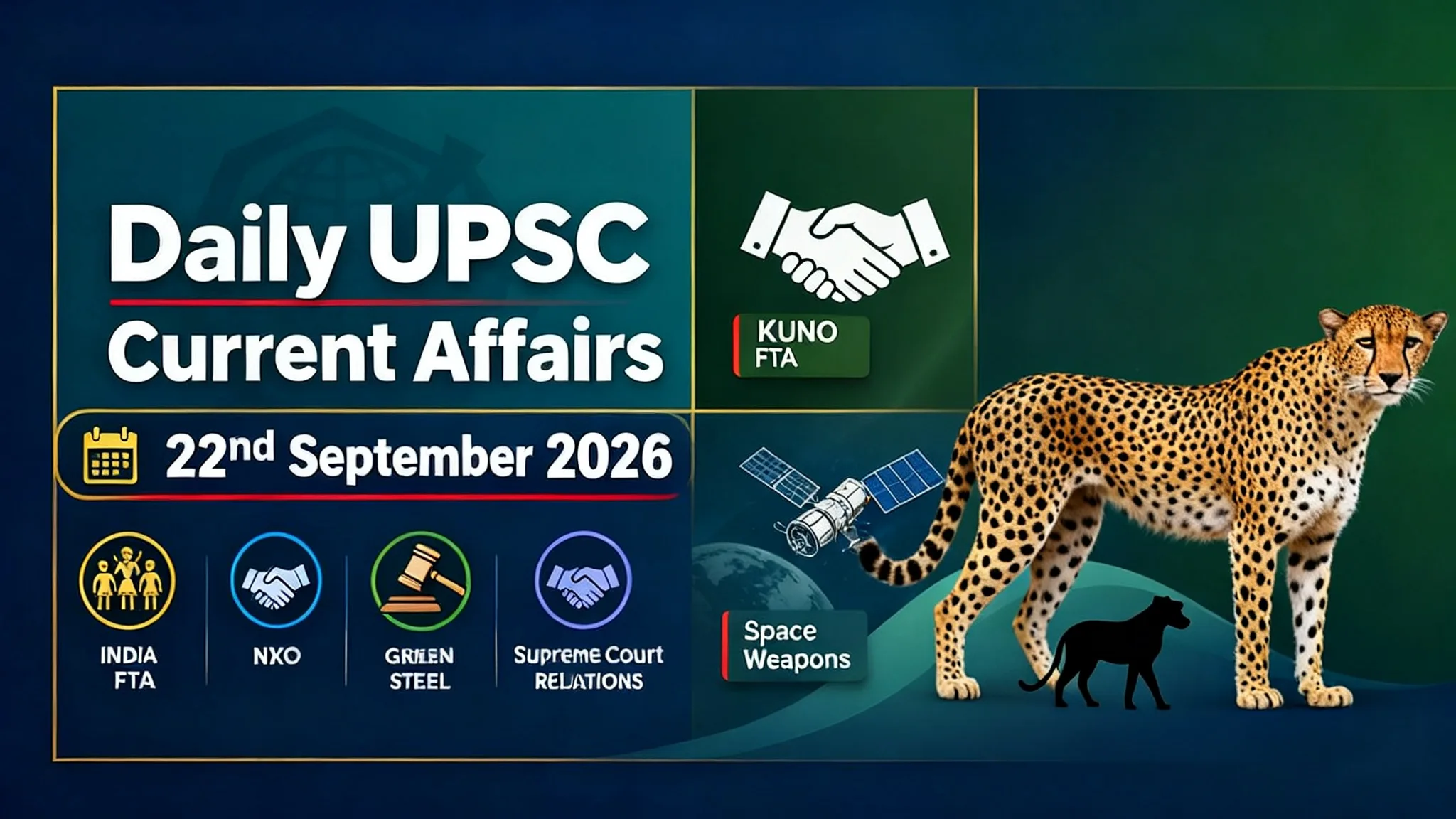
Today’s UPSC Current Affairs digest for 22nd September 2026 breaks down 11 important stories from The Hindu — from the India-New Zealand FTA and the Kasturirangan Report row in Karnataka, to the Supreme Court’s rulings on arrest rights and methanol regulation, the weaponisation of space, the Hormuz-Malacca comparison, India’s EV transition data, the new P4M multilateral grouping, and three fresh Prelims-relevant science stories (a Namibian cheetah’s death, a newly discovered wild cat in Bolivia, and the growing fight against drug-resistant fungi). Each topic is explained with GS paper mapping, background facts, pros and cons, and a way-forward analysis — built for quick, exam-focused revision.
DAILY UPSC CURRENT AFFAIRS | OVERVIEW
| # | Topic | GS Paper / Relevance | Why in News (One Line) |
|---|---|---|---|
| 1 | India-New Zealand FTA | GS II (International Relations) | FTA ratified, set to take effect from 20 October 2026 |
| 2 | Kasturirangan Report on Western Ghats | Prelims (Environment) | Karnataka CM says the report threatens livelihoods in 10 districts |
| 3 | Unsafe Space (Weaponisation of Space) | GS II (International Relations/Security) | US officially admits deploying “on-orbit space control weapons” |
| 4 | Malacca-Singapore Model for Hormuz | GS II (International Relations) | Proposal to use a cooperative straits model to ease Hormuz tensions |
| 5 | Decoding Transition to Alternative Fuels | GS III (Economy/Environment) | FADA data shows EVs overtook petrol/diesel share in new vehicle sales |
| 6 | SC Strikes Down Maharashtra Methanol Rules | GS II (Polity/Governance) | SC held the rules disproportionate and unconstitutional |
| 7 | P4M (Partners for Multilateralism) Meet | GS II (International Relations) | New grouping pushes UN-based multilateralism at UNGA session |
| 8 | Right to Know Grounds of Arrest | GS II (Polity/Fundamental Rights) | SC declares it a non-negotiable fundamental right under Article 22(1) |
| 9 | Namibian Cheetah Dies in Kuno | Prelims (Environment) | 10-year-old cheetah Gaurav dies during treatment |
| 10 | Tilcayo – New Cat Species in Bolivia | Prelims (Environment) | First new living cat species formally described in over a century |
| 11 | Fungal “Arms Race” (Candida auris) | GS III (Science & Technology/Health) | New research shows fungi resisting antifungal drugs through genetic changes |
DAILY UPSC CURRENT AFFAIRS | INDIA-NEW ZEALAND FTA
Heading & Syllabus Mapping
GS Paper II — International Relations, Bilateral Agreements and Trade Diplomacy.
Why in News?
India and New Zealand have formally ratified their Free Trade Agreement, which is scheduled to come into force on 20th October 2026. The deal is being described as an attempt to nearly double bilateral trade within the next four to five years while still protecting India’s sensitive farm sectors.
Core Facts & Background
- Bilateral trade between the two countries stood at around $1.3 billion in FY 2024-25, and the FTA targets pushing this towards ₹35,000 crore over the next four to five years.
- Under the deal, India will eliminate tariffs on 100% of New Zealand’s goods, while New Zealand will remove tariffs on around 95% of Indian exports, either immediately or with a phased reduction.
- India has kept its dairy and sensitive agricultural products — including items like onions, almonds, chickpeas, peas, honey and sugar — outside the scope of any tariff concessions to New Zealand.
- New Zealand has committed close to $20 billion in potential foreign direct investment (FDI) into India, with interest particularly in manufacturing, agri-technology and engineering goods.
- India is currently New Zealand’s ninth largest export market, and the government sees the agreement as a way to attract not just trade, but also technology transfer and export-oriented investment.
Pros & Cons
| Opportunities | Challenges |
|---|---|
| Wider market access for Indian MSMEs, farmers, handicraft producers and weavers | Increased imports may create competition for domestic industries |
| Potential $20 billion FDI commitment from New Zealand | Dairy and agriculture remain politically sensitive sectors |
| India could become a manufacturing/export base for New Zealand-linked companies | Benefits depend on whether Indian firms actually use the new market access |
| Technology and investment cooperation, especially in agri-tech | Liberalisation has to be balanced carefully against protecting vulnerable sectors |
Way Forward
Analysts suggest India should focus on helping MSMEs actually understand and use the new market access, improve product quality and export infrastructure to meet New Zealand’s standards, and use the agreement to pull in manufacturing- and technology-oriented investment rather than only focusing on the trade-in-goods numbers.
DAILY UPSC CURRENT AFFAIRS | KASTURIRANGAN REPORT ON WESTERN GHATS
Heading & Syllabus Mapping
Prelims — Environment and Ecology (Committees on Western Ghats).
Why in News?
Karnataka’s Chief Minister told the state Legislative Assembly that implementing the Kasturirangan Committee’s recommendations could threaten the livelihoods of people across 10 districts, even as the state government reaffirmed its commitment to protecting the Western Ghats. The Centre has asked Karnataka to convey its final decision on the report.
Core Facts & Background
- According to the report, around 20,668 sq. km of Karnataka’s Western Ghats region has been identified as ecologically sensitive, spread across 1,449 villages.
- The Kasturirangan Committee, formally the High-Level Working Group (HLWG), submitted its report in 2013, chaired by Dr K. Kasturirangan, and identified roughly 37% of the Western Ghats’ natural landscape (about 59,940 sq km) as an Ecologically Sensitive Area (ESA).
- This is often contrasted with the earlier Madhav Gadgil Committee (Western Ghats Ecology Expert Panel, 2011), which took a stricter, more conservation-first approach and identified nearly 64% of the entire Western Ghats as ecologically sensitive.
- While the Gadgil panel proposed dividing the region into three Ecologically Sensitive Zones (ESZ-1, 2 and 3) with graded restrictions and strong Gram Sabha involvement, the Kasturirangan panel instead tried to keep human-dominated and cultural landscapes largely outside the ESA and relied more on existing government institutions for implementation.
- Both committees restrict mining, quarrying and polluting industries in the identified zones, but the Kasturirangan report’s restrictions are more narrowly focused on highly damaging activities.
Pros & Cons
| Aspect | Gadgil Committee (2011) | Kasturirangan Committee (2013) |
|---|---|---|
| Area as ESA | ~64% of Western Ghats | ~37% of natural landscape |
| Approach | Conservation-first | Conservation + development balance |
| Local participation | Strong emphasis on Gram Sabhas | Recognised, but more government-led |
| Governance | Proposed a new Western Ghats Ecology Authority | Relied on existing institutions |
Way Forward
Karnataka has sought a review of the boundaries, especially where agricultural land has been included within proposed ESA limits. A workable path forward would involve ground-truthing village-level boundaries, ensuring genuine local consultation, and separating ecologically fragile forest zones from settled agricultural land before any final notification.
DAILY UPSC CURRENT AFFAIRS | UNSAFE SPACE — WEAPONISATION OF ORBIT
Heading & Syllabus Mapping
GS Paper II — International Relations and Global Security; also relevant for GS III (Science & Technology, Space).
Why in News?
On 14th September, the US Air Force Secretary publicly acknowledged — and the Space Force chief confirmed — that the United States has deployed “on-orbit space control weapons” meant to “defend against hostile adversary action.” This admission has revived global concern about an emerging arms race in space.
Core Facts & Background
- Modern satellite systems now underpin communications, energy grids, financial networks and military operations, making orbit a strategically critical — and increasingly contested — domain.
- The US, Russia, China and India, among others, have been developing counter-space capabilities, adding to the risk of earth’s orbit becoming a future battlefield.
- The primary legal framework is the set of five UN treaties on outer space: the Outer Space Treaty (1967), the Rescue Agreement (1968), the Liability Convention (1972), the Registration Convention (1976), and the Moon Agreement (1979).
- India is a signatory to all five treaties but has ratified only four — it has not ratified the Moon Agreement.
- The Outer Space Treaty does not ban weapons in orbit outright, but Article IV prohibits nuclear weapons or other weapons of mass destruction in orbit, leaving conventional weapons in a legal grey zone.
- A growing complication is the rise of dual-use and autonomous satellites, some of which may run AI systems, making it harder to distinguish civilian, military and genuinely hostile intent.
Pros & Cons
| Significance | Challenges |
|---|---|
| Secure space infrastructure protects both national security and civilian economic activity | No comprehensive international ban on conventional weapons in orbit |
| Clearer international rules can reduce miscalculation and accidental escalation | Dual-use satellites make it hard to separate civilian and military assets |
| Existing frameworks like the Liability Convention provide a partial basis for accountability | Autonomous, AI-enabled satellites raise unpredictable escalation risks |
Way Forward
Experts point to the need for strengthening multilateral space governance through the UN, clearer definitions of what counts as a “hostile act” in orbit, transparency and confidence-building measures around military space capabilities, and new international norms specifically addressing AI-enabled and autonomous space systems.
DAILY UPSC CURRENT AFFAIRS | MALACCA-SINGAPORE MODEL FOR RESOLVING HORMUZ
Heading & Syllabus Mapping
GS Paper II — International Relations, Important International Institutions and Agreements.
Why in News?
With tensions continuing around the Strait of Hormuz, commentators have suggested reviving the cooperative model used for the Straits of Malacca and Singapore as a possible template for easing the Hormuz standoff between Iran and other stakeholders.
Core Facts & Background
- The Strait of Malacca runs about 800 km between the Malay Peninsula and Sumatra, linking the Andaman Sea to the Strait of Singapore, which itself connects to the South China Sea.
- In 1971, Indonesia, Malaysia and Singapore jointly proposed a coordinating body to manage the straits, and under UNCLOS, states eventually agreed on a right of “transit passage” — allowing continuous, expeditious movement for all vessels, including warships.
- In 2007, the three littoral states set up a Cooperative Mechanism, including an Aids to Navigation Fund supported by voluntary contributions from user states, industry and organisations, to jointly maintain navigational safety without charging tolls.
- The Strait of Hormuz, by contrast, lies between Iran and Oman, and in 1993 Iran (which has not ratified UNCLOS) passed a law requiring foreign warships to seek its authorisation before transiting — a point of continuing friction.
- Regional players such as the UAE and Qatar have supported the idea of exploring a Malacca-Singapore-style framework, but the US has signalled it may not accept such an arrangement even if Gulf states agree.
Pros & Cons
| Why the Model Could Work | Why It’s Difficult to Apply |
|---|---|
| Shows sovereignty and free navigation can coexist through cooperation | Iran and Oman hold different legal/strategic positions on navigation |
| Could improve navigation safety, security and environmental protection | US-Iran tensions and wider Gulf rivalries complicate any deal |
| Important for India’s energy imports and maritime trade security | A framework built only by littoral states may not satisfy major outside powers |
Way Forward
A realistic path would start small — focusing on navigation safety, search-and-rescue and information-sharing rather than trying to resolve every geopolitical dispute at once — while gradually building confidence-building measures between Iran, Oman and other stakeholders, using UNCLOS principles as the underlying framework.
DAILY UPSC CURRENT AFFAIRS | DECODING THE TRANSITION TO ALTERNATIVE FUELS
Heading & Syllabus Mapping
GS Paper III — Indian Economy, Infrastructure, Environment and Energy Transition.
Why in News?
Data from the Federation of Automobile Dealers’ Associations (FADA) shows that August 2026 marked a “historic fuel crossover” in India’s passenger vehicle segment — for the first time, the combined share of alternative fuels (EV, hybrid, CNG/LPG) overtook the share of petrol and diesel vehicles.
Core Facts & Background
- In the passenger vehicle category, alternative fuels captured a 41.95% share of new registrations in 2026, edging past petrol and diesel’s 40.85% share — even though petrol and diesel still dominate overall vehicle sales at around 83.5%.
- The two-wheeler segment (over 70% of all vehicles registered) saw EV share rise from 6.4% in 2025 to 9.1% in 2026, while petrol two-wheelers dropped below the 90% mark for the first time.
- The three-wheeler segment has seen the fastest shift: EV share of new three-wheelers jumped from under 40% in 2021 to over 60% in 2026, while the share of petrol and diesel three-wheelers has roughly halved.
- Car buyers, however, have moved more towards CNG and LPG options rather than EVs — the EV share of new car registrations is still only around 10.6%, and petrol/diesel remains the dominant car fuel at roughly 61-62%.
Pros & Cons
| Segment | 2021 EV Share | 2026 EV Share | Trend |
|---|---|---|---|
| Two-wheelers | ~4.1% | ~9.1% | Steady EV growth |
| Three-wheelers | ~9% | ~60.5% | Sharp EV dominance |
| Cars | Low | ~10.6% | Slower; CNG/LPG preferred over EV |
Challenges: limited charging infrastructure, higher upfront EV cost, and range anxiety continue to slow four-wheeler EV adoption, while battery replacement cost and fire-safety concerns remain issues even for existing CNG/LPG and EV users.
Way Forward
Accelerating car-segment EV adoption will likely require faster expansion of charging infrastructure, purchase incentives to offset upfront costs, and continued investment in battery safety standards, even as CNG/LPG continues to serve as a practical bridge fuel for cars in the near term.
DAILY UPSC CURRENT AFFAIRS | SUPREME COURT STRIKES DOWN MAHARASHTRA METHANOL RULES
Heading & Syllabus Mapping
GS Paper II — Polity, Fundamental Rights and Judicial Review of Executive Rules.
Why in News?
On 18th September, the Supreme Court struck down Maharashtra’s rules mandating that methanol sold to non-drug manufacturers be mixed with a colourant and a bitterant, holding the restrictions disproportionate and lacking a rational connection to the problem they aimed to solve.
Core Facts & Background
- Methanol (methyl alcohol) is a highly toxic industrial chemical used in paints, resins, formaldehyde and pharmaceutical manufacturing — but it is also sometimes diverted to adulterate liquor, causing fatal poisoning.
- The restrictions originated from a 1991 hooch tragedy in Mumbai that killed around 93 people, after which Maharashtra amended its Poisons Rules, 1972 to add Rules 18A and 18B.
- The Court examined whether these rules violated Article 14 (equality and non-arbitrariness) and Article 19(1)(g) (the right to practise a trade or business, subject to reasonable restrictions under Article 19(6)).
- Applying the proportionality test laid down in K.S. Puttaswamy v. Union of India (2017), the Court held that while preventing loss of life from adulterated liquor was a legitimate aim, the specific restrictions were neither suitable nor necessary to achieve it.
- The Court also struck down Rule 18B, which allowed confiscation of methanol possessed without a Form A licence, holding it could override lawful possession under other permits and was redundant.
- Along with striking down the rules, the Court issued guidelines directing states to strengthen methanol regulation through better licensing, stock and transport controls, inter-departmental coordination, and support for de-addiction and counselling centres.
Pros & Cons
| Significance | Concern |
|---|---|
| Reinforces that regulation must be evidence-based and proportionate | Methanol can still be diverted for illicit liquor production |
| Protects legitimate industries (paints, pharma) from disproportionate burden | Effective enforcement needs coordination across police, excise, transport and health departments |
| Strengthens the constitutional proportionality standard for future regulatory challenges | Excessively weak regulation could endanger lives if not replaced with better safeguards |
Way Forward
The judgment pushes states towards risk-based regulation rather than blanket restrictions — stronger licensing and traceability, digital stock records, secure transport, and better inter-departmental information sharing, so that genuine industrial users are not penalised while illegal liquor networks are still targeted effectively.
DAILY UPSC CURRENT AFFAIRS | P4M (PARTNERS FOR MULTILATERALISM) MEET
Heading & Syllabus Mapping
GS Paper II — International Relations, International Groupings and India’s Foreign Policy.
Why in News?
India is set to join a new grouping called Partners for Multilateralism (P4M), founded by the European Union, Brazil, Kenya and Canada, which held a meeting on the sidelines of the UN General Assembly’s High-Level session this week.
Core Facts & Background
- P4M was launched to support UN-based multilateralism, positioning itself away from what its founders call “superpower politics.”
- In a joint editorial, the four founding leaders said the grouping would support the UN while pushing it to become more representative, effective and trusted, and to be better prepared for challenges like AI, climate change, health security and digital transformation.
- India is already part of several similar groupings, including BRICS, the G20 and the Non-Aligned Movement, which the P4M editorial noted share similar objectives.
- UN Secretary-General António Guterres, commenting separately, said it was “time for superpowers to understand the limits of their power,” pointing to ongoing difficulties for major powers in conflicts such as the war in Ukraine.
- P4M’s founders have described the platform’s purpose as creating a flexible, open framework for countries across regions and political traditions to build coalitions and push practical multilateral reform — explicitly stating it does not aim to become another exclusive bloc.
Pros & Cons
| Opportunities | Challenges |
|---|---|
| Gives countries a platform to cooperate beyond traditional geopolitical blocs | Member countries have differing strategic interests and priorities |
| Supports genuine reform and modernisation of the UN system | Building consensus among diverse countries is difficult |
| Creates room for cooperation on emerging issues like AI and climate | Converting broad principles into actual collective action remains a challenge |
| Aligns with India’s demand for greater representation of developing countries | UN reform requires agreement from countries with very different interests |
Way Forward
For P4M to be effective, experts suggest it must remain a genuinely open and inclusive platform rather than evolving into another exclusive bloc, focus on practical cooperation in areas like AI, climate and global health, and push for real UN reform while preserving the central role of international law and the UN Charter.
DAILY UPSC CURRENT AFFAIRS | RIGHT TO KNOW GROUNDS OF ARREST — SUPREME COURT VERDICT
Heading & Syllabus Mapping
GS Paper II — Polity, Fundamental Rights (Article 22).
Why in News?
In a significant ruling, a Supreme Court Bench headed by Justice Ujjal Bhuyan held that an arrested person who is kept unaware of the grounds of arrest, and denied access to a lawyer of choice, is entitled to immediate release — describing this as a right that “cannot be breached under any situation.”
Core Facts & Background
- The Court held that the right to know the grounds of arrest in writing, in a language the person understands, along with the availability of a lawyer of choice, is a sacrosanct fundamental right under Article 22(1) of the Constitution.
- This protection applies across the board, including offences under the Indian Penal Code and even special laws dealing with terrorism and money laundering — there is no blanket immunity for serious offences.
- The Court clarified that when a person is released for violation of their rights under Article 22(1), they are not being “enlarged on bail” — rather, they are being released from what the Court called illegal and unconstitutional detention.
- Investigating agencies cannot treat a breach of Article 22(1) as a “mere procedural lapse”, and even the later filing of a chargesheet does not retroactively validate an arrest made in violation of this right.
- The Court also directed that any future re-arrest of a person previously released on these grounds must first get specific sanction from a magistrate, based on strict judicial oversight, to guard against arbitrary police action.
Pros & Cons
| Significance | Practical Concern |
|---|---|
| Strengthens a core personal-liberty safeguard under Article 21 and 22 | Requires strict, consistent training and discipline within police forces |
| Applies uniformly, even to serious offences like terrorism and money laundering | Agencies may need updated procedures to avoid future violations |
| Creates a strong deterrent against arbitrary arrest practices | Courts will need to monitor implementation closely across states |
Way Forward
The ruling effectively asks investigating agencies nationwide to institutionalise clear, documented arrest procedures — recording reasons in writing, communicating them in a language the arrestee understands, and ensuring prompt access to legal counsel — as a non-negotiable part of any arrest, not just a procedural formality.
DAILY UPSC CURRENT AFFAIRS | NAMIBIAN CHEETAH DIES IN KUNO NATIONAL PARK
Heading & Syllabus Mapping
Prelims — Environment and Ecology (Project Cheetah).
Why in News?
A 10-year-old Namibian cheetah named Gaurav died on Monday evening at Madhya Pradesh’s Kuno National Park while undergoing treatment, park officials confirmed.
Core Facts & Background
- Gaurav was rescued from the wild on 12th September after being observed weak and dull, and was suspected to have an underlying chronic condition based on preliminary clinical examination.
- Despite continued treatment and supportive care, his condition deteriorated and he died around 4 p.m. on Monday; the exact cause of death will be confirmed through a post-mortem examination.
- Following his death, Kuno National Park now has 51 cheetahs, according to the park director.
- This development is part of the broader Project Cheetah initiative, under which cheetahs translocated from Namibia and South Africa are being monitored for survival, breeding success and adaptation to Indian conditions.
Pros & Cons
| Relevance for Prelims | Note |
|---|---|
| Tests awareness of Project Cheetah’s ongoing status and current cheetah count | Numbers like total cheetah population at Kuno are frequently updated and exam-relevant |
| Tests knowledge of the source countries (Namibia, South Africa) for translocated cheetahs | Individual cheetah names and death causes are less exam-critical than overall project trends |
Way Forward
Wildlife experts continue to stress close, ongoing health monitoring of the translocated cheetah population, along with post-mortem-based scientific study of deaths, to refine future translocation and habitat-management strategies under Project Cheetah.
DAILY UPSC CURRENT AFFAIRS | TILCAYO – NEW CAT SPECIES DISCOVERED IN BOLIVIA
Heading & Syllabus Mapping
Prelims — Environment and Ecology (Biodiversity, New Species Discovery).
Why in News?
Scientists have formally identified a small wild cat found in Bolivia’s cloud forests as a previously unknown species, marking the first time in more than a century that a new living cat species has been formally named and described.
Core Facts & Background
- The cat, locally called “Tilcayo,” belongs to a group known as tiger cats, found across much of South America, and was located in Bolivia’s Yungas forest, a humid, cloud-covered mountainous region.
- It measures around 46 cm in length and weighs about 1.4 kg, making it smaller than the average domestic cat.
- Researchers gave it the scientific name Leopardus tilcayo, based on genetic analysis of DNA samples from 38 cats across several South American countries, published in the journal Current Biology on 17th September.
- Tiger cats were long considered a single species, but the new study found they actually represent five genetically distinct species — the Tilcayo lineage is estimated to have separated from other tiger cats around 1.4 million years ago.
- The study also described a new tiger cat subspecies in Peru’s Yungas region, named Leopardus tigrinus antisuyo. The IUCN Red List currently tracks tiger cats as two “vulnerable” species with declining populations.
Pros & Cons
| Relevance for Prelims | Note |
|---|---|
| Tests awareness of newly discovered/reclassified species and their scientific naming | “Cryptic species” — species that look alike but are genetically distinct — is an important concept here |
| Tests general biodiversity awareness for South America and IUCN status categories | Exact measurements are less important than the species/genus-level facts |
Way Forward
Conservationists note that formally recognising Tilcayo as a distinct species is significant for conservation planning, since a smaller, geographically limited population may need species-specific protection measures rather than being grouped with more widespread tiger cat populations.
DAILY UPSC CURRENT AFFAIRS | FUNGAL “ARMS RACE” — ANTIFUNGAL RESISTANCE
Heading & Syllabus Mapping
GS Paper III — Science & Technology, Health (Antimicrobial Resistance).
Why in News?
New research suggests that the long-standing strategy of dousing fungal infections with higher doses of antifungal drugs is nearing its limits, as fungi increasingly develop resistance through genetic mutations and by producing extra copies of protective genes.
Core Facts & Background
- The fungus at the centre of this concern is Candida auris, first reported in Japan in 2009, which has emerged as a serious multidrug-resistant pathogen, particularly dangerous in ICU and healthcare settings, with a reported mortality rate of 30-40% among untreatable, severe cases.
- Global warming is considered a contributing factor: most fungi cannot survive at the human body’s 37°C, but researchers suggest a “thermal adaptation” hypothesis — warmer climates may be selecting for fungal strains better able to tolerate mammalian body heat.
- In a recent study published in Nature Communications, researchers found that over 90% of clinical Candida auris isolates from India are resistant to azole-based antifungals, and around 30% are resistant to a second drug class, echinocandins.
- Two key resistance mechanisms were identified: mutations in the Erg11 gene (linked to producing more ergosterol, an important component of the fungal cell membrane, which reduces the effect of azole drugs) and mutations in the Fks1 gene (linked to fungal cell-wall synthesis, which drives resistance to echinocandins).
- Researchers noted that some resistant strains need antifungal concentrations far above the current diagnostic testing thresholds to be effectively treated, meaning many labs may currently be underestimating true resistance levels.
Pros & Cons
| Term | Meaning |
|---|---|
| Candida auris | Emerging pathogenic fungus, especially dangerous in healthcare settings |
| Antifungal resistance | Fungus survives a medicine that normally kills or inhibits it |
| Erg11 | Gene linked to ergosterol production; mutations contribute to azole resistance |
| Fks1 | Gene linked to fungal cell-wall synthesis; mutations contribute to echinocandin resistance |
| Azoles / Echinocandins | Two major classes of antifungal drugs, targeting different fungal structures |
Way Forward
Scientists are calling for more nuanced susceptibility testing to correctly identify drug-tolerant strains, development of therapies that target fungal compensatory pathways rather than just raising drug doses, and closer clinical monitoring — arguing that the “arms race” approach of simply increasing dosage is reaching its practical and biological limits.
DAILY UPSC CURRENT AFFAIRS | FAQs
Q1. When will the India-New Zealand FTA come into effect? The agreement is set to take effect from 20th October 2026, after being ratified by both countries.
Q2. What is the key difference between the Gadgil and Kasturirangan reports on the Western Ghats? The Gadgil Committee (2011) identified around 64% of the Western Ghats as ecologically sensitive with a stricter conservation-first approach, while the Kasturirangan Committee (2013) identified a smaller area (around 37%) and tried to balance conservation with development and existing human settlements.
Q3. What did the Supreme Court rule on the right to know grounds of arrest? The Supreme Court held that this right under Article 22(1) is a sacrosanct fundamental right that cannot be breached under any circumstances, and any violation entitles the arrested person to immediate release from illegal detention — not release on bail.
Q4. Why did the Supreme Court strike down Maharashtra’s methanol rules? The Court found the rules disproportionate and lacking a reasonable connection to preventing liquor adulteration, holding they violated Articles 14 and 19(1)(g) of the Constitution.
Q5. What is Project Cheetah and how many cheetahs are currently at Kuno National Park? Project Cheetah is India’s initiative to reintroduce cheetahs translocated from Namibia and South Africa. Following the recent death of a Namibian cheetah named Gaurav, Kuno National Park now has 51 cheetahs.
Q6. What is Candida auris and why is it a growing health concern? Candida auris is a multidrug-resistant fungal pathogen, first reported in 2009, that is increasingly showing resistance to major antifungal drug classes like azoles and echinocandins, particularly in healthcare settings.
Q7. What is the P4M grouping and which countries founded it? Partners for Multilateralism (P4M) is a new grouping founded by the European Union, Brazil, Kenya and Canada to support and strengthen UN-based multilateralism, which India is set to join.
Previous Post >>